They still come to ‘meet’ Zubeen Garg: Inside the memorial that has become a home for his admirers
More than a year after his death, thousands continue to visit Zubeen Kshetra in Assam. They arrive from different states, bring their children, sing his songs and speak of him as a member of their own families. For many, he is not someone they have come to remember. He is someone they have come to meet.
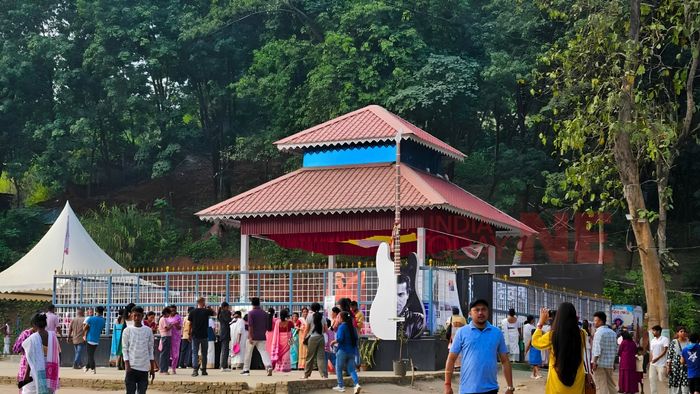
Aparmita Das / Hrijoy Das Kanungo
- Nov 18, 2026,
- Updated Nov 18, 2026, 1:54 PM IST
Six-year-old Abdullah Ali has travelled from Hajo with his parents and three siblings. A photograph of Zubeen Garg is printed on the front of his T-shirt; Mayabini, written in Assamese, runs across the back. The fabric is worn, softened by repeated washing and use. Abdullah says he bought it about three months ago. He knows Zubeen through his songs.
“I have come to meet Zubeen da,” he says.
He looks around the place, taking in the people gathered there. There is something in his eyes that is difficult to put into words — a hint of pain, perhaps, and questions that a six-year-old may not yet know how to articulate. Around him, people have travelled from different districts and states to stand at the place where a singer they loved was cremated. Some pray. Some sing. Others remain quiet, taking in the surroundings before making their way out.
Abdullah's answer is uncomplicated. He has come to meet someone who is no longer alive. Yet he speaks of the visit as a meeting, not a farewell.
More than a year after Zubeen Garg's death, that distinction has become central to the life of Zubeen Kshetra at Kamarkuchi, near Sonapur, around 25 km from Guwahati. The crowds that filled Assam's roads in September 2025 have long dispersed, but the movement of visitors to the cremation site has continued. Some arrive for the first time; others have returned two or three times. Families bring children. People travel from outside Assam. There are those who come to pray, those who sing his songs and those who simply want to spend time at a place associated with him.
The question is not how many people mourned Garg when he died. Assam witnessed that extraordinary farewell. It is why, after the initial shock and public mourning have passed, people still feel the need to make their way to his memorial.
The voice that became part of everyday life
Perhaps the answer begins with a relationship that existed long before Zubeen Kshetra did — one built not necessarily through personal encounters, but through a voice that had found its way into people's homes, journeys and private routines.
Former Chief Justice of India Ranjan Gogoi never met Garg. Yet, speaking after the singer's death, he said he listened to at least three of his songs every day. It had become a habit over the years. “For me, music means Zubeen,” Gogoi said, describing the singer's voice as “out of the world”.
A person need not have met Garg to feel that he belonged to a part of their life. His music had made that possible. For some, it was the Assamese songs that accompanied childhood and adolescence; for others, it was his Hindi film work, including “Ya Ali” from Gangster, that first brought his voice to their attention. His repertoire crossed linguistic and geographical boundaries, while his presence in Assam's cultural and public life gave his music a meaning that extended beyond entertainment.
At Zubeen Kshetra, these different relationships converge. The visitors do not all remember the same version of him. But they share the feeling that Garg had become familiar in a way that is difficult to explain to someone who did not grow up with his music.
That familiarity can also produce an urge to return. Rajiv Das, 43, from Jorhat, had earlier visited the memorial with his wife, son and daughter. On another occasion, he woke up one day with the feeling that he wanted to go back and meet Garg. There was no special date to mark, no event to attend. He simply felt like returning.
When the gate to the cremation enclosure was opened, Das went inside, paid his respects and prayed. During the conversation, he became overwhelmed. “I have so much to say,” he said, “but I can't say anything.”
He has listened to Garg for years. The attachment, he said, is difficult to explain. For him, the journey back was not about marking an occasion. It was about responding to a feeling that had stayed with him.
For Karuna Rahang, 29, from Sonapur, that connection has become part of his daily life. Visitors know him as Pandit or Panditji. He comes early each morning to clean the cremation site, light incense and perform puja. He began visiting voluntarily, day after day, until a committee of like-minded people noticed his commitment and asked him to take responsibility for the place.
Rahang had seen Garg perform once but had never met him. “He was our own person,” he says. “I thought I would meet him one day. I never imagined he would go.”
There is regret in his voice when he speaks about not having been able to do anything for Garg while he was alive. Looking after the site is now what he can do for him. He becomes emotional as he speaks and says he feels Garg's presence there.
That sense of presence is not limited to Rahang. A policeman who has been stationed at the site since Garg's death also spoke of feeling that the singer was still there. Another security personnel, who came from Silchar and has been associated with the site since it was established, described how visitors continue to arrive throughout the day. The numbers may have come down from the days immediately after the cremation, but the flow has not stopped. People sit, sing and spend time there. Some, he observed, appear to find a sense of peace in simply being at the memorial.
The site is now more than the marble structure built over the cremation spot, where visitors offer prayers and rituals are performed. A large covered area has photographs of Garg and his guitars, giving people a place to sit and spend time. The grounds are also being developed into a more organised memorial space.
The scale of the upkeep is reflected in the people who work there. Around 21 women caretakers and 10 male workers look after the premises, while approximately 50 police personnel are deployed for security. Their presence, along with the steady stream of visitors, has made the memorial a place that remains active well beyond ceremonial occasions.
Small shops and stalls have come up outside. People from different economic and social backgrounds share the space. Some sit together, others pray or sing. Maya, one of the dogs associated with the site, has been there since she was about six months old. A black-and-white cat and pigeons are also familiar presences. An elephant, too, came to the memorial and paid homage to Garg.
For some, the place is a cremation site. For others, it has become a shrine, a temple or a samadhi. The words differ, but the need to come there is much the same.
Someone from the family
The language people use for Garg at the memorial is strikingly personal. He is spoken of as a son, a brother, a father, a friend or a mentor. Some visitors call him God. In several homes, his photograph is kept alongside pictures of family members and deities. The relationship, for many, seems to have outgrown the usual boundaries between an artiste and his audience.
Sonpona Borkakoty, 78, arrived with his wife, Sadari, 75, their son Madhurjya, 37, daughter-in-law Anamika Dutta, 30, and two-year-old grandson Aarit. The older man struggled to hold back his tears. “Zubeen was like my son,” he said.
It was a short sentence, but it said much about the nature of his attachment. For Sonpona, the loss was not simply that of a singer whose songs he admired. Garg had occupied a place in his life that he described in familial terms.
Madhurjya, meanwhile, was thinking about the youngest member of the group. “Aarit will grow up knowing Zubeen, just as I grew up knowing him,” he said. The two-year-old may not yet understand why the family has brought him to Kamarkuchi. But he will grow up with the songs and stories that his parents and grandparents pass on. The visit is one small part of that inheritance.
Children also arrive with their own understanding of Garg. Ten-year-old Anwayjyoti Saikia visited with his mother, schoolmates and a teacher after winning a science competition. It was not a singing competition, but he sang Mayabini at the memorial. He wants to become a singer, although he is certain that nobody can sing like Zubeen Garg.
He has written a book of poems dedicated to the artiste. Asked what Garg meant to him, Anwayjyoti described him as “a consciousness for us”. The Hindi phrase he used was, “Zubeen Garg hamare liye ek chetana hai.” He believes Garg taught people without announcing that he was teaching them; it was for listeners to recognise and learn from those lessons.
“When I sing, I feel he is correcting me,” he said. “When I write, I feel he is guiding me.”
For a child who never had the chance to know Garg personally, this is an intimate way of describing an influence. The singer is not simply someone whose songs he wants to reproduce. He has become an imagined presence against which the boy measures his own work.
Ratul Nath, from Tamulpur, speaks of a similar influence, though in different terms. He has visited Zubeen Kshetra two or three times and has listened to Garg since childhood. “Zubeen Garg taught us to become better human beings,” he said. He believes that returning to the site reminds him to do good for others. The love people feel for the singer, he says, is unconditional. He does not believe Garg has truly gone; he remains with those who continue to carry him in their lives.
The stories of these visitors suggest that the attachment is not sustained by music alone. It is also bound up with the values, aspirations and memories they associate with the person behind the songs.
A journey to understand him
The visitors who arrive from outside Assam bring another dimension to the story. Some knew Garg's music but not the place he occupied in Assamese life. His death made them look again at the singer behind the songs.
Shoma Suji, 52, came from Delhi with her husband, Dinesh, 56, who has been working in Assam for around two years. She knew some of Garg's Hindi film songs, but had little understanding of his significance to the state while he was alive.
Dinesh was in Assam when Garg died. He told her about the crowds, the roads blocked by mourners and the shops that had shut. He spoke, too, of policemen trying to manage the gathering while struggling to hold back their tears. The scale of the response left an impression on Shoma. She began searching for Garg online, watching videos and listening to his songs, one after another.
She was disheartened that she had discovered the person behind the music only after his death. She had followed the deaths of major singers, including KK and Lata Mangeshkar, but said she had never witnessed a public response like the one she heard about in Assam. She believes Garg deserves the attention he is receiving and that people will continue to visit his memorial. For her, Zubeen Kshetra is a place where she can begin to understand him.
Lakhyajyoti Nath, 33, who grew up in Assam and now lives in Visakhapatnam, has noticed a change in the conversations around Garg since his death. Before then, he felt that many people outside the state recognised some of the singer's songs, particularly his Hindi film work, without knowing much about the person who sang them or his connection with Assam. Now, he finds himself answering questions about Garg and speaking about the state with a renewed sense of pride.
“What people could not do while he was alive, Zubeen Garg did even after his death,” Nath said. He was referring to the attention the singer's death brought to Assam and its culture. He compares the public response with the reaction to the deaths of Michael Jackson and Bhupen Hazarika.
A family of five from West Bengal came to the memorial with a different sense of connection. They knew Garg while he was alive and spoke about his Bengali heritage and the songs he had sung in the language. They felt that he belonged to Bengal as well, through his roots and his music.
The journeys are different, but they lead to the same place. Some visitors come because they have known his music all their lives. Others arrive after discovering, through his death, how much he meant to people in Assam. The memorial has become a point of entry into both the singer's life and the culture with which he was so closely associated.
The life beyond the songs
Garg's public life was not confined to music. In December 2019, during protests against the Citizenship (Amendment) Bill at Latasil playground in Guwahati, he sang “Politics Nokoriba Bondhu” before a large gathering. The song became closely associated with the protests. He also took part in relief efforts during floods in Assam through his foundation and fan club. For admirers such as Nath, these memories are inseparable from the singer they continue to mourn.
His death also brought his work to audiences who may not previously have encountered it. Videos and explainers by creators outside the state, helped introduce his life and music to a wider online audience. For people such as Shoma, that digital trail became a way of discovering him. For those already familiar with his work, it offered another reason to speak about him beyond Assam.
There is a distinction between popularity and attachment. A song can travel far beyond the place where it was made; a singer can become familiar to millions through recordings. But the people who visit Zubeen Kshetra appear to be seeking something that a playlist cannot provide. They want to stand at the place associated with him, perform a ritual, sing in the company of others or simply feel close to someone who remains important to them.
Bereavement researchers have a term for one part of this experience: “continuing bonds”. It describes the ways people maintain an inner relationship with someone who has died through memories, rituals, photographs, conversations and a sense of presence. A 2023 systematic review of 79 studies found that such bonds can offer comfort and help shape identity, though they can also bring distress. Research on fans grieving the death of a musician has similarly found that the loss can feel deeply personal even when there was no direct relationship with the artiste. These studies do not explain every visit to Zubeen Kshetra, but they offer a way to understand why the relationship between a performer and an audience need not end with death.
After the farewell
The scale of public mourning for Garg was visible in the days immediately after his death. He died in Singapore on September 19, 2025. When his mortal remains reached Guwahati on September 21, people gathered at the airport and lined the route to Kahilipara. They carried flowers, gamosas and cut-outs, sang his songs and called out his name. The roughly 25-kilometre journey took hours amid the crowds. His mortal remains were later kept at Sarusajai for public homage before he was cremated with state honours at Kamarkuchi, near Sonapur, on September 23.
The farewell was immense, but it was not the first time Assam had come together to mourn a cultural icon. When Bhupen Hazarika died in 2011, hundreds of thousands gathered for his final rites. His memorial continues to draw visitors, particularly around anniversaries. The comparison is not a measure of one artiste against another. Both occupied distinct and enduring places in Assam's cultural life. What merits attention in Garg's case is the steady movement of people to his cremation site on ordinary days, without a public event to bring them together.
There is no formal daily count of visitors at Zubeen Kshetra. But the flow is visible well beyond commemorative occasions. People arrive in family groups, alone or with friends. They bring children who may know Garg only through his songs. They stand near the enclosure, offer prayers, sing or talk about him. The site is also sustained by the people who work there every day — caretakers, workers and security personnel whose presence has become part of its everyday life.
Perhaps what makes Zubeen Kshetra different is that it has become more than a place of mourning. It is where private memories have acquired a public address. A song that once played in a household, a voice that accompanied a journey, an artiste whose words shaped someone's understanding of Assam — all of it finds expression here.
The memorial is sustained not by a calendar of commemorations, but by people who continue to make their own journeys. They come with their families, their memories and their prayers. Some have a clear reason for visiting; others find it difficult to explain why they feel compelled to return. Their experiences differ, but the attachment they describe has endured.
More than a year after his death, Zubeen Garg remains an active presence in the lives of those who listen to his music, speak of him and carry his memory forward. At Kamarkuchi, that enduring connection takes a physical form: people continue to arrive, not simply to look back at his life, but to spend time in a place that has become part of their own.
ALSO WATCH:
MORE NEWS
Read more!