Two kilometres from help: How Assam’s young techies tried to bridge a flood relief gap
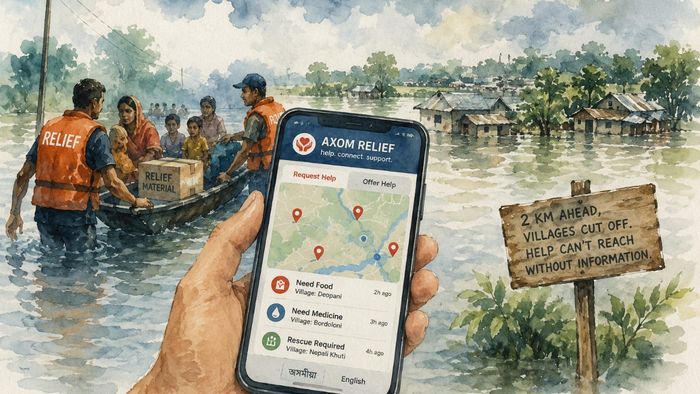
A relief effort was underway across Assam, but for some of the worst-hit villages, help was still only two kilometres away — and seemingly out of reach. Then a group of young techies tried to fix the gap in just 24 hours.
Aparmita Das
- Aug 09, 2026,
- Updated Aug 09, 2026, 2:33 PM IST
Relief teams kept reaching the same accessible stretch of road in Upper Assam. Two kilometres further in, whole villages sat submerged and cut off, invisible to everyone outside them, and nobody could say what condition they were in. Tinku M Kaushik, a young techie from Guwahati, noticed the pattern by the third week of July.
"The problem in Assam isn't a lack of human empathy or resources," Kaushik says. "It's a communication gap."
It was not that people had stopped helping each other. Volunteers were out in numbers, and relief material was moving. But requests for help had no structured way to travel outward, and people offering help were, in Kaushik's words, operating blindly.
That observation, made in the days after the devastating floods tore through Sivasagar and the districts around it, led to a relief-coordination platform called Axom Relief. It is a small piece of the story of this year's floods, not the whole of it. But it offers a way into a larger, harder question: what happens when help exists, and the systems meant to connect it to the people who need it do not work well enough.
A disaster still unfolding
The July 19 floods hit Upper Assam with unusual speed. Sivasagar and Charaideo were among the worst affected, and by early August the cumulative death toll for this year's flood season in Assam had climbed to 99, according to the Assam State Disaster Management Authority. More than 1.5 lakh people remained affected across thirteen districts, with tens of thousands still in relief camps or dependent on distribution centres.
Before relief became the problem, communication already was. The residents across flood-hit Upper Assam said no warning reached their phones before the floods struck, and that the state's cell broadcast alert system had, at the time, only been piloted in Kamrup Metro. That belongs to an earlier stage of the disaster and a different story. It matters here only as a reminder that the question of what reaches whom did not begin with relief distribution.
The first gap
Kaushik's account of the roadside pattern was not, on its own, a plan. It was a DM, sent late one night to Ankita Bhagawati, a software engineer and tech content creator he knew from Instagram. He asked her a simple question: could something be built to fix this.
Bhagawati's first instinct was to say no. Assam already had WhatsApp groups coordinating relief. Why build another platform to do what one already did.
Then she asked people who were actually out on the ground. What she heard back changed her mind. WhatsApp groups were too chaotic to be useful at the volume the floods demanded. Requests for help and offers of it were arriving in the same feed, in the same font, at the same speed, and getting buried under each other. There was no way to track what had already been answered and what hadn't. "There was no proper platform to track everything," Bhagawati says, "and no systematic way of coordinating."
She was not a neutral observer of the problem. Her own family had been affected by the floods. "I couldn't think straight," she says of that period.
Twenty-four hours
It happened in the middle of a disaster some of the team were themselves living through.
Bhagawati brought in three people she knew from Assam's small tech circles: Mrigakshee K, Tonmoy Mahanta and Nikumoni Borah. Mrigakshee worked on the interface design, Bhagawati built the platform, and Tonmoy and Nikumoni tested it.
By the team's own account, Kaushik's message arrived on a Wednesday. A testing link went out at 2.30 am the next morning; by daybreak the team had a list of bugs and fixes; by afternoon the changes were made; by evening, the platform — Axom Relief — was live. Roughly twenty-four hours passed between the idea and the launch.
ALSO READ: After father dies saving farm animals in Assam floods, daughters vow to fulfil his IAS dream
How it was built to work
The design choices were deliberate responses to who would be using the platform, and under what conditions. There is no login and no sign-up — a flood victim with patchy connectivity and no time to spare should not have to create an account before asking for help. The interface works on slow internet, and requests can, according to the team, be submitted in under thirty seconds. There is a live location map, and the language can be switched to Assamese without digging through a settings menu.
Verification was handled first by the team itself, then, from the third day, in coordination with the Sivasagar district administration. Four people now work on the backend, matching incoming requests with the nearest available helpers. According to the team, Axom Relief has logged close to 150 relief registrations from affected areas of Upper Assam.
A pharmacy owner who used the platform told the team it helped him work out which areas needed boats rather than other kinds of transport — information that had previously only surfaced once volunteers were already on the ground and had wasted time discovering it. It's a small, practical example of the gap the platform was built to close: not a lack of willingness to help, but a lack of usable information about where help was needed and in what form.
The clearest example the team offers is a request from a girl in Mautgaon, Simaluguri, logged on the platform's first day. She asked for sanitary items, clean clothes and cooking utensils for herself and her village. Bhagawati assigned a team to the request. Three days later, she says, she got a call confirming that help had reached the girl, who thanked her. "That moment, I realised my development skills were actually helping someone," Bhagawati says. "It was emotional."
What the platform cannot answer
A platform that logs 150 registrations says something about demand, not about coverage. It does not establish how many villages beyond that reach still had no way to ask for help.
Do accessible villages get relief faster than remote ones, platform or no platform? Does aid, in practice, follow roads rather than need? When several relief teams converge on the same easy-to-reach location, who notices and redirects them? What happens to a household with no smartphone, no data, and no strong local network to ask for help on its behalf? Is there any single system, official or otherwise, that shows which areas have already received relief and which haven't?
Those questions point to gaps in the wider system Axom Relief was trying to patch: a flood-affected household on how it learned the platform existed at all, an independent relief volunteer on whether duplicated effort was still common on the ground, the Sivasagar administration on whether any centralised tracking of relief existed apart from what this team built.
The second gap
Jabor, the other platform to come out of this reporting, was not built for the floods, and treating it as a flood-response tool would misrepresent it. Bhagawati says the idea came from scrolling Reddit and seeing a post about NammaKasa, a civic-tech platform out of Bengaluru that lets residents report garbage complaints. She wondered why Assam didn't have something similar, for every street, town and district — not just the flood-hit ones.
Jabor lets people report garbage and civic waste problems anonymously. Reports go automatically to the relevant MLA or MP and to the municipal authority by email, and are posted on X, tagging the people responsible. If there's no response within seven days, a follow-up is triggered. Reports are moderated before they go out.
Asked whether Assam has a garbage problem or an accountability problem, Bhagawati doesn't pick one. "Both," she says. "We have a garbage problem because the authorised people don't take accountability."
Whether an automated email and a tagged post actually produce accountability, or simply document its absence more efficiently, is a fair question. What Jabor demonstrates, at minimum, is a mechanism for making a problem visible to the people responsible for it. Whether visibility converts into action is a question for a municipal official or an MLA's office, not a developer.
ALSO WATCH:
What relief leaves behind
The connection between Jabor and the floods, when it appears, is not the tidy one it might look like on paper. Bhagawati says she saw footage, during the relief effort, of people throwing plastic water bottles and food packaging — material that had itself arrived as flood relief — into the floodwater. It's the kind of detail that could easily be turned into a story about careless victims. It shouldn't be. "We can't blame them or expect them not to throw waste," Bhagawati says, "because they are not in the right mindset to think about the environment."
The more useful question is who plans for the waste relief itself generates. Bhagawati suggests two things relief operations could do differently: cut non-biodegradable packaging where possible, and encourage people to keep waste in one place until proper disposal becomes possible once the water recedes. Neither is a solved problem. Nobody interviewed could say who, if anyone, is responsible for waste management at relief distribution points, or whether relief organisations in Upper Assam have received any guidance on packaging or disposal.
This is where Jabor re-enters, not as a solution to flood waste but as a demonstration of what a citizen-reporting mechanism can do: it can make a pile of relief packaging in a relief camp as visible, in principle, as a garbage dump in a Guwahati market. Whether anyone acts on that visibility is the same open question the platform raises everywhere else.
Who answers, and who doesn't
Both platforms rest on the same basic transaction. Someone reports something — we need help here, there is a problem here — and depends on someone else, official or otherwise, to act on it. Bhagawati is clear that neither platform can force that second half to happen. "I can make the platform," she says, "but it won't work if there are no users to participate."
She says the floods taught her something about Assam that surprised her: people who are usually, in her words, "activists only on social media" showed up in numbers to help when it mattered. She found that encouraging, even as she acknowledges some tried to exploit the situation.
What she has not found is an answer to the harder version of that question: what happens to a request, or a report, once it leaves a citizen's phone and lands with someone who may or may not act on it. Three days after the girl from Mautgaon asked for help, it arrived — a small, real, useful reminder of what a working link between citizens and systems can do. It is not proof that the link holds everywhere else, or that it will keep working once the flood season ends and attention on Upper Assam moves elsewhere. That question, not the app and not the flood, is the one left open here.
MORE NEWS
Read more!