‘What is Bihuna?’: Row erupts over Centre’s Facebook post on Assam’s folk heritage
A seemingly simple quiz post by the Union Ministry of Culture has snowballed into a cultural controversy, with many in Assam accusing the Centre of misspelling and misrepresenting two of the state’s most cherished traditions “Husori” and “Bihu” on its official social media page.
- Feb 23, 2026,
- Updated Feb 23, 2026, 11:57 AM IST
A seemingly simple quiz post by the Union Ministry of Culture has snowballed into a cultural controversy, with many in Assam accusing the Centre of misspelling and misrepresenting two of the state’s most cherished traditions “Husori” and “Bihu” on its official social media page.
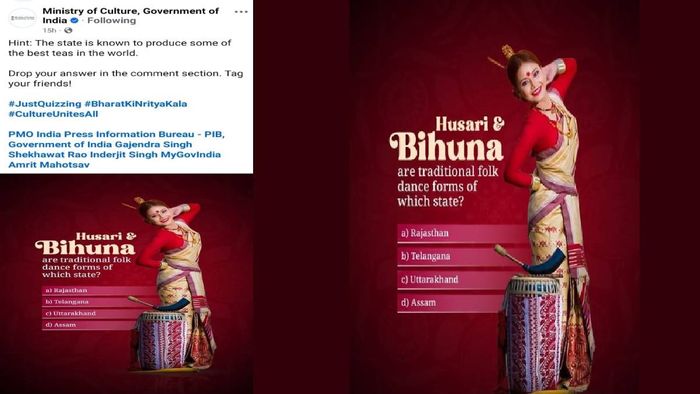
The post, shared on the Facebook account of the Ministry of Culture, carried the hint: “The state is known to produce some of the best teas in the world.” It featured an image of a young Assamese woman in full traditional attire and posed the question: “Husari and Bihuna are traditional folk dance forms of which state?”
For many Assamese people, the answer was obvious - Assam. But the spellings were not. What followed was a flurry of sharp reactions, with netizens questioning whether the error stemmed from a typographical oversight or a deeper unfamiliarity with the cultural heritage of the northeastern state.
“This is a disrespect to our Bihu culture. What is Bihuna!!! ‘Bihu Nach’ or ‘Bihu Naam’ is the correct word,” wrote one user. Another commented, “We don’t know what Bihuna is. I think it’s an error.” Several others echoed similar sentiments, urging the Ministry to correct the post.
Noted film critic, national award winning filmmaker, Utpal Borpujari, reacting to the post said, "Those handling the social media of a Central Government ministry are expected to check and re-check the contents before they post them in public. Such silly mistakes unnecessarily create a controversy and also spread misleading information. I hope the senior officials in the Culture Ministry would take note of such things." He further added, "Also, despite many people having pointed out the mistake in comments, including me, it seems they are yet to take notice as the mistake is yet to be rectified."
For the unversed, 'Husori' (also spelled Huchori), is a traditional musical performance associated with Bohag Bihu in Assam. It is performed by troupes of men who move from house to house in villages. Husori is both a celebration and a ritual.
Accompanied by instruments such as the dhol (drum), pepa (buffalo horn pipe), and taal (cymbals), performers announce their arrival with rhythmic beats before singing Bihu songs in courtyards. The household head offers a gamocha and a xorai filled with betel nuts, along with financial contributions, while the troupe blesses the family for prosperity in the coming year.
Historically, Husori is believed to have been performed during the Ahom era, initially in the courtyard of Rang Ghar to entertain royalty, before becoming a village-level tradition. Over time, it absorbed spiritual influences from Assam’s Neo-Vaishnavite movement.
The Neo-Vaishnavite movement in Assam, spearheaded in the 15th–16th centuries by Srimanta Sankardev, reshaped the socio-cultural landscape of the region. His Ek Sarana Naam Dharma philosophy “Ek Deo, Ek Seo, Eko Bine Nai Keo” (There is only one God), emphasised devotion and community.
Beyond religion, Sankardev revolutionised performing arts in Assam. He developed Ankiya Bhaona (one-act plays) performed in Namghors (prayer halls), which blended storytelling with devotion. The Sattriya dance form also emerged from this reformist tradition.
Though Sankardev did not directly intervene in the Bihu repertoire, the socio-spiritual shifts of the era influenced Husori. Elements such as ‘Pada’ and ‘Ghosha’ began appearing in performances. The custom of performers blessing households at the end of Husori, while seated on the ground and receiving offerings, bears resemblance to Vaishnavite prayer practices.
Equally central to the debate is Bihu, misspeled as 'Bihuna' in the post For Assamese people, Bihu is not merely a dance form; it is an identity, an emotion, and a celebration tied to the agrarian cycle.
There are three major Bihu festivals: Rongali or Bohag Bihu (celebrating spring and new beginnings), Kongali or Kati Bihu (marking scarcity), and Bhogali or Magh Bihu (a harvest festival of feasting). The Bihu dance, known as Bihu Nach, is performed by young men and women in vibrant attire — women in red-themed mekhela chador often woven in muga silk and adorned with kopou phul, and men in dhoti, gamocha, and tongali.
Energetic dance movements symbolise joy, fertility, and the arrival of spring. Alongside dance, Bihu Naam, devotional or lyrical songs, form an integral part of the celebration. Over time, these traditions have evolved into cultural markers not only of Assam’s agrarian past but also of its modern identity.
While the Ministry of Culture has not yet publicly responded to the backlash, nor have they pulled down the post, the episode has reignited discussions on cultural sensitivity and representation, especially when it comes to indigenous and regional traditions.
For many Assamese citizens, it was not simply about a spelling mistake, but about recognition, respect, and accuracy in representing India’s diverse cultural mosaic.