When even the apology needs correction: ‘Bihu Naas’ row intensifies after Ministry of Culture's clarification
The controversy over the misspelling of Assam’s traditional cultural forms intensified after the Ministry of Culture issued a clarification apologising for an earlier error in its social media post.
- Feb 23, 2026,
- Updated Feb 23, 2026, 8:00 PM IST
The controversy over the misspelling of Assam’s traditional cultural forms intensified after the Ministry of Culture issued a clarification apologising for an earlier error in its social media post.
The Ministry had earlier faced backlash for a quiz post that misspelt “Husori” and “Bihu Naas” as “Husari” and “Bihuna.”
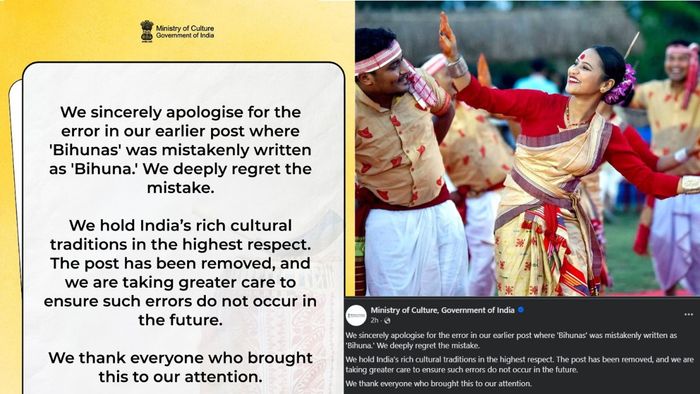
Following public criticism, it released a statement saying, “We sincerely apologise for the error in our earlier post where ‘Bihunas’ was mistakenly written as ‘Bihuna.’ We deeply regret the mistake. We hold India’s rich cultural traditions in the highest respect. The post has been removed, and we are taking greater care to ensure such errors do not occur in the future. We thank everyone who brought this to our attention.”
However, the clarification itself has drawn further criticism from social media users and cultural commentators in Assam, who pointed out that the correct term is “Bihu Naas”, two separate words referring to the traditional Bihu dance — and not “Bihunas.” Many argued that the Ministry’s statement failed to accurately acknowledge the correct terminology, thereby compounding the original mistake.
Filmmaker Utpal Borpujari said that while the effort to apologise was appreciated, the correction should have clearly stated “Bihu Naas,” explaining that “Naas” (pronounced similar to “Naach” in Hindi) denotes dance in Assamese. He stressed that government communication must be culturally precise, especially when referring to regional traditions.
Husori is a traditional Bohag Bihu performance in which groups visit households singing and offering blessings, while Bihu, celebrated as Rongali, Kongali and Bhogali, remains central to Assam’s cultural identity.
The episode has sparked a wider debate on cultural sensitivity, linguistic accuracy and the need for greater diligence in official social media communication concerning regional heritage.