When grazing reserves become battlegrounds: The anatomy of Karbi Anglong’s unrest
Migration and weak land governance have sparked violent protests in Karbi Anglong, Assam. Indigenous Karbis demand justice and transparent enforcement of their land rights under the Sixth Schedule.
- Dec 28, 2025,
- Updated Dec 28, 2025, 3:56 PM IST
Long before the British surveyor’s chain cut straight lines across hills and valleys, before gazetteers froze fluid landscapes into files and notifications, the Karbis moved with the land, naming it not by ownership but by memory. Hills were not real estate; they were ancestors. Rivers were not boundaries; they were lifelines. It is from this deep historical consciousness that the legendary artist, thinker and revolutionary Bishnuprashad Rabha once described the Karbis as the “Columbus of Assam”, not as conquerors, but as discoverers in the truest civilisational sense. Like Columbus in the Western imagination, the Karbis symbolised first arrival, early settlement, and foundational presence. Unlike Columbus, their discovery did not erase others, it shaped a plural landscape.
To call the Karbis the “Columbus of Assam” is to recognise them as among the earliest peoples to inhabit, traverse, and define the cultural geography of the region. Oral histories and anthropological accounts trace their ancient migration from Central Asia, a long journey that eventually anchored them in the forested uplands of what is today Karbi Anglong. Over centuries, they evolved systems of governance, land use, and subsistence that were deeply adapted to the ecology of the hills. These systems were communal, cyclical, and restrained, designed not to extract endlessly, but to endure.
Yet history, especially modern history, rarely allows endurance to remain undisturbed.
A hills district born of rearrangement
The political story of Karbi Anglong begins formally in 1951, when the United Mikir and North Cachar Hills District was created by carving out territories from Golaghat, Nagaon, Cachar, and the United Khasi and Jaintia Hills. It was a bureaucratic act with deep civilisational consequences. In 1970, the district was bifurcated into the Mikir Hills District and North Cachar Hills District, and in 1976, Mikir Hills was renamed Karbi Anglong, restoring indigenous identity to administrative language.
Jones Ingti Kathar, former IAS officer while speaking to India Today NE said, "Karbi Anglong or the Kingdom of Karbis, have been in existence since before the arrival of the British. I think in the late 1890s, the whole Karbi area was declared as scheduled area. Because we had our own king and even now we have our own king. By having our king it means, we have our all own laws, revenue system, administration of justice, everything, we already have our own law. That is why the sixth schedule was made for us".
Placed under the Sixth Schedule of the Indian Constitution, Karbi Anglong was meant to enjoy autonomy over land, forests, culture, and governance, a constitutional promise born from the vision of leaders like Gopinath Bordoloi, Assam's first Chief Minister, who in the 1950s understood that tribal societies could not be governed by the same logic as the plains.
"In paragraph 3 of the sixth schedule, it is stated that the council should make their own land and revenue law. Not new one, but the already existing land and revenue law should have been modified and developed to suit the modern laws. In July 21, 1953, Assam government imposed, Assam Land Revenue Regulation 1886. I say imposed, because there was no signature of the chairman of the council. If it were done by the council itself, it would have been a resolution. We could not find the resolution. Assam government has no constitutional right to make any land or revenue law for us". added Kathar.
In 1971, the hill districts together made up 19.38 per cent of Assam’s geographical area, but only 3.12 per cent of its population. Population density was strikingly low, 30 persons per square kilometer compared to 224 in the plains. These numbers mattered. Sparse population, abundant land, and weak connectivity would soon combine to redraw the demographic future of the hills.
Migration and the quiet rewriting of the hills
From the early twentieth century onward, migration entered the hills, not as a sudden invasion, but as a slow, cumulative force.
Nepali pastoralists arrived first, settling fertile slopes and grazing lands. Hindu migrants from East Pakistan (later Bangladesh) followed the communal violence of the 1950s. North Indian migrants from Bihar and Uttar Pradesh began arriving in significant numbers from the 1950s onward, attracted by land availability, railway connectivity, and agricultural potential. By 1971, Hindi speakers constituted 7.59 per cent of Karbi Anglong’s population, higher than the Assam average. By 2001, the figure rose to 10.4 per cent.
Unlike the Brahmaputra valley, where migrants largely arrived as labourers, tea garden workers, construction hands, rickshaw pullers, the hills witnessed a different pattern. Here, migrants arrived as direct cultivators, transforming virgin or community land into privately held agricultural plots. Migration to Karbi Anglong was not seasonal; it was permanent. It introduced settled agriculture, individual land ownership, and commercial production into a region historically governed by communal land use and shifting cultivation.
This transformation was not merely economic. It reconfigured power.
From jhum to the market: A civilisational shift
For generations, the Karbi economy revolved around jhum cultivation, a system often misunderstood as primitive but in reality deeply ecological. Crops rotated. Land rested. Forests regenerated. Maize, not rice, was central to Karbi life, used for food, fodder, and ritual brewing. In the mid-1980s, hill districts accounted for over 66 per cent of Assam’s maize cultivation, despite occupying a fraction of its population.
Migration altered this balance. Settled agriculture brought sugarcane, wet paddy, and market-oriented production. It also brought land concentration, leasing systems, and informal arrangements like Paikas, Sukti Bandhok, and Khoi Bandhok. Though legally prohibited under land transfer laws of 1959 and 1979, these systems flourished because they benefited both tribal landholders and migrant cultivators.
Law existed. Enforcement did not.
What emerged was a contradiction at the heart of Sixth Schedule governance: autonomy on paper, erosion on the ground.
Member of Autonomous Council, Pawan Kumar, speaking on the matter related to how the non-tribals or rather say the Hindi speaking belt people managed to buy, purchase, exchange land and settle in the sixth schedule area said, "
The long build-up to December 2024
Decades of unresolved land alienation, demographic anxiety, and selective enforcement created a pressure cooker. Political mobilisation in the 1990s, movements like the Autonomous State Demanding Committee (ASDC), channelled tribal frustration into demands for autonomy and resistance to migration. Militant groups followed. Violence entered the hills. Migrants, particularly North Indians, bore the brunt—despite their role in developing agriculture, markets, and council revenues.
By February 2024, the issue returned sharply to the foreground. The Karbi Anglong Autonomous Council (KAAC) announced eviction plans, identifying nearly 2,100 families as illegal occupants on Village Grazing Reserve (VGR) and Professional Grazing Reserve (PGR) lands, areas historically protected since the British era for community livelihood and livestock.The settlers approached the Gauhati High Court, arguing that the lands were not properly notified. The court issued an interim stay. Evictions halted. anger did not.
"We have been listening and hearing to the issue since we were kids. When this discussion and debate on the existence of PGR and VGR lands started getting prominence, our people thought that there should be a clarity on the entire matter. So I, as a member of the Autonomous Council and questioned the concerned department that whether PGR and VGR lands exist? And if they do, can we have the official documents demarcating PGR and VGR lands? So the answer I get is, there is no official document of PGR and VGR lands with the department. So we got the clarity, that there were no official records or notification of PGR and VGR lands", said Pawan Kumar, twice elected Member of Karbi Anglong Autonomous Council.
When rumour ignites history
On December 9, several Karbi locals led by Litsong Rongphar began a fast unto death at Phelangpi, demanding immediate eviction of encroachers from . After over two weeks, police moved them for medical treatment. Rumours spread that they had been detained at 3.00 am early morning and taken to the Gauhati Medical College and Hospital for treatment following 15 days of hunger strike.
That rumour was enough.
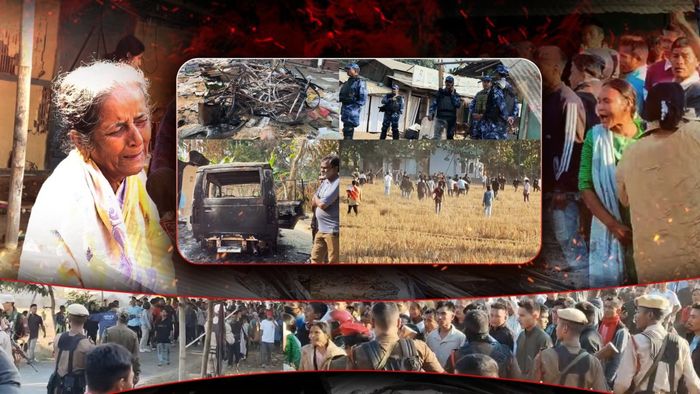
What followed in West Karbi Anglong’s Kheroni–Phelangpi belt was one of the most serious breakdowns of order in recent years. Stones, arrows, crude bombs. Tear gas, rubber bullets. Markets burned. Homes torched. Two people died, a specially abled Bengali shopkeeper burned alive, and a Karbi protestor killed during police action. Over 45 were injured, including senior police officers. The ancestral home of KAAC CEM Tuliram Ronghang was set ablaze in Karbi Anglong's Donkamokam. The Army was deployed. Internet services were suspended to stop the spread of rumours and misinformation as stated by Assam Chief Minister Himanta Biswa Sarma while addressing the media on the violence that erupted on December 22. This was not spontaneous violence. It was history erupting through a rumour.
"What are we asking? Our fundamental rights. Under the sixth schedule no non tribal can buy or settle permanently in the tribal area. Then how did the encroachers settle here? Don't they know the law here? It is shocking now that our tribal population has now reduced to 35 to 40 per cent while of the non-tribals risen to 60-65 per cent. Our identity, our land, our rights are under threat" said Litsong Rongphar, social activist who led the hunger strike in Karbi Anglong's Phelangpi on December 9.
Land as identity, law as delay
At the heart of the crisis lies a truth often missed in administrative language, for the Karbis, land is not property, it is identity.
PGR and VGR lands are not surplus assets waiting for redistribution. They are collective safeguards against dispossession. Their erosion is experienced not as legal ambiguity, but as cultural extinction. Yet the crisis also exposes administrative failure. If these lands were protected, how did encroachment persist for decades? Where were land records, demarcations, and enforcement?
"Yet to make things clear, with regards to the sixth schedule, how did we purchase land or became settlers here? We were born here. I am the third generation now. I am a Karbi. I am Assamese. To say this is not my land, will be completely wrong and also wrong if we say this land does not belong to the Karbis. But one cannot deny the historical facts. We have proofs of 1983 land records. The records stem from a detailed land survey initiated by the Assistant Settlement Officer (ASO) in 1983. These historical records, held by some long-standing residents, often classify disputed land as PGR (grazing land) or forest, contradicting current claims or occupation by non-tribals. The 1983 records are central to the conflict, with residents pointing to them as proof of legitimate, long-term settlement, while tribal groups use them to demand eviction from lands deemed reserved for the community" added Pawan Kumar.
Karbi Anglong Hindi Bhashi Sanstha President, Shiv Narayan Paul speaking on the controversy surrounding the existence of PGR and VGR land documents to India Today NE said, "We filed a High Court case with regards to the PGR and VGR land records. After filing the case, the High Court then asked the autonomous council to halt the eviction back in 2024. Also when the high court asked the council to furnish details or proofs of PGR and VGR lands, then the council failed to provide the documents. Then a tense situation continued to persists even after the court stay order on the eviction notice as few people from the Karbi community began a hunger strike on December 9, 2025 demanding eviction of non-tribals from PGR and VGR areas. So our issue is that we filed a case in the high court and the matter now is sub-judice. And as far as we know, in a democratic system, there can nothing be higher than the law. Whatever the High Court will pronounce as its verdict, we are ready to accept that".
The High Court’s intervention has placed the burden back on institutions, to prove, document, notify, and govern transparently. Violence cannot substitute due process. But due process delayed for decades cannot expect silence.
What unfolded in Karbi Anglong is not an isolated disturbance. It is a warning.
Across Sixth Schedule areas, from Bodoland Territorial Region to Dima Hasao, similar vulnerabilities exist: weak land governance, ambiguous records, rising demographic pressure, and political mobilisation around identity. Without reform, today’s Karbi Anglong could be tomorrow’s elsewhere.
The Sixth Schedule was meant to protect tribal futures, not to fossilise grievance. When autonomy is reduced to paperwork and enforcement becomes selective, frustration fills the vacuum.
A choice history will remember
The December 26 tripartite meeting held between representatives of the Karbi Anglong Autonomous Council, Assam Government and protesters in Guwahati signalled an attempt to step back from the brink. Decisions were taken to jointly approach the High Court, fence vacant lands, cancel illegal trade licences after 1951, evict encroachers from departmental land, and withdraw cases linked to the agitation. Another round of talks is planned, with directions issued to the council to finally file its affidavit and end legal ambiguity.
Karbi leader Litsong Rongphar has welcomed the steps but cautioned that the movement is led by society, not any single organisation, and public consultation will determine the next course.
Karbi Anglong now stands at a crossroads. One path leads toward transparent land governance, lawful enforcement, and dialogue that respects both constitutional limits and indigenous memory. The other — delay, denial, and coercion — leads back to cycles the hills know too well.
The Karbis were called the “Columbus of Assam” because they came first, named first, and belonged first. The tragedy of the present moment is that they are now forced to repeatedly prove that belonging — through protest, hunger, and blood.
History will not ask who enforced order.
It will ask who restored justice.