When Moral Force Becomes Vulnerability: Understanding the Political Psychology of Rahul Gandhi
Rahul Gandhi’s emphasis on moral values shapes his political identity but limits his mass appeal. His journey highlights the struggle between idealism and practical politics in India.
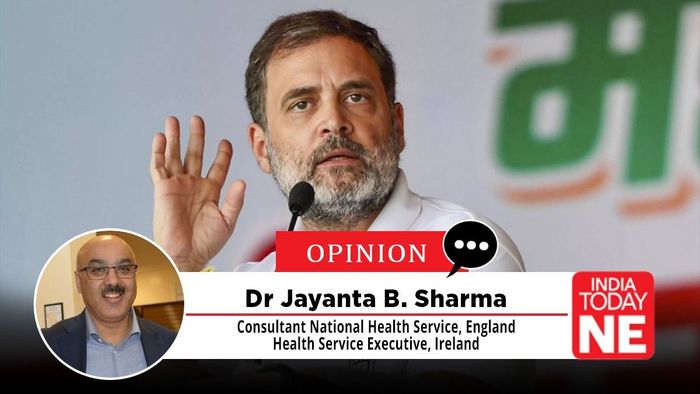
- Mar 14, 2026,
- Updated Mar 14, 2026, 6:49 PM IST
Political leaders are usually judged by ideology, strategy, and electoral success. Yet sometimes the deeper question is psychological: how does a leader instinctively understand politics itself? In the case of Rahul Gandhi, the answer may lie in a paradox that runs through his public life.
Rahul Gandhi’s politics often appears intensely personal in tone, yet fundamentally political in object. His opposition to Narendra Modi frequently sounds emotionally charged—at times even accusatory. Or, is his critique directed less at Modi the individual than at the political system Modi represents?
Understanding this paradox requires stepping beyond everyday political commentary and examining the deeper rhythm of Gandhi’s leadership. It suggests a politician whose worldview has been shaped not only by ideology but also by extraordinary personal experiences of violence, vulnerability, and protected isolation.
Those experiences may have produced a leader who sees politics less as continuous managerial engagement and more as periodic moral confrontation.
A Life Shaped by Political Violence
Few modern politicians anywhere in the world have grown up in circumstances comparable to Rahul Gandhi’s.
As a teenager he witnessed the immediate aftermath of the assassination of his grandmother, Indira Gandhi. Seven years later, his father, Rajiv Gandhi, was killed in a suicide bombing while campaigning.
For most political leaders, violence in politics is an abstract historical subject. For Rahul Gandhi, it forms part of personal memory.
Following Rajiv Gandhi’s assassination, the Gandhi family lived under one of the most stringent security regimes in India. Education, travel, friendships, and everyday movement were shaped by protective protocols. Much of his formative life unfolded within layers of security.
It would be inappropriate to attempt a clinical diagnosis based on biography. Yet it is reasonable to suggest that such experiences could influence how someone perceives politics. For a person whose family history includes political assassination, the language of hatred, fear, and polarisation may not sound metaphorical.
It may feel existential.
This may explain why Gandhi’s political rhetoric repeatedly returns to moral language—love versus hatred, compassion versus fear, unity versus division.
Personal Intensity, Political Object
One of the most striking features of Rahul Gandhi’s politics is the emotional tone with which he criticises Narendra Modi. His speeches often frame the political struggle as an ethical contest over the nature of Indian public life.
The Bharat Jodo Yatra offered perhaps the clearest illustration of this style. Gandhi presented the march not merely as a campaign but as an attempt to counter a politics of hatred with what he described as a politics of love.
Such language inevitably personalises politics. Moral arguments carry emotional intensity. When a leader frames political conflict as a struggle between compassion and hatred, criticism of the opposing leader easily appears personal.
Is the object of Gandhi’s critique is limited to Narendra Modi as an individual?
Or, Modi becomes the most visible representative of a political ecosystem characterised by strong central leadership, polarised rhetoric, and emotionally mobilised nationalism. Although, Gandhi’s opposition may therefore sound personal is this fundamentally directed at a broader political order?
Perhaps his opposition is personal in intensity, but political in object.
Speaking Abroad and the Patriotism Debate
This moral framing of politics also helps explain one of the most controversial aspects of Rahul Gandhi’s conduct: his willingness to criticise the government on foreign platforms.
To many Indians this violates an unwritten political norm. Domestic disputes, the argument goes, should remain domestic. Raising them abroad invites external judgement on national affairs.
Given India’s colonial history and sensitivity to global perception, this instinct is understandable. Criticism abroad can easily be reframed as criticism of the nation itself.
In his view, criticising the government—even internationally—is part of defending democratic values. The distinction between nation and government remains central to his argument.
The controversy arises because in contemporary political discourse these two concepts are often blurred. When government and nation become conflated, criticism of the former appears as disloyalty to the latter.
Politically, Gandhi’s approach carries clear risks. The venue of criticism can become more politically consequential than the substance of the criticism itself.
The Puzzle of Disappearance
Another recurring criticism of Rahul Gandhi concerns his intermittent presence in political life. At various times he has taken extended breaks, maintained uneven parliamentary attendance, or retreated temporarily from the political spotlight.
For critics this reinforces an image of inconsistency.
The pattern is not simple absence. Rather, Gandhi’s political presence appears episodic.
At certain moments he withdraws from daily political management. At other moments he returns with extraordinary intensity—most notably through the Bharat Jodo Yatra, a physically demanding journey across the country intended to symbolically reconnect politics with ordinary citizens.
This suggests that Gandhi may engage politics differently from leaders who thrive on constant tactical management.
The Rhythm of Moral Confrontation
One way to reconcile these patterns is to recognise a distinctive rhythm underlying Rahul Gandhi’s leadership.
He appears to engage most deeply when politics becomes a moral moment. In such moments he acts decisively—through marches, symbolic gestures, or sharply framed critiques.
Between these moments, however, he often seems less invested in the continuous mechanics of political management.
This creates a pattern of punctuated political intensity: bursts of moral confrontation separated by quieter periods of relative withdrawal.
In contrast, Narendra Modi represents the opposite model of leadership—one built on relentless continuity, message discipline, and constant political presence.
The difference between these rhythms partly explains why their rivalry appears so stark.
The Prosecutorial Pattern-Seeker
Another criticism directed at Rahul Gandhi is that he sometimes makes allegations without fully substantiating them. His speeches have occasionally moved quickly from suspicion to accusation—linking political controversies to larger claims about systemic corruption, democratic erosion, or crony capitalism.
This tendency reflects another dimension of his political style.
Rahul Gandhi often acts less like a cautious lawyer building a narrow case and more like a prosecutor identifying patterns within a system. He tries to connect individual controversies to a broader moral narrative about how power operates.
In this mode, he is less concerned with proving each charge in strict forensic detail than with revealing what he perceives as a structural pattern.
The risk, however, is obvious.
A prosecutor must eventually present evidence. A pattern-seeker works through inference. When these two roles blur, political rhetoric can outrun demonstrable proof.
When Moral Force Becomes Vulnerability
This brings us to the central insight.
Rahul Gandhi’s political strength lies in moral clarity. He attempts to frame politics as a contest over the ethical character of public life.
But moral clarity can become political vulnerability when rhetorical intensity exceeds demonstrable evidence.
If a leader speaks like a prosecutor without producing courtroom-level proof, opponents can easily portray the accusations as reckless or defamatory. In democratic politics—where perception often matters more than intention—this can weaken credibility.
In short:
If the boundaries between moral intuition, political inference, and evidentiary accusation blur, moral force becomes vulnerability.
A Different Kind of Opposition
Seen in this light, Rahul Gandhi represents a distinctive type of opposition leader.
He is not primarily a managerial politician whose strength lies in continuous tactical engagement.
Instead, he appears most comfortable when politics becomes a question of ethical meaning—when the stakes are framed as compassion versus hatred, democracy versus authoritarianism, pluralism versus polarisation.
This style gives his politics a recognisable moral vocabulary. It also produces uneven rhythms of engagement and rhetorical overreach.
Whether such a style can succeed against the relentless organisational machinery of contemporary electoral politics remains uncertain.
But it helps explain a leader who often appears contradictory: emotionally intense yet ideologically focused, intermittently present yet capable of dramatic political gestures, morally forceful yet sometimes evidentially vulnerable.
The Man and the Pattern
Rahul Gandhi’s politics cannot be understood simply through conventional categories of strategy or ideology.
It is the politics of a leader shaped by extraordinary biography, moral instinct, and an unusual relationship to political power.
A man whose life has been marked by political violence may naturally interpret politics through the lens of ethical confrontation. Such a leader may seek not merely to win elections but to redefine the moral language of political debate.
That ambition carries both power and risk.
For in politics, as in law, conviction alone is never enough.
And when moral force outruns proof, the very intensity that gives a leader his voice can also become his greatest vulnerability.