When the cows were gone, so was the livelihood: Assam’s silent flood crisis
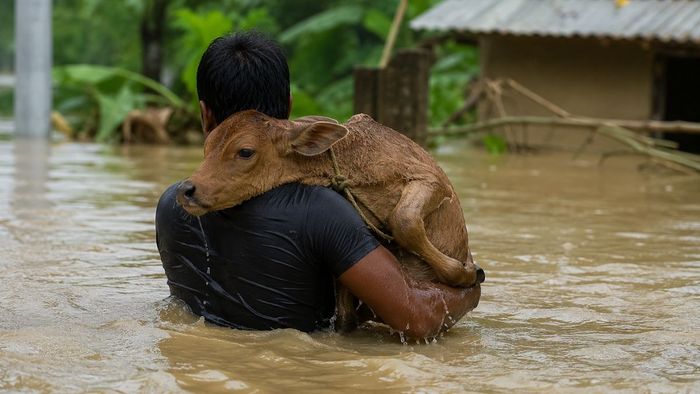
As Assam counts displaced families, damaged homes and submerged villages, thousands of cattle, goats and poultry birds are fighting a quieter battle for survival. In Sivasagar’s Nepali Khuti, where families depend on selling cow’s milk, the loss of livestock has turned a flood disaster into a deepening livelihood crisis.
- Aug 03, 2026,
- Updated Aug 03, 2026, 10:29 AM IST
When floodwaters began entering Nepali Khuti in Assam’s Sivasagar district on the morning of July 19, families initially believed they had time to respond.
By noon, that hope had disappeared.
The water rose with alarming speed, swallowing homes, roads and cattle sheds. Families scrambled to move children to higher ground, but many were unable to save their belongings. For households whose livelihoods depended on livestock, the disaster carried an additional and devastating consequence: the loss of the animals that sustained them.
“Only the tin roof of our house is visible now. We could not save any household items. All our cows are gone. We have nothing left; everything has been destroyed,” said Kali Pradhan, a resident of Nepali Khuti.
Her account reflects a dimension of Assam’s floods that often remains outside the main narrative. While the focus understandably remains on human deaths, displaced families, damaged houses and destroyed infrastructure, thousands of animals have also been caught in the deluge — stranded without fodder, shelter or clean drinking water, and exposed to the risk of disease.
According to the Assam State Disaster Management Authority’s flood report dated August 2, 24,460 animals have been affected by the current wave of flooding.
The figure includes 13,835 large animals, such as cattle and buffaloes, 9,754 small animals, including goats and sheep, and 871 poultry birds.
Behind these numbers are families whose savings, food security and daily income are tied to the animals they rear.
For many rural households, a cow is not merely livestock. It is a source of milk, a regular income stream, a form of savings and, in times of financial distress, an asset that can be sold to meet emergency expenses. A pair of cattle or a small herd of goats may represent years of labour and investment.
When floodwaters take away those animals, the loss can continue long after villages dry up.
A crisis beyond the floodwaters
Dhemaji has reported the highest number of affected animals, with 10,527 livestock and poultry birds impacted by the floods. The district’s losses include 6,310 large animals, primarily cattle and buffaloes, and more than 4,000 small animals, including goats, sheep and other livestock.
Golaghat follows with 9,077 affected animals, while Jorhat has reported 3,114. In Sivasagar, 1,742 animals have been affected, including 851 poultry birds.
The numbers underline the scale of the challenge confronting families and authorities. During a flood, rescuing people is only the first stage. Livestock must also be moved to higher ground, provided with fodder and protected from prolonged exposure to contaminated water.
Many farmers face an impossible choice: remain behind to protect their animals or evacuate with their families.
For those who manage to move their livestock, the struggle does not end. Animals need dry ground, shelter, food and access to clean water. Flooded grazing land can leave cattle without adequate fodder for days, while overcrowding in temporary shelters increases the risk of disease.
The latest flood report shows that relief distribution centres are providing support or shelter to 7,553 large animals, 6,984 small animals and 8,800 poultry birds.
The figures indicate the scale of livestock evacuation and the pressure on relief arrangements in flood-hit districts. In many cases, families have had to move their animals alongside themselves, turning relief and rehabilitation into a challenge that extends beyond human shelter.
Nepali Khuti: When the cows are the livelihood
In Nepali Khuti, the impact is particularly severe because cattle are central to the local economy.
Many families in the area survive by selling cow’s milk. The income may be modest, but it provides a regular source of cash for food, education, healthcare and other household expenses.
When cattle are lost, the damage is not limited to the value of the animal. The family also loses its daily income.
Rajen Pradhan, whose home is located close to the Dikhow river, said the July 19 flood was unlike anything the community had experienced before.
“Our home is located near the Dikhow river. The devastating flood that came on July 19 was unlike anything I had seen in my lifetime,” he said.
The floodwaters washed away the family’s cattle, leaving them uncertain about how they would rebuild their lives.
“Selling cow’s milk is our only source of income. The flood has destroyed everything, and we do not know how we will start our lives again,” Rajen said.
For dairy-dependent families, rebuilding a home may be only one part of recovery. Replacing cattle can take years.
A family that loses its milch cows loses not only an asset but also the income generated every day from milk sales. Even if a new animal is purchased, it may take time before the household can restore its previous level of production and earnings.
The crisis can also trigger a cycle of debt. Families may be forced to borrow money to rebuild homes, replace livestock and meet daily expenses. For those who were already living with limited financial security, the loss of cattle can push recovery further out of reach.
‘We could not even retrieve our belongings’
Kali Pradhan recalled the speed with which the flood transformed the area.
“On July 19, water started entering the area at around 6 am. We went to check, and by 11 am, the water had risen completely. We could not get out and could not even retrieve our belongings,” she said.
The family moved the children to higher ground, while four members were eventually rescued later in the evening.
By then, much of what they owned had already been swallowed by the flood.
“Only the tin roof of our house is visible now. We could not save any household items. All our cows are gone,” she said.
Her words capture the layered nature of flood loss.
A damaged house can be repaired. Household items can be replaced over time. But when a family loses both its home and its source of livelihood, recovery becomes significantly more difficult.
In Nepali Khuti, families are now confronting multiple challenges at once: damaged homes, lost cattle, destroyed household possessions and uncertainty over future income.
The floodwaters may have begun receding, but the economic impact is only beginning to emerge.
Veterinary teams race against disease
The threat to livestock does not end once animals are moved to safety.
Flood conditions can increase the risk of infections and disease outbreaks. Animals may be forced to stand in contaminated water for long periods, consume unsafe feed or live in overcrowded temporary shelters.
Recognising these risks, authorities have deployed veterinary and animal health teams across affected districts.
Charaideo has 43 veterinary and health personnel engaged in flood relief operations. Sivasagar has deployed 37 medical teams, while Golaghat and Jorhat also have response teams working in affected areas.
Their work includes monitoring animal health, providing treatment and preventing disease outbreaks among livestock that have been displaced or exposed to flood conditions.
The response is critical because the death of livestock after the flood can further deepen losses for farming families.
Even animals that survive the initial inundation may face health complications caused by stress, injuries, poor nutrition or contaminated water. Veterinary intervention, therefore, remains an essential part of post-flood recovery.
Fodder becomes a lifeline
With grazing land submerged and local fodder supplies disrupted, feeding livestock has become another major challenge.
The government has begun distributing cattle feed in affected areas. According to the ASDMA report, 959 quintals of wheat fodder and 232.056 quintals of rice bran have been supplied.
Sivasagar received the largest share of wheat fodder, while Dhemaji and Golaghat were among the districts supplied with rice bran.
For farmers who have managed to save their animals, the availability of fodder may determine whether livestock remain healthy enough to support the household’s recovery.
A cow that survives but suffers from prolonged hunger or illness may produce less milk. For dairy farmers, that means a reduction in income at a time when expenses are already rising.
Fodder support is therefore not simply an emergency measure. It is also a form of livelihood protection.
No animals officially recorded as washed away
Despite the scale of the disaster, the latest ASDMA report has not officially recorded any livestock as having been washed away.
The absence of officially recorded livestock deaths may indicate that rescue and evacuation efforts helped save many animals during the widespread inundation.
However, the figure also contrasts sharply with accounts from communities such as Nepali Khuti, where residents say cattle were swept away by the floodwaters.
The difference highlights the difficulty of documenting livestock losses during a fast-moving disaster. In remote and heavily inundated areas, assessments can take time, while some losses may remain unreported or await verification.
For affected families, however, the loss is immediate.
Whether an animal is recorded in an official damage register or not, its disappearance can mean the loss of a family’s income, food security and financial safety net.
Recovery must include livelihoods
Assam’s flood response has traditionally focused on saving lives, providing relief and restoring damaged infrastructure. But the experience of livestock-dependent communities shows that recovery cannot end with the return of families to their homes.
Rehabilitation must also address how people will earn a living after the flood.
For dairy farmers in Nepali Khuti, replacing cattle may be as important as rebuilding houses. Without livestock support, many families may return to repaired homes but remain without a source of income.
Assistance may be required in the form of livestock replacement, veterinary care, cattle feed, compensation, low-interest credit and support for restoring dairy production.
The needs may vary from one household to another. Some families may require new cattle. Others may need temporary income support while surviving animals recover. Families whose cattle sheds were destroyed may need assistance to rebuild safe shelters before they can resume dairy farming.
The recovery process must account for these differences.
The disaster after the disaster
As floodwaters recede across Assam, attention will gradually shift from rescue to rehabilitation.
But for families in Nepali Khuti, the disaster has not ended.
The visible destruction — submerged homes, damaged roads and washed-away belongings — tells only part of the story. The deeper crisis lies in what the flood has taken from the future.
For Kali Pradhan’s family, the loss of cattle means losing assets that took years to build. For Rajen Pradhan, it means the disappearance of the only source of household income.
“We are clueless about how we will start our lives again,” he said.
Across Assam’s flood-hit districts, 24,460 affected animals represent more than a disaster management statistic.
They represent milk that will no longer be sold, income that may not return for months, savings that have disappeared and families whose recovery will depend on whether their livelihoods can be restored.
The flood may have moved on, but for Assam’s forgotten animal victims — and the people who depend on them — the struggle to survive is far from over.