UPI charges are changing: What the new MDR means for merchants and users
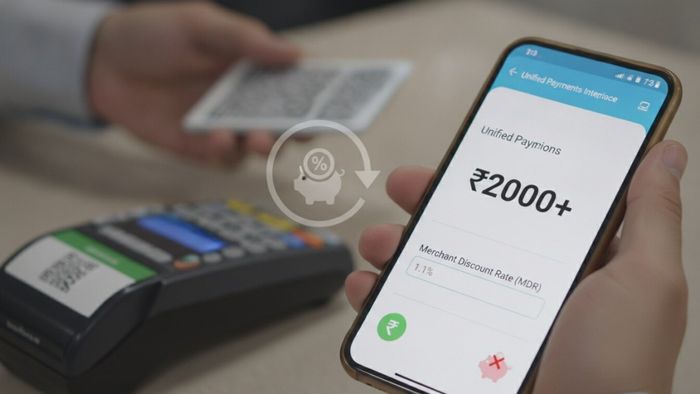
From October 15, UPI merchant payments above Rs 2,000 will attract MDR under a new framework. The move shifts funding towards high-value transactions while keeping most everyday payments free.
- Sep 16, 2026,
- Updated Sep 16, 2026, 1:45 PM IST
India's UPI system is set for its biggest change to the way merchant payments are funded since the government introduced zero MDR in 2020. From October 15, merchants will have to pay a 0.4 per cent Merchant Discount Rate (MDR) on UPI payments above Rs 2,000. The charge will be capped at Rs 300 for transactions of Rs 75,000 or more.
The change does not mean consumers will suddenly have to pay for using UPI. Person-to-person payments will remain free, as will most low-value payments made to merchants. The new charge is targeted primarily at higher-value person-to-merchant transactions.
So, what exactly is changing and why has the government decided to introduce a charge after years of keeping UPI free?
Why is UPI introducing an MDR?
When UPI was made zero-MDR in January 2020, the objective was to accelerate digital payment adoption. Instead of collecting a fee from merchants, banks and fintech companies were compensated through an annual government incentive scheme.
The scale of UPI has since changed dramatically. The platform processed 2,451 crore transactions worth Rs 29.9 lakh crore in August 2026 alone. With transaction volumes increasing, so have the costs involved in running the network, including servers, bandwidth, fraud prevention, cybersecurity and technical support.
NPCI has cited industry estimates that put the annual cost of operating UPI at around Rs 20,000 crore. The Department of Financial Services has separately told Parliament's Standing Committee on Finance that the payments industry spends around Rs 20,700 crore a year on person-to-merchant transactions.
Government compensation has been much lower than these estimates. The highest annual outlay under the incentive scheme was Rs 3,631 crore in FY2023-24. The initial Budget Estimate for FY2025-26 was Rs 437 crore, although the eventual payout rose to around Rs 2,196 crore. For FY2026-27, the allocation stands at Rs 2,000 crore.
This gap has been a central issue in the debate over UPI's long-term financial sustainability. A parliamentary committee report in March also flagged concerns about the absence of MDR and the financial pressure it places on the payments ecosystem.
NPCI has described the annual government incentive as "short-term bridge funding rather than a permanent measure", arguing that dependence on yearly budget allocations creates uncertainty and can restrict long-term investment by banks and fintech companies.
What exactly will merchants pay?
Under the new framework, a merchant receiving a UPI payment above Rs 2,000 will pay an MDR of 0.4 per cent. For a Rs 5,000 payment, that works out to Rs 20. A Rs 50,000 payment would attract Rs 200. At Rs 75,000, the fee reaches Rs 300, which becomes the maximum charge even when the transaction value goes higher.
There are separate provisions for certain sectors. Payments above Rs 2,000 for railways, telecom, fuel and insurance will attract a flat Rs 5 charge per transaction. Capital market transactions, including mutual fund and stockbroking payments, will have an MDR of 0.02 per cent, subject to a Rs 300 cap.
The new charge will not apply to every merchant. Small merchants collecting up to Rs 1 lakh a month through UPI QR codes will remain exempt. UPI QR payments to merchants in rural and semi-urban areas will also remain free. Five per cent of the MDR collected will go into a dedicated fund intended to expand UPI acceptance among small merchants.
Will customers have to pay more?
The stated answer is no. NPCI has said merchants cannot pass the MDR on to consumers. The government has also said UPI app providers cannot impose platform fees or hidden charges in connection with the new system. Banks have been advised to ensure that merchants do not transfer the MDR to customers.
The immediate cost, therefore, falls on merchants. How businesses respond to that additional cost could differ. Some may absorb it as part of their operating expenses, while others could potentially alter prices or payment incentives. The MDR itself, however, is not a fee that the customer is supposed to see added to a UPI transaction.
Why was Rs 2,000 chosen?
The Rs 2,000 threshold allows the government to introduce a charge for larger commercial transactions without changing the economics of most everyday UPI payments.
Government data shows that around 86 per cent of person-to-merchant transactions were below Rs 500 in FY2025-26. Only around 4 per cent of P2M transactions were above Rs 2,000.
But those relatively few high-value transactions represented close to two-thirds of the total value of P2M payments. That distinction is important: while the new MDR covers a small share of merchant transactions by volume, it targets a much larger share of their overall value.
The government is also continuing to support low-value digital payments. The FY2026-27 Budget has allocated Rs 2,000 crore for incentives covering low-value BHIM-UPI and RuPay debit-card transactions.
How much has UPI grown?
UPI's expansion since its launch in August 2016 has fundamentally changed the scale of India's digital payments system.
According to Ministry of Finance data, UPI handled 24,161.69 crore transactions worth around Rs 314 lakh crore in FY2025-26. In FY2016-17, the platform had recorded just 1.78 crore transactions worth Rs 0.07 lakh crore.
The number of banks connected to the platform also rose from 44 to 703 during the period.
The overall figures include two distinct types of transactions. Person-to-merchant payments accounted for 63 per cent of UPI's transaction volume, while person-to-person payments made up 37 per cent. P2P payments, however, accounted for 71 per cent of the total transaction value.
Around 59 per cent of P2P transactions were below Rs 500, and these transfers are not covered by the new MDR.
What was the system before 2020?
UPI was launched by the National Payments Corporation of India (NPCI) in August 2016 under the oversight of the Reserve Bank of India. Four years later, the government introduced zero MDR for UPI and RuPay debit-card transactions by amending the Payment and Settlement Systems Act, 2007, and the Income-tax Act, 1961.
The policy removed the merchant fee that had previously been associated with digital payments and instead relied on government incentives to compensate the payments ecosystem.
The move helped push digital payments into everyday use, but the rapid growth of UPI has also made the question of who should fund its infrastructure more significant.
UPI now handles a large majority of India's digital payment transactions and has expanded internationally, with adoption or linkages in countries including the UAE, Singapore, Sri Lanka, Nepal, Bhutan, Mauritius, Qatar and France.
What does the October 15 change mean?
The new MDR does not amount to a blanket charge on UPI.
The system retains free person-to-person payments and keeps most small-value merchant transactions outside the fee structure. The change instead introduces a mechanism for generating revenue from higher-value merchant payments.
That marks a shift from the model adopted in 2020, when the government relied primarily on budgetary incentives to support a zero-MDR system.
NPCI says the new revenue will be used within the UPI ecosystem for infrastructure resilience, cybersecurity, fraud prevention, innovation and customer service. The change therefore addresses a specific question that has become harder to ignore as UPI has grown: how should the infrastructure behind India's most widely used digital payment network be funded as transaction volumes continue to rise.