How Assam's Joi Barua found his music orbiting a NASA space mission
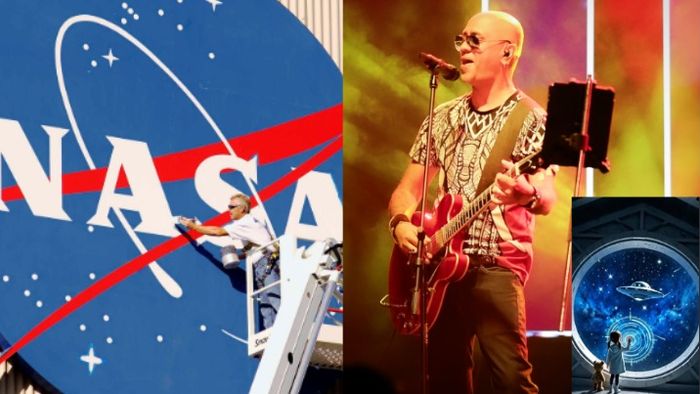
The connection was discovered when Cosmic Rhapsody creators Dr Susan Lim and Dr Christina Teenz Tan visited the Space Sciences Laboratory at the University of California, Berkeley, where the NASA's COSI mission is being developed.
- Sep 16, 2026,
- Updated Sep 16, 2026, 1:00 PM IST
When Indian composer and singer Joi Barua composed a song about a dying star scattering its remains across the universe, he was working with poetry and music, not a NASA space mission.
Months later, that song found an unexpected connection with one.
Barua is part of Cosmic Rhapsody, an international performing arts project created by Dr Susan Lim and Dr Christina Teenz Tan, bringing together music, animation and a story about humanity's search for answers in space.
At the heart of the story is something that sounds almost poetic but is very real in astrophysics — a dying star exploding and sending elements into space, where they can eventually become part of new stars and planets.
That is also one of the questions being explored by NASA's Compton Spectrometer and Imager (COSI) mission.
The connection was discovered when Cosmic Rhapsody creators Lim and Tan visited the Space Sciences Laboratory at the University of California, Berkeley, where the COSI mission is being developed.
They realised that the story's musical climax had a striking connection with what COSI is trying to understand.
And there was an Assamese connection running through the project too.
Barua composed the melodies for “Star Among the Cosmic Clouds” and “Confetti Storm”, with lyrics by Lim. “Confetti Storm” later evolved into “Confetti Star-Ion”, which Barua co-composed with French composer and arranger Manu Martin.
At the same time, another artist from Assam, animator and director Samudra Kajal Saikia, was working on the visual side of the project.
So while Barua was turning the idea of a star exploding into music, Saikia was translating that same moment into animation.
For Barua, the story goes back to a performance in Singapore.
Speaking to India Today NE, Barua said his association with Lim began when she watched him perform a song about Bishnu Prasad Rabha, based on a story by his close associate Gajiram Rabha.
“I composed it, Ibson wrote it, Samudra Kajal Saikia illustrated it and George Brooks played the saxophone,” Barua said, recalling the performance.
That encounter eventually led to his collaboration with Lim and, later, to Cosmic Rhapsody and its journey into the world of space science.
Barua said he feels grateful that music born out of such collaborations has now found a connection with scientific studies and the exploration of deep space.
“I am so thankful to the legends that we have. This feels like pure magic. It came from the legends; they have really blessed us, that we find our work related to studies and explorations in deep cosmic space,” he said.
A song about a star's death
The idea behind the songs is simple but profound.
A massive star eventually reaches the end of its life. In a supernova explosion, material forged inside the star is thrown out into space. Those elements can later become part of new stars, planets and other cosmic objects.
Lim's lyrics look at this not simply as the death of a star, but as a beginning.
The star gives up its own existence and sends its elements back into the universe — almost like throwing confetti across the cosmos.
That image became the starting point for Barua's music.
Rather than making the explosion sound mournful, Barua approached it as something expansive and celebratory — the end of one star becoming material for what comes next.
It was only after the creators encountered the COSI team at Berkeley that they saw how closely that musical idea mirrored real science.
Check the conversation to know more about the project:
Where NASA comes in
COSI is a space telescope designed to study soft gamma rays, a form of high-energy light that can reveal what is happening during powerful events in the universe.
Among its goals is to understand how stars produce and distribute chemical elements.
Scientists are trying to trace the cosmic journey of elements created inside stars, including what happens when stars explode and scatter those elements through space.
That is where Cosmic Rhapsody and COSI meet.
The songs are not a scientific soundtrack commissioned by NASA. Rather, the connection emerged because the artists and scientists found themselves exploring the same cosmic process from very different directions.
Scientists approach it through instruments, observations and astrophysics. Barua and the Cosmic Rhapsody team approach it through melody, lyrics, animation and storytelling.
Two artists from Assam, one cosmic story
For Barua, perhaps the most personal part of the project is that he is not the only Assamese artist involved.
Samudra Kajal Saikia, the animator and director behind the project's visuals, is also from Assam.
That means the same story is being carried in two different forms by two artists from the state — Barua through sound and Saikia through images.
As Barua worked on the musical arc of the exploding star, Saikia translated those musical movements into swirling visuals of colour and stardust.
For Barua, having two artists from Assam contribute to the auditory and visual world of an international project of this scale is particularly meaningful.
The Assam connection may seem small against the scale of the project — NASA, UC Berkeley, the Hollywood Bowl and the Los Angeles Philharmonic. But it is an important part of Barua's journey through Cosmic Rhapsody.
From a song to the Hollywood Bowl
Cosmic Rhapsody was created by Lim and Tan as a large-scale performing arts experience combining live orchestral music, pop songs and animation.
Its story follows a human and an AI travelling into space in search of solutions to Earth's environmental crisis.
Martin serves as the chief composer, orchestrator and arranger of the larger orchestral work, while Barua's contribution is focused on the songs at the heart of the story's cosmic climax.
The project is scheduled to have its US premiere at the Hollywood Bowl on July 27, 2027, with the Los Angeles Philharmonic and pianist Jean-Yves Thibaudet.
The COSI mission is also scheduled for launch from Cape Canaveral.
For Barua, the journey from a song performed in Singapore to a project connected with a space mission is perhaps the most unexpected part of it all.
A song written from poetry about a dying star ended up reflecting a question scientists are preparing to take into space.
And somewhere between the music, the science and the animation, two artists from Assam found themselves helping tell that story to the world.