Nukkad Natak Review: Rough around the edges, real at its core
A film about challenging the system ends up doing exactly that — battling rejection, taking to the streets, and carving its own path to the screen. Nukkad Natak may not be flawless, but its raw honesty, real characters, and the story behind its making linger long after it ends.
- Apr 25, 2026,
- Updated Apr 25, 2026, 5:45 PM IST
The wait was worth it. Mostly.
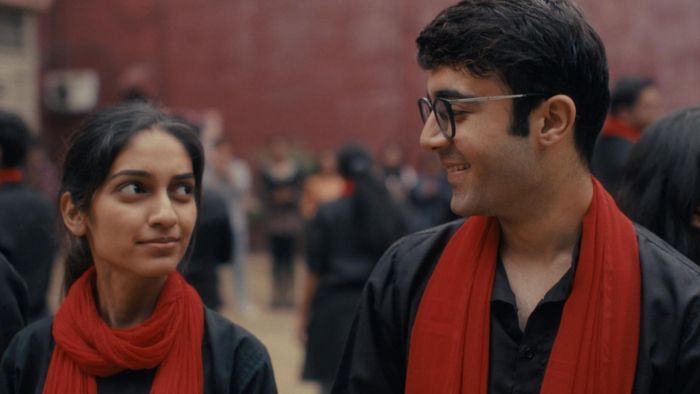
For months, your Instagram feed had one recurring image: a black outfit, a red scarf. One man. One woman. Talking about their film with the kind of conviction that makes you stop scrolling. I waited for the OTT release. Turns out, the makers waited far longer, years, actually, just to shoot it, release it in theatres, and then fight their way onto a streaming platform. April 24, 2026. Netflix. And both kinds of wait had their payoff.
Molshri (played by Molshri Singh) runs a street theatre group at her college in Dhanbad. Shivang (Shivang Rajpal), a closeted gay student, joins her group and gets swept up in her passion for social causes. When the two best friends are caught committing a crime to help Mukund, an impoverished canteen worker, they get expelled. The college principal gives them one chance: enrol five children from Mukund's slum into a local school, and they are back in. Where seasoned social workers have failed before them, Molshri and Shivang decide they will succeed.
Simple premise. But the film uses it to touch on things that matter: the right to education, life in slums, LGBTQ identity in conservative spaces, inequality, and the wide gap between those who have access and those who don't. These aren't just backdrop issues. They are the bones of the story.
The characters don't feel like actors playing roles. They feel like people you've seen around, in your college canteen, at a bus stop, in a rally. That's partly because both Molshri and Shivang Rajpal come with strong theatre backgrounds, and it shows. There's a naturalness to them that polished film actors sometimes lose. Some portions of the film genuinely feel like you're watching a documentary rather than a staged story, and that's a compliment. It keeps you grounded.
Nirmala Hazra is sparky and convincing as Chotti, who clutches her textbooks like they are a lifeline. Small role, but she stays with you.
The characters are fighting for real causes. But somewhere, the fight feels a little half-hearted on screen, not in intention, but in execution. The same raw energy the team put into getting this film made and released doesn't fully translate to the characters living inside it. They are doing good things, but you don't always feel the weight of why. The plot is very much like a street play in its examination of and solutions to the structural causes of poverty...a bit too neat, a bit too resolved.
Molshri's character is clearly the hero of the story, and the film treats her that way, sometimes a little too generously. She's inspiring, yes, but the script doesn't always give her enough real moments of struggle to fully earn that pedestal. A hero needs cracks to feel real.
There's also a moment with Shivang, a desperate, deeply personal decision he makes to keep things moving, that deserved a lot more space than the film gave it. It's the kind of thing that would quietly break a person, or at the very least, stay with them. But the film moves on almost immediately, as if it never happened. No guilt, no quiet moment alone, nothing. For a character whose internal world is already so layered, that felt like a missed opportunity. Some experiences don't just pass through you, they leave a mark. The film forgot that.
Here's where things get genuinely impressive. Director Tanmaya Shekhar is an IIT graduate who left a comfortable job in the US to make this film. That alone tells you what kind of bet he was placing on himself.
The film won the Special Jury Award at the Kolkata International Film Festival and the Best Debut Film trophy at the Indo-German Film Week. Festival recognition came. But OTT platforms weren't interested. Streaming services had become increasingly selective, behaving more like traditional theatres, favouring known stars and established names. An indie film with new faces didn't fit the algorithm.
So what did they do? They went to the streets. Literally. The team embarked on a "Cinema Yatra": a caravan tour across India, performing street plays and connecting with audiences directly. They also launched a viral Instagram series called How to Enter Bollywood, which documented the struggles of outsiders trying to break into the industry, and it clocked over 15 million views. That's the black outfit and red scarf you kept seeing. That was the campaign. They independently released the film in theatres on February 27, 2026, before landing on OTT in April.
The irony is beautiful: a film about using street theatre to reach the unreachable, promoted through actual street theatre to reach an indifferent industry.
Beyond its story, Nukkad Natak does something quieter and more important: it tells young people that the system being closed isn't the end of the conversation. The film's characters believe they can do something that trained professionals couldn't. And the people who made the film lived that same belief, for years, without a studio, without famous faces, without an easy path.
The film recommends that young students move away from the rat race and turn their attention to more worthwhile pursuits. It's hard to argue with that message.
Is Nukkad Natak a perfect film? No. But it's an honest one. And in a space where so much is polished to the point of feeling empty, honesty goes a long way.
Worth your evening. Genuinely.
Nukkad Natak | Directed by Tanmaya Shekhar | Starring Molshri Singh, Shivang Rajpal, Nirmala Hazra, Danish Husain | Now streaming on Netflix