The Nikhil D'Souza the crowd knows, and the one it may be missing
Thousands of students at IIT Guwahati sang Nikhil D'Souza's biggest Bollywood hits back at him, word for word. Few in that crowd, perhaps, know the quieter, more personal catalogue he has been building on the side.
- Aug 31, 2026,
- Updated Aug 31, 2026, 3:55 PM IST
The last song arrived almost without warning.
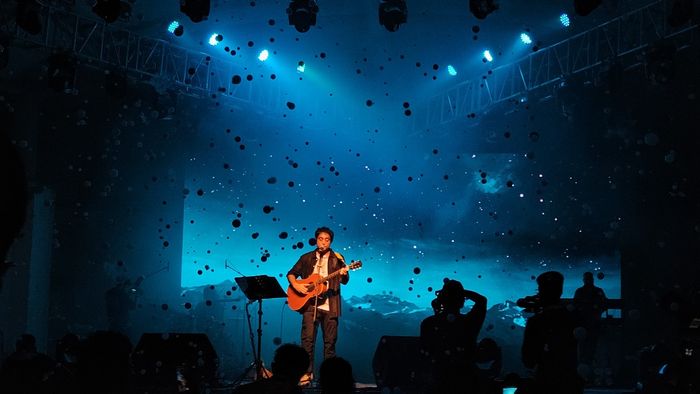
Nikhil D'Souza had been singing for close to an hour and a half, sliding between high notes and low ones without any visible effort, and the cricket ground at IIT Guwahati, thousands of students standing shoulder to shoulder, had been singing right back at him. There was no countdown, no 'dramatic' goodbye. The music simply stopped, and Nikhil was gone.
It felt like the right kind of ending for a performer who had spent the evening letting the songs do the work rather than his own showmanship.
He had walked on stage in a loose, textured black overshirt worn over a long white T-shirt, a stack of necklaces catching the light, dark trousers, hair slightly out of place: the look of someone who had wandered in rather than dressed for an occasion. The performance that followed was considerably less casual. He reached towards the crowd, cupped his hands into a heart above his head, leaned into the mic, and kept going.
There were barely any pauses between songs; the set moved at a clip that never let the energy dip, through octaves that seemed to cost him nothing.
Vaaste opened the evening. Over the course of the evening, Nikhil performed a generous selection of songs familiar to his listeners, including Mere Bina, Sham and other numbers from his Bollywood repertoire, along with songs outside it and renditions of popular tracks such as Pasoori and Bang Bang.
The distinction is worth making, because there are, in a sense, two Nikhil D'Souzas. There is the one this crowd came to see: the voice behind a string of Bollywood songs so familiar that most people could hum them without ever learning his name. And there is another one, quieter and far less visible, who has spent over a decade making music that has nothing to do with films at all.
The first Nikhil is not hard to place. Mere Bina, from Crook; Sham, the acoustic duet from Aisha that first put his voice on the map; O Gujariya, from Queen; Tera Naam Japdi Phiran, from Cocktail; Dil Hi Toh Hai, from The Sky Is Pink; and Vaaste, the duet with Dhvani Bhanushali that turned him into a genuinely mainstream name. These are the songs that travel through films, through playlists, through weddings and long drives, and they have made his voice more recognisable than his face.
The second Nikhil has been building a discography quietly, alongside all of that. His 2018 EP, Simple Kind of Love, leaned into a more alternative, guitar-driven sound. Waqt, released in 2020, was smaller and more intimate, made largely during lockdown. And Leher, an EP that arrived in 2024, gathered five songs — Dobara, Muskaan, Tu Keh De Haan, Besabar and an acoustic version of Socho — that sit closer to singer-songwriter territory than anything in his film work. There are standalone releases too, including Sitaare, People and Because Because Because.
None of it needs to be treated as homework. But it does complicate the idea of Nikhil as simply "the Vaaste guy" or "the Mere Bina guy." Among the songs that could have added another shade to the Guwahati set was Muskaan, released as a single in 2024 before it found a home on Leher, and about as far from a film soundtrack as his music gets. Alongside Dobara and Besabar, it belongs to a version of Nikhil a Bollywood-first audience is less likely to have stumbled upon: less anthem, more diary entry.
It is not that the independent material sounds nothing like his film songs. The falsetto and the melancholy carry over. It is more that the catalogue as a whole covers more ground than the four or five songs most people know him for: there is music here for a quiet night alone, and music that works just as well turned up loud in a room full of people, which is, in its own way, a fair summary of what happened on the ground on the evening of August 30.
Bollywood recognition, in other words, is the entry point, not the whole story, and Nikhil seemed entirely comfortable with that arrangement on stage, right down to how he handled the crowd. At one point, he split the ground into two halves and set them against each other, left versus right, to see which side could sing louder. When one half was handed the job of scoring the other, it gave a unanimous zero. "Even here, the left and right don't agree with each other," he said, a line that worked on the ground and well beyond it, without needing any further explanation.
It was a different scale of crowd from the one Nikhil played to in Shillong in December 2023 — smaller, and working with a sound system that gave him little to work with. What carried over, for whatever it is worth, was the commitment: whether the room was thin or packed, Nikhil appeared to give it the same weight.
In a conversation around that time, Nikhil had spoken about the strange arithmetic of being recognised by voice more often than by face. The freedom, as he put it, of being able to walk into a coffee shop without anyone noticing. On the cricket ground at IIT Guwahati, that particular kind of anonymity looked harder to come by. The crowd knew the face as well as the voice, and it knew the songs well enough to take over from him more than once.
He had also said, back then, that "as an artist, it is the greatest feeling when your songs move people, when your lyrics mean something to someone." Three years on, on a ground in Assam, a few thousand people appeared to be making that exact point for him, singing the words back louder than he could, occasionally louder than the sound system could handle.
What they were singing, though, was still largely the Nikhil that Bollywood introduced them to. The one who wrote Muskaan, who built an entire EP around waves and nostalgia, who has spent a decade making music with no soundtrack attached — that Nikhil was present mostly by implication. The crowd at IIT Guwahati already knows how to sing Nikhil D'Souza. It might be worth finding out what else he's been saying, off camera, all along.