When remembrance becomes responsibility
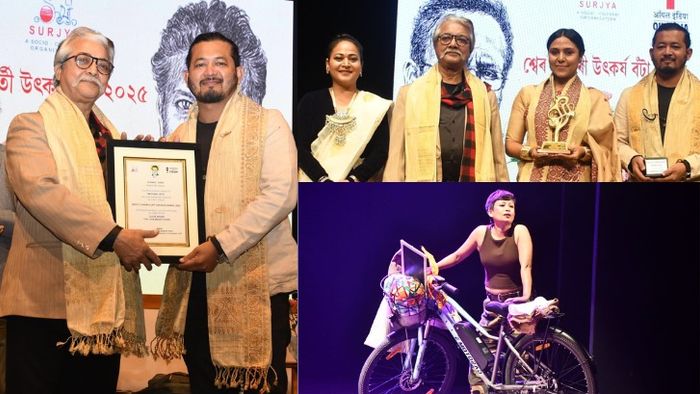
On the evening of December 24, 2025, under the winter stillness of Srimanta Sankaradeva Kalakshetra, Guwahati, Surjya shaped an evening that listened more than it announced, the Bidyut Chakraborty and Sher Choudhury Award 2025.
- Jan 10, 2026,
- Updated Jan 10, 2026, 5:33 PM IST
On the evening of December 24, 2025, under the winter stillness of Srimanta Sankaradeva Kalakshetra, Guwahati, Surjya shaped an evening that listened more than it announced, the Bidyut Chakraborty and Sher Choudhury Award 2025. It was an evening that consciously turned away from spectacle and chose instead the more demanding path of substance, much like the two legends it honoured.
For me, this was a return to neighbourhoods, to voices, to silences that shaped my understanding of theatre and cinema. The evening opened, appropriately, with poetry. Kopil Bora and Zerifa Wahid recited verses that did not announce an event but eased us into a shared emotional register. It was a quiet, intelligent beginning, true to Surjya’s long-standing aesthetic of restraint.
I was entrusted with introducing Bidyut Chakraborty and Sher Choudhury, two of my seniors, two creative forces I had known not through archives alone, but through proximity and lived experience.
Bidyut Chakraborty was from Uzanbazar, my own locality. For many of us growing up there, he was not just a filmmaker; he was a presence. On stage and on screen, he carried conviction without compromise. His film Raag-Birag, which won the Indira Gandhi Award for Best First Film of a Director in 1996, remains a landmark not because of its accolades alone, but because of its moral courage. Films like Anurag, where I acted, Gun Gun Gane Gane, and Dwar followed, each bearing his unmistakable stamp of rooted, socially engaged cinema.
Sher Choudhury belonged to Shillong, another geography that shaped me deeply. We were neighbours, he in Lumparing, we in Laban. By profession, Sher Choudhury worked at the Accountant General’s Office. By destiny, he belonged to music. An exceptional mandolin player, he never chased the spotlight; it found him.
My father, Dhiru Bhuyan, while making Pratham Ragini, shot entirely in Shillong, entrusted Sher Choudhury with the music. That instinctive decision marked the beginning of Choudhury’s journey as a film music director. His most celebrated recognition came with Gautam Bora, directed by Bidyut Chakraborty, for which Sher received the National Film Award for Best Music Direction. His work in Sanjib Hazarika’s Halodhar, and in films like Mimangsha, I Killed Him, Sir, and Raag-Birag, confirmed what we already knew, that his music understood cinema from within.
Sher Choudhury left us in 2012. Bidyut Chakraborty followed in 2019.
Both left early. The awards instituted in their names are not memorials in the static sense. They are continuations.
The Bidyut Chakraborty and Sher Choudhury Utkorxo Bota was conferred upon Shilpika Bordoloi, a filmmaker whose work resonates deeply with the values Bidyut Chakraborty stood for. Her film Mau: The Spirit Dreams of Cheraw, which won Best Debut Film in Mizo at the 71st National Film Awards, is marked by cultural sensitivity, quiet strength, and narrative integrity. It was later screened that evening, allowing the award to speak through cinema rather than citation.
The Sher Choudhury Award was presented to Sasanka Samir for his directorial debut Bhaimon Da, a film that reflects emotional honesty and compositional restraint—qualities Sher Choudhury himself embodied.
True to Surjya’s thoughtful curation, the evening did not conclude with the awards alone. It transitioned into theatre with The Girl Who Rode a Bicycle, written by Dr. Manebandra Sharma on the life of Chandraprabha Saikiani and directed by Nayan Prasad with visual intent and conceptual clarity. The choice to end the evening with theatre was apt, reinforcing the idea that courage, conviction, and creativity are shared inheritances that travel across forms.
The solo performance by Namrata Sharma was marked by an ambitious use of form and technology. The LED screen functioned as a narrative companion, while suspended chains and circular rings—employed with gymnastic precision—operated as potent symbols of constraint, resistance, and the constant negotiation of balance that defined Chandraprabha Saikiani’s life. Visually, the ideas were compelling and thoughtfully conceived.
Yet, while the design carried strength, the performance itself occasionally struggled to sustain emotional continuity. Moments of stillness and transition required greater poise, and the inner rhythm of the character demanded deeper intensity and control. The physical vocabulary, though striking, sometimes overtook the emotional arc, causing the flow to waver and the audience’s attention to momentarily drift.
What remained evident, however, was the sincerity of intent. With sharper modulation, firmer grounding, and a more concentrated inner force, the performance has the potential to match the conceptual ambition of its staging. In its current form, it stood as a thoughtful experiment—suggestive, visually resonant, yet awaiting fuller embodiment.
As I left Kalakshetra that night, I did not feel I had attended a ceremony. I felt I had participated in a conversation, between generations, between art forms, between memory and responsibility. That, perhaps, is Surjya’s quiet achievement, as always. Moreover, it reminded us that true legacy is not what we preserve, but what we pass on.