Bangladesh awakes to uneasy calm after violent night of assaults on Press
Bangladesh awoke to an uneasy calm on December 19 after a night of widespread violence that left newsrooms torched, journalists trapped for hours and several cities on edge, following the death of Inqilab Moncho convenor Sharif Osman bin Hadi.
- Dec 19, 2025,
- Updated Dec 19, 2025, 10:03 AM IST
Bangladesh awoke to an uneasy calm on December 19 after a night of widespread violence that left newsrooms torched, journalists trapped for hours and several cities on edge, following the death of Inqilab Moncho convenor Sharif Osman bin Hadi.
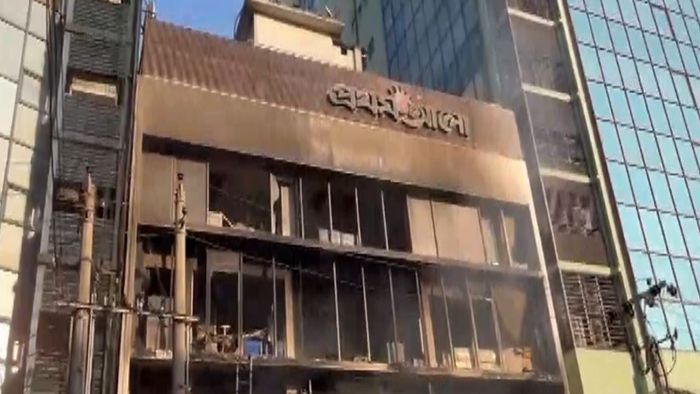
The most serious flashpoint was Karwan Bazar in Dhaka, where mobs targeted two of the country’s most prominent newspapers — English-language daily The Daily Star and Bangla daily Prothom Alo. The coordinated assault marked one of the gravest attacks on media institutions in recent years, deepening fears over press freedom and public safety.
According to journalists who were inside the building, staff at The Daily Star received an urgent phone call warning that a mob, after vandalising Prothom Alo, was heading towards their office. As employees attempted to evacuate, attackers reached the ground floor, smashing property before setting parts of the building on fire.
Thick smoke rapidly filled the premises. Attempts to escape through the staircases failed, forcing a group of journalists to flee to the rooftop on the 10th floor, where 28 people became trapped for hours. A canteen worker who tried to climb down an external fire-exit ladder was beaten by the mob at ground level, a scene that deterred others from attempting to escape.
Fire Service personnel later doused flames on the lower floors and climbed to the rooftop to rescue those stranded. With attackers still vandalising the building below, journalists refused to descend and shut the rooftop door. Firefighters sought to reassure them, saying Army personnel were present.
During the ordeal, senior journalist Zyma Islam posted on Facebook: “I can’t breathe. So much smoke. I’m inside. You are trying to kill me.”
Editors’ Council president and New Age editor Nurul Kabir, along with photographer Shahidul Alam, arrived at the scene to calm the attackers. Instead, Kabir was harassed, branded an “Awami League agent”, shoved and had his hair pulled, according to videos later circulated online.
After Army personnel opened a section of the staircase, attackers again surged upward, resuming vandalism and looting. Eventually, journalists trapped on the rooftop and inside the building were evacuated through a fire-exit staircase and taken out through the rear. The rescue operation ended around 3:45 am, with at least 25 The Daily Star journalists saved after more than four hours.
“We were lucky — we narrowly escaped a major disaster today,” one journalist said. “I don’t know where this country is headed.”
Both Prothom Alo and The Daily Star later announced they would not publish Friday editions. BBC Bangla reported that online operations were also almost paralysed after all staff were ordered to evacuate.
Violence spread well beyond Karwan Bazar. In Dhanmondi, the cultural institution Chhayanaut was attacked after 1 am, with protesters breaking in through a rear entrance, looting and later setting fire to the frontage before security forces restored order.
In Rajshahi, an Awami League office was demolished with a bulldozer. In Chattogram, protesters torched the residence of former city mayor ABM Mohiuddin Chowdhury in the Sholoshahar area. The house had been used by his son, former education minister Mohibul Hassan Chowdhury Nowfel.
Road blockades paralysed transport in several districts. In Jhalakathi, protesters blocked the Barisal–Khulna highway late at night, while in Barisal, students halted traffic at multiple points on the Dhaka–Barisal–Kuakata highway, stranding hundreds of vehicles. Slogans were raised against India and the Awami League.
Student protests were reported in Dhaka and other cities. Demonstrations took place at Shahbagh involving leaders of the Dhaka University Central Students’ Union and several student organisations. Jagannath University students blocked roads in Old Dhaka, joined by female students from Nawab Faizunnesa Chowdhurani Hall.
As tensions escalated, Inqilab Moncho issued a late-night appeal on Facebook urging restraint. Warning against violence, vandalism and arson, the group said such actions were meant to weaken Bangladesh. “As the February elections approach, consider who truly benefits if unrest is created in the country,” the statement said, calling for stability and cooperation with the authorities.