India, South Korea have complementarities 'from ships to chips': Jaishankar calls for deeper partnership
At the Jeju Forum, S Jaishankar urged India and South Korea to deepen strategic and economic cooperation. He said their complementarities, from ships to chips, can support resilience in a fragmented world.
- Jun 25, 2026,
- Updated Jun 25, 2026, 10:30 AM IST
External Affairs Minister S Jaishankar on June 25 urged India and South Korea to strengthen cooperation across strategic and economic sectors, saying the two countries have complementarities "from ships to chips" that can help build a more resilient global order amid growing geopolitical fragmentation.
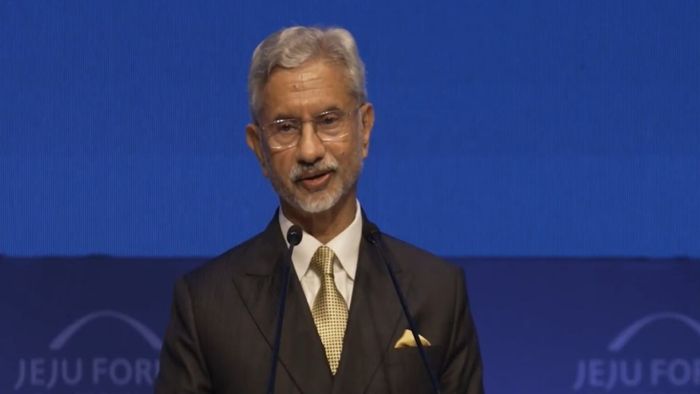
Delivering the keynote address at the Jeju Forum for Peace and Prosperity 2026 during his two-day visit to South Korea, Jaishankar said the international community must accept that fragmentation is now a reality while finding new ways to cooperate.
"This forum is discussing a fragmented world as a problem and reinventing cooperation as a solution. I agree with both the diagnosis and the treatment," he said, adding that fragmentation "is here to stay" and, in some respects, has created "less dominance, more space and greater democratisation".
Highlighting the changing nature of globalisation, Jaishankar said economic integration continues despite geopolitical tensions, with supply chains, technology and data becoming increasingly interconnected.
"The world is increasingly about supply chains, their efficiency and their resilience," he said, noting that artificial intelligence would further deepen cross-border integration as "the capture of data and the deployment of models is inherently transnational".
At the same time, he said challenges such as pandemics, terrorism and extreme climate events cannot be addressed by individual nations alone. "International cooperation is therefore a must," he said, invoking India's civilisational philosophy of Vasudhaiva Kutumbakam — "the world is a family".
The minister also warned against the growing "weaponisation of everything", saying commercial decisions are increasingly being shaped by strategic calculations, while restrictions on market access and competitiveness were limiting the industrial growth of developing nations.
"The right to industrialise... is being denied to many developing states by the manipulation of competitiveness and by restrictions of market access," he said, describing it as another form of exercising dominance.
Jaishankar further said the world is witnessing "higher risk-taking" and a political environment increasingly driven by the social media era, where "the interests of a few are openly prioritised" over the many.
To respond to these challenges, he proposed five priorities: de-risking the global economy through diversified supply chains, strengthening cooperation among influential nations, safeguarding international law and institutions such as UNCLOS, creating greater opportunities for the Global South, and advancing reformed multilateralism.
Linking those priorities to bilateral ties, Jaishankar said they made "a powerful case" for India and South Korea to work more closely together.
"We have complementarities... in many fields, from ships to chips, and also health, infrastructure or defence, which are just waiting to be exploited," he said.
Referring to his meetings in Seoul a day earlier, the minister said discussions had focused on expanding economic and technology partnerships, enhancing political and strategic cooperation, and strengthening people-to-people ties, underscoring the growing importance of India-South Korea relations in an increasingly fragmented world.