Myanmar holds first general election in five years amid civil war
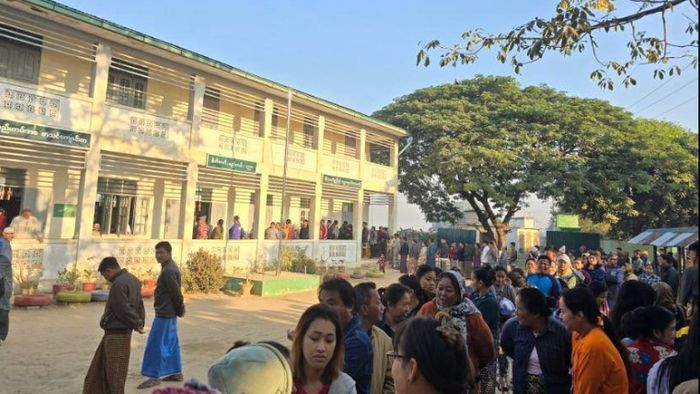
Voters in Myanmar went to the polls on December 28, for the first phase of the country’s first general election in five years, conducted under the supervision of the military government amid an ongoing civil war and widespread criticism over its legitimacy.
- Dec 28, 2025,
- Updated Dec 28, 2025, 12:11 PM IST
Voters in Myanmar went to the polls on December 28, for the first phase of the country’s first general election in five years, conducted under the supervision of the military government amid an ongoing civil war and widespread criticism over its legitimacy.
The election, the first since the military ousted the elected government of Aung San Suu Kyi in February 2021, is being held in three phases. The initial round took place in 102 of Myanmar’s 330 townships on December 28, with subsequent phases scheduled for January 11 and January 25. Final results are expected to be announced later in January.
Polling was held at high schools, government offices and religious buildings in Yangon, the commercial capital, Naypyitaw, and other areas. Security was visibly tightened, particularly in Yangon, with armed guards stationed outside polling stations and military vehicles patrolling key roads. Electronic voting machines were deployed for the first time.
Critics have dismissed the exercise as an attempt to lend a veneer of legitimacy to continued military rule. They argue the polls lack credibility due to the exclusion of major political parties, severe restrictions on freedom of expression and an atmosphere of repression. The military-backed Union Solidarity and Development Party is widely expected to emerge victorious, raising doubts over any genuine transition to civilian governance.
Aung San Suu Kyi, now 80, is not participating in the election as she is serving a 27-year prison sentence on charges widely regarded as politically motivated. Her party, the National League for Democracy (NLD), which won a landslide victory in the 2020 elections, was dissolved in 2023 after refusing to register under new military rules. Several other parties also declined to participate, while opposition groups have called for a boycott.
According to election analysts, the absence of meaningful political choice has undermined the process. Amael Vier of the Asian Network for Free Elections noted that 73 per cent of voters in 2020 supported parties that no longer exist.
Opposition organisations and armed resistance groups had threatened to disrupt the polls, but no major incidents were reported during the first phase.
Myanmar has remained engulfed in conflict since the military violently suppressed mass protests against its takeover in 2021. The ensuing civil war has displaced more than 3.6 million people, according to the United Nations. Rights groups report that over 22,000 individuals are currently detained for political reasons, while more than 7,600 civilians have been killed by security forces.
A recently enacted Election Protection Law has imposed stringent penalties and restrictions, effectively barring public criticism of the electoral process. UN High Commissioner for Human Rights Volker Türk has warned that Myanmar is witnessing escalating violence and intimidation, stating that conditions for free expression and peaceful assembly do not exist.
Despite the polls, both supporters and opponents of the junta believe power is likely to remain firmly with Senior General Min Aung Hlaing, who led the 2021 coup.
More than 4,800 candidates from 57 political parties are contesting seats in national and regional legislatures, though only six parties are competing nationwide with any realistic prospect of parliamentary influence.