A Community That Chose Nature Over Everything
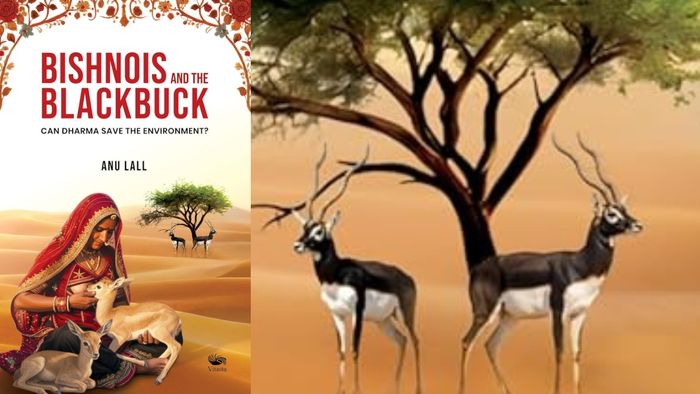
"In my study of the Bishnoi community, a poignant moment that stopped me in my tracks was witnessing a woman breast-feeding a baby deer alongside their own child. It was not a performance, not dramatic, simply an act of care that dissolved the boundary between human and animal, between ‘us and them’."
- Mar 26, 2026,
- Updated Mar 26, 2026, 9:34 PM IST
"In my study of the Bishnoi community, a poignant moment that stopped me in my tracks was witnessing a woman breast-feeding a baby deer alongside their own child. It was not a performance, not dramatic, simply an act of care that dissolved the boundary between human and animal, between ‘us and them’."
There are books that inform, and then there are books that alter the way you see the world. Anu Lall's 'Bishnois and the Blackbuck: Can Dharma Save the Environment?' belongs firmly to the latter. It is not merely another addition to the shelf of environmental narratives or wildlife chronicles; it is a deeply researched, thoughtfully layered work that unfolds the story of a community whose relationship with nature transcends the ordinary.
Right from the outset, the book establishes its compelling tone. An extract in the beginning sets the stage with striking clarity: "For most Indians, the word ‘Bishnoi’ evokes two stark images—the blackbuck poaching case involving superstar Salman Khan and, more recently, the Lawrence Bishnoi stand-off with him". It is a line that instantly grounds the reader in familiarity, only to gently dismantle these limited associations as the narrative progresses.
For many, the very mention of the Bishnoi community evokes a sense of unease – a perception shaped by fragments of media narratives and misunderstood convictions. Their fierce devotion to their beliefs is often misread, sometimes even reduced to assumptions of aggression or illegality. But is any of it truly reflective of who they are? This book does not argue; it reveals further reshaping your understanding.
As the author herself suggests, the journey into this world begins by listening – by absorbing those "anecdotes" which have "felt like distant folklore from another land, far away..."
The Bishnoi community has long fascinated scholars, researchers, and observers alike. And rightly so...because how often does one come across "tales of Bishnoi women nursing orphaned deer fawns"? There is something almost otherworldly about such imagery, and yet, within these pages, it is presented with a simplicity that makes it feel profoundly real.
Anu Lall does more than document; she immerses. As a writer and researcher, she fulfils her role with precision, but as a storyteller, she allows her own fascination with the community to seep through.
She dives deep into the origins of the community with an inquisitive lens, tracing questions of identity and beginnings – whether rooted in royal mandates, political structures, capitalist interventions, or indigenous wisdom. These explorations lend the narrative both depth and dimension.
Also Read: Revisiting nationalism through India’s historical past, politics and an Assam prediction
Beyond their unwavering commitment to wildlife and environmental preservation, the Bishnois emerge as living embodiments of ‘dharma’ and ‘sanatan’ in their purest sense. Their philosophy is not preached; it is practiced. As the book beautifully encapsulates: "...which regards humans as guardians of nature, not owners, of nature." It is a line that lingers.
Importantly, Lall’s work never slips into romanticism without grounding. It is not mere sentiment – it is substantiated with facts, references, and cultural intersections. The mention of the film 'Kantara', for instance, acts as a bridge, allowing contemporary audiences to find points of connection within a narrative that might otherwise feel distant.
What truly sets 'Bishnois and the Blackbuck' apart is its quiet magic. There is an almost cinematic quality to the storytelling – one that nudges the reader to imagine, to reconstruct, to step into a time and space that feels both bygone and ever-present.
In my opinion, the second chapter, 'Blackbuck Poaching: Breaking a Sacred Bond', strikes with particular force. It is here that the narrative sharpens, confronting the reader with revelations that are both startling and thought-provoking. With references to high-profile cases such as Salman Khan’s and the rise of Lawrence Bishnoi, the book manages to remain gripping without ever losing its intellectual anchor. It is rare to encounter a work that is as informative as it is unputdownable.
An entire chapter dedicated to understanding the relentless spirit of the community further enriches the reading experience. It unpacks questions that many have long held but rarely explored. Through these pages, one begins to understand how deer are not merely animals within this ecosystem, but beings nurtured with the same tenderness as one would reserve for their own children. It is here that the narrative reaches an emotional crescendo – where acts of conservation are no longer abstract ideals, but deeply personal choices, often made at the cost of one’s own life.
Another striking feature of the book lies in its visual storytelling. The images preceding each chapter are not mere embellishments; they are evocative preludes. Each photograph feels like a story waiting to unfold – quiet, powerful, and deeply resonant. They do not just complement the text; they elevate it.
For me, this extract — "Environmental victories are never easy, and they rarely happen overnight. For years, activists and communities have fought relentless battles against the forces of unchecked development striving to protect India’s fragile ecosystems" – forms the very backbone of the book. It encapsulates not just the struggle of the Bishnois, but the larger, ongoing battle between preservation and progress.
And perhaps that is where this book finds its most enduring relevance. It is not just about a community; it is about a way of being. It gently asks – without ever imposing – what it truly means to coexist with nature.