Book Review: Can One National Narrative Explain India’s 2024 Election?
An edited volume offers a fresh lens on the 2024 Lok Sabha verdict, arguing that India’s electoral politics can be understood only by looking at the complex interplay between state and national politics.
- Aug 15, 2026,
- Updated Aug 15, 2026, 8:45 PM IST
After every parliamentary election, experts, scholars, and academicians write columns and journal articles and publish books to understand and analyze the election outcomes.
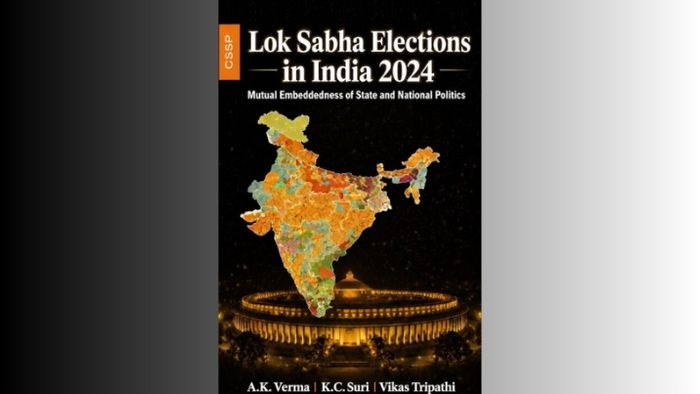
The book under review, 'Lok Sabha Elections in India 2024: Mutual Embeddedness of State and National Politics', edited by A. K. Verma, K. C. Suri, and Vikas Tripathi, is no different in this regard. However, what sets this work apart is its attempt to make a methodological intervention in how we view and understand elections in India. Other than this, the comprehensive coverage of 25 political units (including states and union territories) spread across 28 chapters, including chapters on northeastern states, which are often overlooked in such studies (Assam being an exception), is also a strong point of the book, as most earlier works tend to focus on 12-13 major states to make sense of electoral politics in India. There are also books like ‘State Politics in India’ edited by Himanshu Roy, M. P. Singh, and A. P. S. Chouhan, which cover 29 states and union territories, but it is not related to election studies; hence, the comprehensive coverage of the book under review still stands out in its field.
The 2024 general elections were remarkable for various reasons. The BJP returned to power with Prime Minister Narendra Modi assuming office for a record third consecutive term, becoming only the second Indian to do so. However, unlike the previous two general elections, the BJP failed to secure a clear parliamentary majority in the Lok Sabha and had to depend on alliance partners to form a government. In the age of coalition politics, this is not an aberration. However, the surprise was that the party, which was confident of winning a majority on its own and claimed to outperform its previous records with the slogan ‘Abki Baar 400 Paar' (This time, crossing 400) was reduced to 240 seats from 303 seats in the last general elections. This was made possible by the party's uneven performance across different states. On the one hand, there were states where the BJP performed exceedingly well, including Madhya Pradesh, Uttarakhand, Himachal Pradesh, Delhi, and Tripura, where it won all seats. However, in states like Uttar Pradesh, Maharashtra, West Bengal, Karnataka, Rajasthan, and Haryana, it faced a major setback and lost substantial ground compared with the 2019 general election results.
The essays in this volume interpret the general elections of 2024 through the prism of the states. Methodologically, this opens a challenge. Historically, there have been two distinct vantage points to study general elections in India. The first view treats states merely as an extension and reflection of the national mood. It hence focuses entirely on how the national narrative is constructed, managed, or percolated through the states. The second vantage point holds that each state and union territory, as political units, is discrete and reflects a distinct political culture; hence, they need to be studied independently to make sense of politics in India. This approach holds that the hegemony of the national narrative has limits, and state elections often play out independently of its influence, largely guided by local issues and concerns. This book, however, takes a ‘middle vantage point’ and advocates what the editors have called the ‘mutual embeddedness approach’. This approach is different and probably more effective because it treats state and national politics as part of an integrated process, in which state and national issues interact and interplay to produce electoral outcomes. So, neither is electoral politics at the level of states autonomous of national politics, nor does the national narrative overdetermine it. Based on this approach, the authors in the volume try to analyse electoral outcomes of the 2024 elections.
Further, the book also offers a significant framework for understanding electoral politics at the state level and, through it, making sense of national politics. Based on the analysis of trends reflected in 2024 general elections, it underscores four important features that determined the outcomes: a) Dominance of the national parties: In the current context the electorates in the states were primarily focussing whether the mandate should be pro- or against the BJP; b) Role of regional parties: This includes especially parties like the Samajwadi Party that outwit the BJP in candidate selections, or like TMC and DMK that further consolidated their power on grounds of anti-BJP agenda; c) The significance of Caste and Identity based issues: For example, mobilization in states like UP and Maharashtra where BJP’s slogan of ‘400 Par’ was projected by the opposition parties as a strategic ambition to remove reservations, or in regions like Kashmir and Tamil Nadu, where ‘Kashmiriyat’ and ‘Dravidian identity’ were respectively invoked to counter BJP’s nationalist narrative; and d) The impact of Welfare populism and development: Wherein the unconditional cash transfers and other welfare policies initiated either by the Union or the State governments helped electoral mobilizations in favour of the party in power in respective states. All these features together contributed to determining the fate of political parties in each state and thereby impacting their prospects in the national arena. The way in which the authors of each chapter have analysed these features to map the 2024 elections is truly remarkable. Equally fascinating is the writing style and the language used by all authors in the book. Although the endeavour and methodology are deeply academic, the chapters are easy to understand. They will be appreciated not only by students of political science or election studies but also by laypeople interested in understanding the outcomes of the 2024 general elections.
However, the book is not free of lacunae or limitations. The greatest strength of the book also becomes its greatest limitation. The methodological intervention that the editors promise in the preface and the first chapter raises high expectations, which are ably supported by the chapters they either authored or co-authored. However, it loses steam and consistency in chapters authored by other scholars. Some authors continue to subscribe to the traditional frameworks for analyzing elections, which the editors themselves aim to disrupt. There are exceptions, like the chapter on Jammu and Kashmir by Arunima Deka, on Telangana by Rupak Kumar, or on Tamil Nadu by Vignesh Karthik KR, which ably take the ambitious objective of the editors seriously. Secondly, there is also this issue about data. The volume has two kinds of chapters. Some chapters are exclusively dependent on data from sources such as Lokniti-CSDS’s National Election Survey. Although there is nothing wrong with doing so, a stark difference can be felt in chapters where authors have substantiated similar data with their own field experiences, as in the case of chapters on Delhi, Uttar Pradesh, or Assam, among others. It goes without saying that even in today’s digital age, nothing serves election studies better than first-hand field experience, which often unlocks epistemological boundaries created by large datasets.
Thirdly, there is the issue of the inclusion and exclusion of states and union territories under study. Although it is the prerogative of the editors to decide which states to include in the analysis, when the claim is for a comprehensive study, questions ought to arise about the criteria used for selection and omission. For example, the editors have justified the inclusion of chapters on Jammu and Kashmir and Delhi, which are both Union Territories, arguing that they ‘possess elected legislative assemblies and therefore exhibit political dynamics comparable to those of full-fledged states’. However, if that is the reason for inclusion, they should have explained the exclusion of Puducherry, which is also a Union Territory with an elected legislative assembly. Similarly, although Jilly Sarkar and Vikas Tripathi have done excellent work in their chapter on the North-eastern states, which comprehensively covers most states in the region, one is left confused, and the editors did not bother to explain why they thought that Nagaland, with one parliamentary seat, deserved a separate chapter, and not states like Arunachal Pradesh, Tripura, Meghalaya, or Manipur, which each have two parliamentary seats.
Fourthly, this is not a limitation of the book itself, but rather the wide expectations of a curious reader. The fact that many of the states discussed in the books also held assembly elections after the parliamentary elections of 2024, and that, if we try to analyse the outcomes of these elections through the prism of the chapters in this volume, we might fail to find explanations. For example, in the case of Haryana, the tides completely turned during the Assembly elections, and the chapter in this volume does not hint or explain any such possibilities. There are also exceptions, for example, in the chapter on Tamil Nadu, where the author Vignesh Karthik KR, although not explicitly, has successfully provided hints of what to expect. As it turned out, one could find a possible explanation for the results of the assembly elections in his chapter. However, as I already mentioned, that was not the purpose of the volume. It focused on what had happened rather than on what could happen in the future, and the authors did an excellent job of what they were aiming to do. Lastly, as an academic, it often appears curious when the book is published by an institution where the editors themselves are closely associated or have great influence over. Although one can understand that external publishers could take a long period to publish, which may at times affect the relevance of the study, and also that drafts of the current volume were also reviewed by eight internationally recognized professors from different reputed institutions across the world, the question regarding objectivity and fair review remains under the scanner.
Regardless of all these limitations and boundaries, the volume is exceptional and will interest all who wish to understand and make sense of Indian politics. The methodological intervention undertaken by the editors is likely to be referred to and discussed by scholars and academics in the coming years. It has the potential to carve out a distinct identity within political science in general and election studies in particular