This Book Captures Cinema in Reflection and Reality
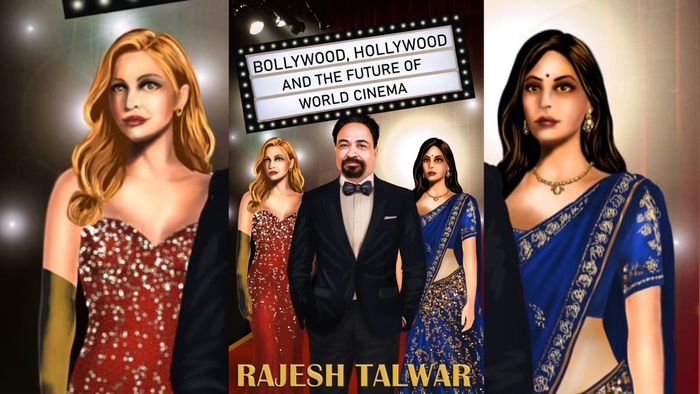
‘Bollywood, Hollywood and the Future of World Cinema’ by Rajesh Talwar is far more than a mere entertainment package – it is not only a compelling read for movie junkies but equally a thoughtful offering for critics.
- Apr 11, 2026,
- Updated Apr 11, 2026, 8:18 AM IST
‘Bollywood, Hollywood and the Future of World Cinema’ by Rajesh Talwar is far more than a mere entertainment package – it is not only a compelling read for movie junkies but equally a thoughtful offering for critics.
Divided into four concise parts, even a glance at the index is enough to establish that this is not a superficial exploration, but a carefully structured narrative.
The extract – "For most of us growing up in India, cinema has been a formative influence, one way or the other" – resonates deeply, because, after all, hasn’t nearly every Indian been captivated by the magic of cinema at some point?
Given that the book revolves around entertainment, it is only fitting that each chapter carries a rhythm of its own. There is a certain ease with which Talwar draws the reader's attention, making the experience both insightful and enjoyable.
The book opens with a mention of Amitabh Bachchan – a choice that feels somewhat justified, maybe not entirely. In many ways, he has come to define Indian cinema. However, Talwar does not merely indulge in praise or dwell on the glamour of actors, their lifestyles, or their films. Instead, he brings to light details that most tend to overlook.
What stands out is how Rajesh Talwar seems to speak on behalf of the audience – particularly when addressing films that failed to meet expectations despite featuring celebrated names. As he writes – "...On the heels of the above listed films, Ranveer Singh’s Jayeshbhai Jordaar, Ranbir Kapoor’s Shamshera, and even Tiger Shroff ’s Heropanti 2 all fell by the wayside. Flop after flop after flop." It takes a certain candour to acknowledge such missteps in an industry that India takes immense pride in.
There is no attempt here to please or sugar-coat reality. The author presents facts with conviction. One understands that while actors, producers, and directors invest immense effort into their work, audiences too invest their anticipation and expectations. When those expectations remain unmet, the disappointment is real and valid. So when Talwar observes – "Star power seemed not to matter anymore" – it hits home.
On another note, the book – with its conversational tone – makes for an accessible read while never compromising on substance. It is evident that the author has done his homework; he knows when to appreciate and when to criticise, without pretense.
One chapter that especially caught my attention is ‘The Nepo kids of Bollywood and Beyond’. Rather than approaching the subject in an obvious or predictable manner, Talwar introduces an intriguing dimension by connecting it to Sushant Singh Rajput’s death. The result is a chapter that feels layered, thought-provoking, and likely to hold the reader’s attention.
The book also touches upon iconic dialogues – “dreamgirls” – and references towering figures such as Raj Kapoor, Charlie Chaplin, and Satyajit Ray, while even extending its gaze to the Malayalam film industry.
One of the most compelling aspects, however, is Talwar’s willingness to acknowledge evolving trends. His reflections on the growing appreciation for documentaries are particularly striking. As he notes: "In recent years, Indian documentaries have been making waves internationally. With practically no support from the government, they are still going great guns." If that isn’t the truth, it is hard to say what is. In this sense, the book becomes a plea to the untapped potential of the film industry.
Unlike the usual accounts that linger on the pomp and spectacle of cinema, this work offers an understated reflection on what works and what doesn’t. The author’s intent to improve, to question, and to acknowledge without hesitation; but also to praise and appreciate where it is genuinely deserved.