Chapter One: Tronglaobi bomb attack kills two kids; mother survives, but nothing remains
This is not just a report from Manipur—it’s a ground-level journey into a conflict where a single night’s tragedy reveals the deeper fractures shaping everyday life. At its core, the story unravels how loss, uncertainty, and silence intertwine, exposing the human cost behind a crisis that continues to unfold beyond the headlines.
- Apr 26, 2026,
- Updated Apr 26, 2026, 3:53 PM IST
There are incidents that pass as headlines, and then there are those that stay—lingering long after the cameras are switched off, refusing to be reduced to a script. April 7 in Tronglaobi was one such night. At approximately 01:10 am, when the village was wrapped in the deceptive calm that conflict zones often learn to live with, a suspected projectile cut through the darkness and struck a civilian residence. It travelled from an unknown, an unknown location; but the distance it covered cannot measure the damage it left behind. By the time the echoes faded, two children—a five-year-old boy and a five-month-old girl—had lost their lives. Their mother, Oinam Binita, was left critically injured, and a home that once held routine, laughter, and familiarity was reduced to a space marked by absence.
Yet, the story did not emerge in real time. In a state already grappling with deep divisions and prolonged unrest, internet disruptions across the valley slowed the flow of information to a trickle. What came out in the hours and days that followed were fragments—conflicting accounts, unverified claims, and emotionally charged narratives that blurred more than they clarified. The distance between what had happened and what was being understood grew wider with every passing hour. By April 12, it became evident that the only way to make sense of the situation was to step into it, to leave behind the mediated comfort of studio discussions and enter the uneasy terrain where the story had actually unfolded.
A journey through a fractured valley
Clearance came late on April 12, and by early morning on April 13, I was on a flight to Imphal with my colleague Abhijit Lashkar. Assignments like these carry a certain silence with them, and we both could feel it .You know, even before you land, that what you are about to witness will not remain confined to the duration of the report. It will follow you back. Waiting for us in Imphal was Keny Phurailatpam, our Manipur correspondent, who had already been to Tronglaobi in the immediate aftermath of the attack. With her was Rahman da, our driver and guide and also ‘saviour’ a Pangal with access to both Meitei and Kuki areas. In a region where identity often dictates movement and, at times, survival, his presence was not just logistical support; it was a quiet assurance that we might be able to navigate spaces that would otherwise remain closed, or worse, hostile.
We left for Tronglaobi around early afternoon from Imphal, but the journey quickly revealed that this was not a routine field visit. The roads told their own story. Burnt tyres marked protest points, makeshift barricades interrupted the flow of movement, and groups of locals stood guard at various stretches, questioning every vehicle that passed through. At each checkpoint, we were stopped, asked to identify ourselves, and made to explain our purpose. The absence of internet connectivity had done more than disrupt communication; it had deepened suspicion. Without access to real-time information, every unfamiliar face became a potential threat. Digital payments had collapsed entirely; UPI was unusable, and ATMs had run out of cash. In a time defined by connectivity, the valley had been pushed into a state that felt years behind, where transactions, trust, and information all relied on physical presence and personal validation.
Reaching ground zero
By the time we reached Tronglaobi, the atmosphere had shifted from tension to a heavy stillness. It was not peace, but a pause and numbness, the kind that follows violence, where the immediate chaos has subsided, but its imprint remains everywhere. As we approached the residence of Oinam Binita, a thought surfaced that was difficult to ignore. Much of what we report is constructed from a distance, framed within the controlled environment of a newsroom. But standing in front of that house, visibly damaged yet still standing, the abstraction dissolved. This was no longer a story in development; it was a reality that had already taken its toll.
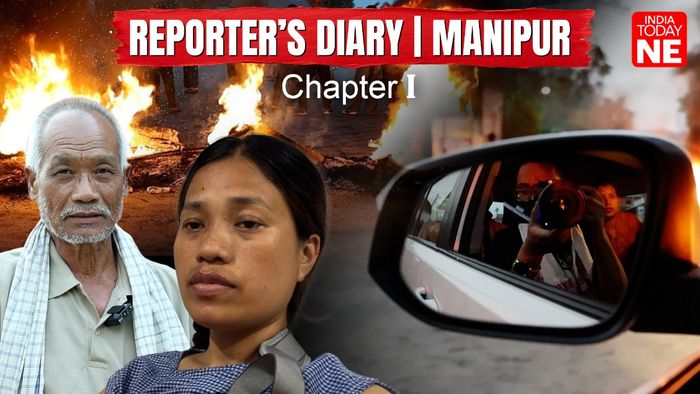
Inside, we met Oinam Babuton, the grandfather of the two children who had been killed. A retired government employee, he appeared composed in a way that was almost unsettling. He was engaged in a small household task when we saw him, as if routine had become a necessary anchor in the aftermath of loss. Yet, his eyes carried a depth of grief that words could barely contain. When he spoke, it was without drama, just stating facts like an emotionless machine. “When I first heard the explosion, I never thought it was my house,” he said. It is a sentiment that resonates beyond the specifics of this incident. There is a natural human tendency to believe that catastrophe belongs elsewhere—that it will not arrive at one’s own doorstep. In that moment, his statement reflected shock and also the collapse of that belief.
The room that holds the memory
We were then led to the room where the projectile had struck. Keny, who had visited the site on the morning of April 7, began to describe what she had witnessed then…scattered toys, blood stains, and a scene that bore the raw immediacy of violence. What we saw now had been partially cleared, but the weight of what had occurred lingered in the air. The family pointed to a specific spot, indicating where the five-month-old girl had died in her mother’s arms. It is in such moments that the distance between observer and participant narrows uncomfortably. As journalists, we are expected to document, to remain composed, to continue asking questions. But there are instances when the act of recording feels intrusive, almost inadequate in the face of such personal loss. Abhijit da and I exchanged a brief glance, an unspoken acknowledgement of the emotional weight we were struggling to contain.
Further conversations with locals revealed that the fatal strike was not an isolated incident. Another projectile had landed approximately 100 metres away on the same night. It had not exploded and was later neutralised by a bomb disposal squad through a controlled explosion. This detail complicated the narrative significantly. It suggested randomness and also the intent; not a single act, but a sequence. The implications of this were not lost on the residents, nor on us.
What intensified the situation further was the proximity of a CRPF camp, located less than a kilometre from the site of the attack. For the residents, this raised immediate and pressing questions about security and response. On the morning following the incident, an agitated crowd gathered and moved towards the camp, seeking answers. What began as an expression of anger soon escalated. According to accounts, parts of the camp were set on fire, and there were allegations of attempts to loot the armoury. In response, the CRPF opened fire, resulting in the deaths of three Meitei civilians. This sequence of events transformed an already tragic incident into a larger flashpoint, amplifying anger and deepening mistrust between civilians and security forces. We saw the extent of the violence physically, shattered guard posts, burned documents, destroyed rooms, and more.
In the days that followed, Imphal witnessed widespread protests. Civil society groups, including the Meira Paibi, mobilised and called for accountability. The city experienced shutdowns, and the demand for justice became the dominant narrative. Yet, amidst the protests and political reactions, the core tragedy—the loss of two young lives—risked being overshadowed by the scale of the unrest that followed.
Meeting the mother
Before concluding our visit to Tronglaobi and heading to the hotel for that day, we decided to go to the hospital where Oinam Binita was undergoing treatment. It was, perhaps, the most difficult part of the assignment. There is no training that adequately prepares you to face a parent who has lost both her children in a single incident. When we entered the room, she did not appear outwardly different from any other patient recovering from injuries. It was only when the conversation began that the weight of her experience became evident. After a brief introduction facilitated by Keny, she spoke in a calm, almost measured tone: “Jo hua mere saath, woh kisi ke saath nahi hona chahiye” (“What happened to me should not happen to anyone.”). There was no visible anger in her words, no direct attribution of blame, only a quiet expression of hope that such a tragedy would not be repeated. At that moment, the larger identities that dominate the conflict—Meitei, Kuki—seemed irrelevant. What remained was a mother articulating a loss that transcended all divisions.
As of now, that is, till today, the bodies of the two children remain in a government morgue. The family has chosen not to perform the last rites until they receive justice. It is both a form of protest and an assertion of dignity, a refusal to allow the incident to fade without accountability. As Manipur approaches the third year of ongoing conflict, such acts reflect a broader sense of exhaustion and unresolved grief that cuts across communities.
The road back
The journey back to the hotel was quieter than the one that brought us to Imphal. The roadblocks remained, the checkpoints were still in place, but our perception of them had shifted. We were no longer moving towards a story; we were carrying one with us. Some assignments end when the report is filed. Others continue, lingering in memory, shaping the way you understand conflict, loss, and the fragile line between them.
There is, however, another dimension to this journey…one that involves navigating identities, crossing invisible boundaries, and recognising how precarious our own position had been at certain moments. Rahman da’s ability to move between both sides of the conflict played a role far greater than we initially understood. That story, still unfolding in our minds, will be told in the next chapter.
For now, this is where my pen pauses—not because the story has concluded, but it is an initiation of another.
(With Keny Phurailatpam & Abhijit Lashkar | Filed from Guwahati)