CSOs rejects Kiren Rijiju views on Manipur crisis as communal conflict, questions centre’s handling
A coalition representing 14 civil society organisations (CSOs) in Kangleipak has criticised Union Parliamentary Affairs and Minority Affairs Minister Kiren Rijiju’s recent remarks on the Manipur crisis, arguing that the prolonged violence should not be viewed solely as a communal conflict and questioning the Centre’s approach towards armed groups operating in the state.
- Oct 03, 2026,
- Updated Oct 03, 2026, 11:06 AM IST
A coalition representing 14 civil society organisations (CSOs) in Kangleipak has criticised Union Parliamentary Affairs and Minority Affairs Minister Kiren Rijiju’s recent remarks on the Manipur crisis, arguing that the prolonged violence should not be viewed solely as a communal conflict and questioning the Centre’s approach towards armed groups operating in the state.
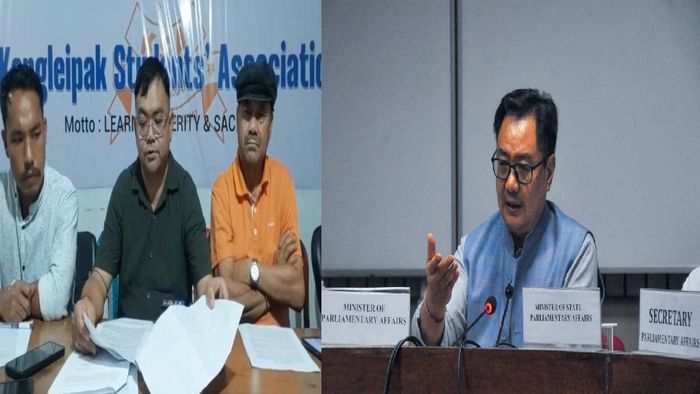
Addressing a press conference, convenor of the 14 CSOs Kangleipak, Shanta Nahakpam, alleged that the violence in Manipur was linked to an armed conflict involving militant groups and accused the Centre of failing to adequately address the security dimensions of the crisis.
Rijiju, speaking at a conclave in New Delhi on September 27, said lasting peace in Manipur would require dialogue among the Meitei, Kuki and Naga communities. He also said the Centre could not use military force to bring an end to the conflict and stressed the need for communities to engage in talks.
Nahakpam said Rijiju’s description of the crisis and his emphasis on dialogue reflected, in the CSOs’ view, an inadequate understanding of the security situation. He alleged that the violence involved armed militant groups and attacks on civilians and villages.
Drawing a comparison with violence in parts of Arunachal Pradesh along the India-Myanmar border, Nahakpam referred to incidents in Changlang and Tirap involving armed groups and questioned whether such attacks would also be categorised as communal conflicts.
The CSO representative also questioned the continuation of the Suspension of Operations (SoO) arrangement with Kuki militant groups despite earlier resolutions and decisions in Manipur.
The Manipur Legislative Assembly had unanimously passed a resolution on February 29, 2024, seeking abrogation of the SoO agreement with Kuki-Zo armed groups. The resolution is recorded on the Assembly’s official website.
The SoO arrangement was subsequently extended in September 2025 between the Centre, the Manipur government, the Kuki National Organisation (KNO) and the United People's Front (UPF), with revised ground rules requiring the groups to abide by the Constitution, Indian laws and the territorial integrity of Manipur.
Nahakpam questioned the rationale behind continuing the arrangement and referred to allegations that groups covered by the pact had been involved in incidents of violence.
He cited the abduction and killing of six Naga civilians in May 2026, in which Manipur Deputy Chief Minister Losii Dikho had alleged that a group operating under the SoO framework was involved. The state government subsequently said the case had been handed over to the National Investigation Agency (NIA) for investigation.
Nahakpam also referred to the recent attack in Kamjong district, where four Tangkhul Naga civilians were killed near the India-Myanmar border. Naga organisations attributed the attack to the Myanmar-based Kuki National Army-Burma (KNA-B), although such attribution has been reported as an allegation and has not been independently verified.
The CSO representative questioned the Centre’s response to such incidents and sought greater clarity on its approach towards armed groups and violence along Manipur’s international border.
His remarks come amid renewed violence in parts of Manipur and demands from Naga organisations for action against armed groups and a review of the SoO arrangement. Eight of Manipur’s nine Naga MLAs had also recently written to Union Home Minister Amit Shah seeking action over attacks on Naga civilians and termination of the SoO agreement with Kuki militant groups.