Manipur University launches MARC to preserve Northeast’s audiovisual heritage
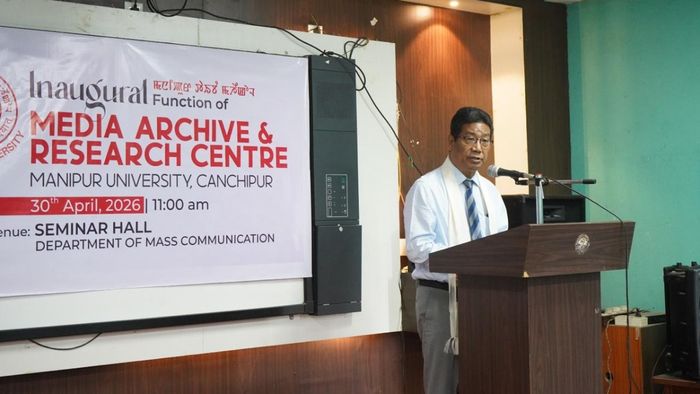
In a landmark initiative to safeguard the cultural memory of the region, Manipur University on April 30 inaugurated the Media Archive and Research Centre (MARC), a dedicated facility established to preserve, document and promote the rich audiovisual heritage of Manipur and the wider Northeast India.
- Apr 30, 2026,
- Updated Apr 30, 2026, 5:28 PM IST
In a landmark initiative to safeguard the cultural memory of the region, Manipur University on April 30 inaugurated the Media Archive and Research Centre (MARC), a dedicated facility established to preserve, document and promote the rich audiovisual heritage of Manipur and the wider Northeast India.
The centre was formally launched at the Seminar Hall of the Department of Mass Communication and Journalism, marking a significant step toward systematic archival preservation and academic research focused on the region’s media history and cultural narratives.
MARC has been conceived as a dynamic platform for cultural expression as well as a repository of historically and socially significant materials, ranging from traditional practices and oral histories to contemporary audiovisual productions.
Vice Chancellor of Manipur University, Prof. N. Lokendra Singh, attended the inauguration as Chief Guest. Dean of Social Sciences Dr. Memcha Loitongbam was present as Guest of Honour, while Secretary of MSFDS Sunzu Bachaspati Mayum joined as Special Guest. The event was presided over by Dr. Nongmaithem Rohinkanta Singh, Head of the Department of Mass Communication and Journalism.
According to the university, the new centre is structured around four foundational pillars — Identity, Form, Research and Inclusion.
Through these guiding principles, MARC aims to preserve the linguistic, social and cultural identities of communities across the Northeast while also highlighting the technical and artistic evolution of regional media practices.
The centre will actively collect, conserve and catalogue audiovisual works, documents and related materials that reflect the diverse lived experiences of people from the region.
Officials said MARC will function not merely as a storage facility but as an important academic resource supporting interdisciplinary research in subjects such as history, sociology, anthropology, media studies and cultural studies.
A major focus of the centre will be to address longstanding gaps in historical representation by amplifying the voices of indigenous communities and underrepresented groups whose stories have often remained outside mainstream archives.
One of the key figures behind the initiative is Dr. Johnson Rajkumar, Guest Faculty in the Department of Mass Communication and Journalism, who has been appointed expert and certified archivist of MARC.
With specialized expertise in film preservation and archival methodologies, Dr. Rajkumar is expected to play a crucial role in shaping the centre’s acquisition strategies, conservation standards and long-term research direction.
The launch of MARC is being viewed as a pioneering move in the Northeast, where large portions of audiovisual history remain vulnerable to deterioration, neglect or loss. Academics and cultural observers believe the centre can emerge as a critical institution for preserving the region’s creative legacy for future generations.