New critically endangered shrub species Dillenia nagalim discovered in Manipur's Kamjong
Scientists have formally described a new species of Dillenia from a single site in Manipur’s remote Choro village, Kamjong district, on the Indo-Myanmar border.
- Apr 16, 2026,
- Updated Apr 16, 2026, 8:03 AM IST
Scientists have formally described a new species of Dillenia from a single site in Manipur’s remote Choro village, Kamjong district, on the Indo-Myanmar border.
Local Tangkhul Naga residents use its tender leaves as a vegetable and eat the fruits, which have a sweet, pungent golden-berry aroma.
The paper was accepted on 1 April 2026 and published on 15 April 2026 by Magnolia Press.
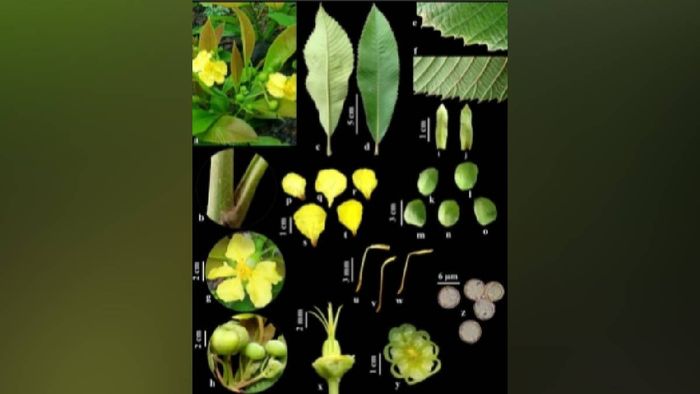
Named Dillenia nagalim, the 0.6–1.2-metre shrub is distinguished by its short habit, amplexicaul petioles, doubly serrate leaves with acuminate tips, large 6–8 cm yellow flowers, about 270 stamens and 7–8 carpels.
Molecular analysis of the rbcL gene confirms it as distinct yet closely related to D. pentagyna and D. hookeri. It is known only from the type specimen and has been assessed as Critically Endangered (CR B2ab(i,ii,iii,iv,v)) under IUCN criteria.
The discovery was made during botanical surveys between May 2024 and May 2025 by a team from Dhanamanjuri University, Manipur. The plant grows in open tropical deciduous forest at 250–350 m elevation alongside species such as Dipterocarpus tuberculatus and Tectona grandis.
Lead author Sochanngam Kashung and corresponding author Kazhuhr ii Eshuo, together with colleagues Urikhimbam Leishilembi, Kholi Kaini, Rachel Sochui Maheo, Tilling Rupa, Gladys o Kashung, Kerene Gangmei and Kreni Lokho, published the detailed morphological description, colour photographs, artificial key to Indian Dillenia species, and phylogenetic tree in the journal Phytotaxa (volume 751, issue 2).
The authors emphasise that the Indo-Burma biodiversity hotspot, already under intense anthropogenic pressure from development and habitat conversion, continues to yield previously undocumented flora.
With D. nagalim restricted to one known location and facing immediate threats, the team has called for urgent conservation measures to protect this narrow endemic before it is lost.
The find underscores both the botanical richness of Northeast India’s borderlands and the fragility of its remaining undisturbed forests.