One Manipur: Building a Sustainable Future Beyond Ethnic Boundaries
For just as each of us has one body with many members, and these members do not all have the same function, so in Christ we, though many, form one body, and each member belongs to all the others (Romans 12:4-5 NIV).
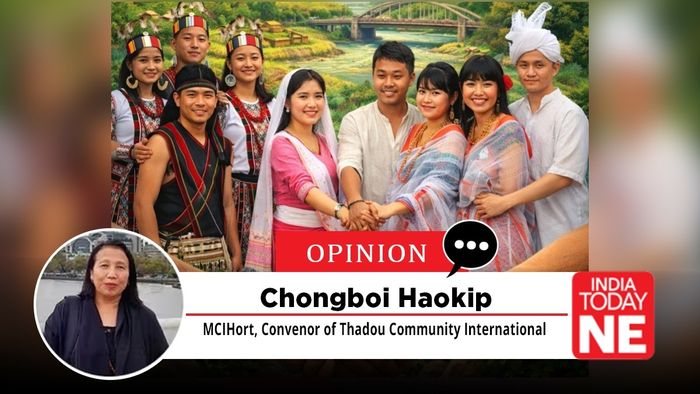
- Mar 17, 2026,
- Updated Mar 17, 2026, 3:56 PM IST
Would anyone challenge me if I say Manipur holds deep cultural and ecological wealth? More than thirty ethnic communities are living across the state, each with its own language, traditions, cultural background, ecological knowledge, and so on.
Obviously, this diversity forms the state’s strength. As a reference from the biblical image from the Epistle to the Romans, we can see a clear parallel. A body holds many parts - each with a distinct role, and health depends on cooperation among all parts.
Likewise, Manipur operates as a shared social and ecological system in which different communities support the well-being of the whole.
Ethnic competition and community-based governance deepen divisions, as debate focuses on group gains rather than the state’s well-being in India. We need a shift in political thinking for a stable future.
Leaders and citizens face a clear choice. Policy must serve narrow ethnic community interests or protect the long-term stability and shared future of the entire state.
Could we ask ourselves, "What is best for Manipur? And what can I contribute towards the benefit of Manipur?" If the state is to build a genuinely sustainable future, these are important questions.
The Imperative of Wholeness
Let us delve deeper into sustainable development, as it involves more than infrastructure, institutions, or policy frameworks. The process is a long -term cooperation, as at its core, it builds political, social, and ecological foundations so each generation stands on stronger ground than the last.
The state borders Myanmar and sits at the gateway to Southeast Asia, which places it within the scope of the Act East Policy - the stakes carry strategic weight, and of course, its hills and valleys form a connected ecological and economic system, while rich biodiversity and a young, educated population provide strong foundations for economic self-reliance and a stable future.
The ecological interdependence of hills and valley does not pause for communal boundaries. Markets do not fragment neatly along ethnic lines. Watersheds, trade routes, and investment climates do not recognise the logic of bloc-by-bloc governance. Let us look at the big picture – the territorial and civic unity of Manipur is not a sentimental preference – it is a developmental prerequisite. Fragmenting Manipur for ethnic convenience does not protect diversity. Such division weakens the shared conditions required for diverse communities to live and grow together.
Who Does the Government Serve?
There is a question that every citizen of Manipur must ask and answer honestly: who is the government working for? The answer is straightforward in a healthy democracy: it works for all the people, without distinction. But when that answer fractures, sadly, when governance becomes a negotiation of ethnic entitlements rather than a collective effort for shared progress something more than political cohesion is lost. The very possibility of sustainable development begins to erode.
This is the challenge Manipur faces today. When ministerial allocations are driven primarily by ethnic arithmetic rather than competence and vision, the result is governance that appears diverse on paper but operates communally in practice. Will the ministers become accountable not to the state's overall progress but to their ethnic community's share of the pie? Resources are managed as communal claims rather than collective assets. Are the troublemakers who successfully leverage ethnic grievances are rewarded, while those who play by the rules and work for the common good are left behind? If yes, this is not a sustainable political culture and it is not a culture capable of producing sustainable development.
As a professional in sustainable development, I view this with real concern not ideological opposition to ethnic representation, but a recognition that representation divorced from capability and civic purpose is hollow. What would you say - Manipur needs leaders who serve the entire state, not just their own ethnic communities?
The Danger of Oversimplication: Beyond the Trio-Ethnic Framework
Another big concern, inclusive governance in Manipur must reflect its full diversity, as reducing more than thirty distinct ethnic communities to a “trio - ethnic framework” oversimplifies reality and undermines the languages, cultures, and ecological knowledge of those who do not fit the categories.
Case study: The Thadou tribe is one clear illustration. Formally recorded as a distinct ethnic community since the 1881 census, recognised as a Scheduled Tribe since 1956, the Thadou possess their own language, literature, cultural patterns, and deep knowledge of the landscapes they inhabit.
As affirmed by the Thadou Convention in Guwahati in 2024, the Thadou are not Kuki, not underneath Kuki, not part of Kuki but a separate, independent people. In my view, when they are absorbed into a larger political umbrella without their consent, their specific knowledge, their specific needs, and their specific voice in development planning disappear. The same is true of the Hmars, the Zomis, and every other community whose identity and ecological knowledge the trio-ethnic framework renders invisible.
Social Capital: The Foundation That Policies Cannot Build
Where shall we put communities like the Thadous, Hmars and Zomis, who are erased by simplified frameworks made for political convenience? When there is participation, dialogue, and the integration of local knowledge from all ethnic communities in the state, sustainable development is achieved. An important saying "every little helps", as every individual/ethnic community has a unique role to play in the benefit of Manipur. On the contrary, silencing communities undermines both inclusivity and long-term sustainability.
It is inspirational that leaders from the Meitei and Thadou (Thadou Inpi Manipur) communities have pursued sustained dialogue and mutual respect, building trust that forms the foundation for peace and lasting progress "community understanding" which laid a foundation for a lasting road map to peace and is a vital achievement!! In a context where the easier road is grievance and the politically rewarding path is often communal mobilisation, the choice to build bridges carries a real cost and a real value.
Our leaders in the state are building social capital through trust, shared norms, and strong relationships. This foundation is vital as it supports lasting development, since infrastructure and institutions fail without civic commitment to sustain them. Institutions decay without the shared belief that they serve everyone. Schools fail without the community investment that sustains them across generations. Social capital forms the foundation of development. In Manipur, trust and shared responsibility grow through repeated choices by people who view one another as partners in a shared future.
The leaders who have chosen community understanding over conflict are doing the most consequential development work in Manipur today. Other communities are watching and following in due course. And in its spread lies a genuine hope not the manufactured optimism of political slogans, but the hard-won hope that comes from watching real people make real choices for the common good.
The Civic Manipur – Identity as a Condition for Sustainable Progress
Food for thought - Manipur’s future requires a civic identity that values ethnic pride while prioritising responsibility for the whole state and its shared well-being. This identity does not grow from formal power sharing alone, since such arrangements manage division rather than remove it. Lasting unity develops through shared stakes, fair governance, and institutions that serve every ethnic community.
Integrated planning must connect markets, manage shared watersheds, and link communities to broader regional and national trade networks. Education must cultivate not just skills but civic imagination. I trust most of you would agree with me - leadership should be judged by how well it serves the whole state, enabling Manipur to sustain its own development instead of relying on external support. The capacity to picture oneself as part of something larger than one's own ethnicity!
Reflection - The Manipur That Was Always Possible!
Leaders in Manipur who choose dialogue across deep divides deserve recognition – for example, the Meitei and Thadou (TIM) community leaders. No doubt, they have laid a trust and social foundation much needed for lasting peace and sustainable development. By working together, different ethnic communities show that a shared future strengthens the state rather than diminishing their identities. Those leaders help to build a whole, capable, strong and plural Manipur, where diversity becomes a shared strength, where many languages, traditions, and ecological knowledges support a common future.
The question Manipur must answer is not which community deserves more, it is whether its people are ready to choose the harder and more rewarding path of building together. The evidence that some have already made that choice is the most hopeful sign the state possesses. Sustainable development in Manipur begins with a shared civic choice. The example set by those who build trust across divides must inspire others to follow. Progress grows when people choose to stand together as “Manipuri first”.
Statement: I do not support illicit poppy cultivation. I support sustainable alternatives that strengthen society and help affected farmers in Manipur. I stand firmly behind the Manipur Government's "War on Drugs" campaign. As a strong, united community, we must work alongside government agencies that are helping farmers abandon illegal poppy farming. We, the people of Manipur, can eliminate unlawful poppy cultivation through collective effort. I call upon the entire Manipur community to unite as one team in this fight against illegal cultivation of poppy, working together to create sustainable livelihoods and a healthier future for all.