Three years, four deadlines, zero convictions: Manipur's Commission of Inquiry has failed its dead
Three years after Manipur ethnic violence 2023, an inquiry meant to uncover the truth has produced only silence—while thousands wait for answers that never come. In a conflict where over 260 died and none have been convicted, the real question lingers: is justice delayed here… or deliberately denied?
- May 03, 2026,
- Updated May 03, 2026, 8:08 PM IST
On the morning of May 3, 2023, a demonstration moved through the hill town of Churachandpur. Kuki-Zo tribal communities had come out to protest a Manipur High Court order that seemed to endorse the dominant Meitei community's long-standing demand for Scheduled Tribe classification, a demand that, if granted, would have allowed Meiteis to buy land in hill districts currently protected under tribal laws, and to compete for reserved seats that had been the hill communities' most durable safeguard. The protest was, by the standards of northeastern India's restive political landscape, unremarkable. By nightfall, it no longer was.
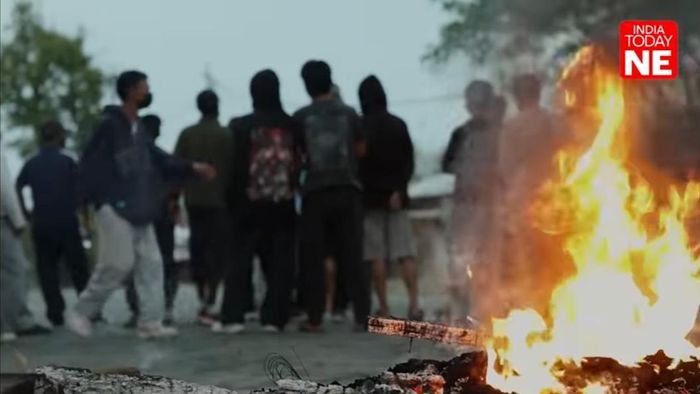
What followed in the hours and days after May 3 was the systematic unravelling of a multi-ethnic state. Churches burned. Homes were reduced to ash. Communities that had coexisted across the valleys and hills of Manipur found themselves separated by armed men and burning buildings. By the time the first wave of violence subsided, Manipur had been effectively divided into two hostile territories, one Meitei and one Kuki-Zo, each fortified against the other.
Three years on, that division has not healed. The Commission of Inquiry constituted to explain how it happened has not reported.
Commission and its clock
The Central government established the three-member Commission of Inquiry on June 4, 2023, a month after the violence began, charging it with investigating the causes and spread of the clashes, identifying any administrative failures or derelictions of duty, and assessing whether the state's response measures had been adequate. Citizens and organisations could bring complaints before it. In theory, it was the most comprehensive official accounting India had yet attempted of the Manipur catastrophe.
The panel was given six months from the date of its first sitting to deliver its findings.
It missed that deadline. It was granted an extension to September 13, 2024, and missed that, too. A third deadline of December 3, 2024, passed without a report. A fourth, set for May 20, 2025, came and went. By December 2025, the Union government had extended the commission's mandate a fourth time, now to May 20, 2026, three years after the violence began, and nearly three years after the commission itself was born.
Even that was not the end of the disruptions. In February 2026, Justice Ajai Lamba, the Gauhati High Court's former Chief Justice who had chaired the commission since its inception, submitted his resignation. The government accepted it and offered no public explanation for his departure. In his place, the Ministry of Home Affairs appointed retired Supreme Court judge Justice Balbir Singh Chauhan, who took charge on March 1, 2026, inheriting a commission that had spent nearly three years producing nothing, with a deadline now seventy-seven days away.
The Supreme Court, in the interim, had done what it could from the bench. It called the situation in Manipur a near-total failure of the constitutional order, expressed revulsion at the pace at which police had registered FIRs in cases of sexual violence, and directed that select cases be handed to the CBI. These were not small interventions. They were also, in themselves, an indictment: if the highest court in the land had to repeatedly intervene to compel basic police functioning, what had the state government, the home ministry, and the commission itself been doing?
The violence of May 3 did not arrive without warning. In the months before the protest march, the conditions for catastrophe had been carefully, if perhaps unwittingly, assembled.
Former Chief Minister N Biren Singh, a Meitei, had governed Manipur in a manner that Kuki-Zo communities experienced as increasingly hostile. His government had publicly associated hill tribal communities with poppy cultivation, illegal forest encroachment, and the harbouring of undocumented migrants from Myanmar. These characterisations, repeated in political speeches and official communications, fed a narrative in which Kuki-Zo people were not merely a rival community but an illegitimate presence, a security threat masquerading as indigenous citizens. In March 2023, his cabinet moved to terminate Suspension of Operation agreements with several suspected Kuki militant groups, a step the Central government itself did not endorse. Meitei civil society groups had organised demonstrations in Delhi demanding that the National Register of Citizens exercise use 1951 as its base year, a demand that, given Manipur's demographics, amounted to a challenge to the legal status of much of the hill population.
When violence erupted after the May 3 rally, the state's security apparatus behaved in ways that have never been fully explained. Police armouries were looted on a scale that, in ordinary circumstances, would be inconceivable. By conservative estimates, some 6,000 firearms and over 600,000 rounds of ammunition were taken, along with grenades, mortars, and police uniforms that allowed armed men to move through checkpoints unchallenged. The armouries were not defended. No senior police officer or administrator has been held responsible for the failure. Only a fraction of the looted weapons has been recovered. The remainder circulates through a state that has been, in all practical terms, re-armed along ethnic lines.
The numbers that define the crisis are now well established, even if the government was slow to acknowledge them. Over 260 people have been killed. Close to 70,000 were displaced from their homes, the largest such movement within India in nearly a decade. In 2023 alone, Manipur recorded more than 6,200 arson cases, a figure that in any previous year would have been counted in the dozens, and that represented close to half of every arson case filed anywhere in the country that year. By March 2026, nearly 59,000 people remained in relief camps, their destroyed or abandoned homes counted in a government data set that took a Right to Information petition, pursued for seven months by an opposition legislator, to extract.
The partition nobody named
The word partition carries too much history, too much admission of failure. But drive the highway between Imphal and Churachandpur today, and the evidence is before you: a succession of checkpoints operated by Meitei civil society groups, Meitei armed youth, Manipur Police, Assam Rifles, CRPF, SSB, BSF, the Indian Army, and finally, on the other side of an invisible but very real line, the armed youth of the Kuki-Zo side. The central forces in the middle are not peacekeepers in any meaningful sense. They hold a line between two communities that have separated themselves, armed themselves, and are waiting.
The religious character of that separation has deepened the wound. The Kuki-Zo are overwhelmingly Christian; the Meitei community is predominantly Hindu, with a significant following of the indigenous Sanamahi faith. When the first churches were torched in the valley within hours of the violence beginning, nearly 250 of them in the first day and a half, the conflict ceased to be merely a land dispute or a political argument about affirmative action. It became something that would take far longer to undo.
The world noticed, even if the government preferred that it hadn't. The UN High Commissioner for Human Rights publicly identified the violence as an expression of deep ethnic and indigenous tensions and called on India to investigate in compliance with its international obligations. The US Commission on International Religious Freedom recorded the targeting of Christian places of worship and demanded accountability. The European Parliament urged the establishment of a Truth and Reconciliation Commission. The Indian government's response to each of these interventions was, in effect, silence.
Zero convictions
Here is the fact that sits at the centre of three years of Manipur: more than 260 people are dead. Not one person has been convicted.
The absence of accountability is not due to a lack of evidence. The conflict produced some of the most thoroughly documented atrocities in recent Indian history, not because the state documented them, but because survivors did, and because video footage made suppression impossible. In July 2023, a recording surfaced that drew condemnation from around the world: two Kuki-Zo women, stripped of their clothing, being marched through open ground by a group of men, one of them subsequently alleging gang rape. The recording had been made on May 4, two months before it reached public attention. In those two months, local police had knowledge of what had occurred and took no action. The Supreme Court had to order the CBI to take over the case. It remains unresolved.
Sexual violence was not a by-product of the Manipur conflict. Testimony, documentation, and the pattern of attacks all point to its use as a deliberate instrument of ethnic terror against Kuki-Zo women and girls. The Commission of Inquiry was tasked with investigating this. It has not reported. Meanwhile, one survivor did not live to see the commission's findings. A woman who had been eighteen when she was gang-raped in May 2023 died on January 10, 2026, aged twenty, from sustained illness tied directly to injuries from the attack. She had been taken from near an ATM in Imphal, assaulted on a hilltop, and left in a stream. A case was registered; it was transferred to the CBI in July 2023. When she died, no one had been arrested. Her mother asked for one thing only: that the men who did this be made to answer for it.
Amnesty International India described her death as evidence of a culture of impunity around sexual violence in Manipur, saying the systems meant to protect and support survivors had done neither.
Benjamin Mate of the Kuki Organisation for Human Rights Trust has been specific about what real accountability would require: an independent commission genuinely empowered to examine the conduct of senior state officials, police officers, bureaucrats, and commanders of armed groups, one with the authority and the will to name who failed and who acted with malice. What exists instead is a panel that has operated in near-total silence for three years, lost its chairman to a resignation whose reasons remain officially undisclosed, and is now in its fifth extension.
Twenty months of Biren Singh, then a year of no one
Manipur was governed throughout the first twenty months of the crisis by N Biren Singh, whose administration Kuki-Zo organisations hold responsible not merely for failing to prevent the violence but for creating the conditions that made it possible. He remained in office until February 2025, when the prospect of a floor test he could not win forced him to resign. President's Rule followed, lasting nearly a year. The Union government determined that the state's divisions were too raw, its politics too volatile, to risk holding together an elected government.
Yumnam Khemchand Singh became Chief Minister on February 4, 2026. His government, cognisant of the reputational damage that the Singh era had inflicted, moved to project a conciliatory tone. On March 21, 2026, it convened what officials called the first face-to-face dialogue between Meitei and Kuki-Zo representatives since the conflict began. It was a symbolic step, and not an insignificant one.
Fourteen days later, it was overtaken by events. On April 7, a bomb struck a house in Tronglaobi village in Bishnupur district. A five-year-old boy and his six-month-old sister were killed. Their mother was wounded. Protests broke out across Meitei areas, and in Churachandpur, CRPF personnel opened fire on demonstrators, killing three and injuring two dozen more.
Seven further deaths followed in the days after. Internet services were suspended. Curfew was imposed in several districts.
The conflict, meanwhile, had also grown more complicated in ways that receive less attention. Naga communities, which had largely remained outside the Meitei-Kuki-Zo confrontation in 2023, have since been drawn into their own clashes with Kuki-Zo groups — principally in Kangpokpi district, where competing claims over land have generated recurring violence. A crisis that was already bilateral has become triangular. Since May 2023, just under 300 conflict-linked fatalities have been recorded across more than 130 separate incidents, including at least 121 civilians.
A reckoning deferred
The Commission of Inquiry has until May 20, 2026, to submit a report that was originally due in late 2023. Its first chairman has resigned without explanation, its deadlines have been extended four times, and not a single person has been convicted for any act of violence committed since May 3, 2023. Whatever the panel ultimately produces, it will arrive into a Manipur that has already lived three years without an answer.