Air pollution linked to dramatic rainfall decline in Meghalaya's Mawsynram
Air pollution is significantly reducing rainfall in Mawsynram, Meghalaya, according to new research. Experts urge immediate action to control pollution and safeguard the region's climate and water supply
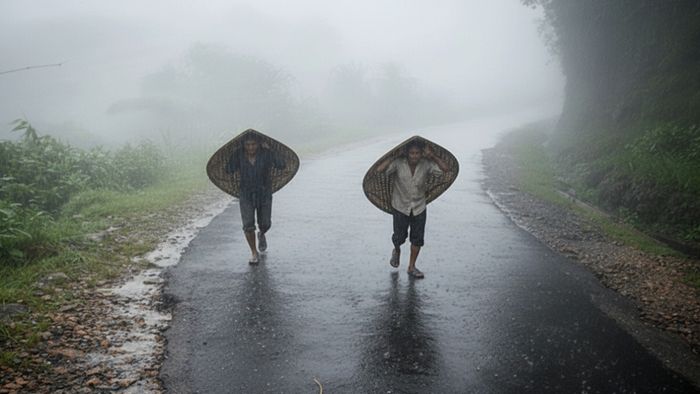
- Dec 25, 2025,
- Updated Dec 25, 2025, 2:05 PM IST
Mawsynram in Meghalaya, traditionally known as the wettest place on Earth, has experienced a sharp drop in annual rainfall over the past decade, with researchers linking the decline to rising air pollution levels.
A study published in the Journal of the Indian Society of Remote Sensing reveals that annual rainfall in the region plummeted from 10,235 millimetres to 8,838.2 millimetres between 2014 and 2023.
The research team, led by Mamta Devi et al., found a strong correlation between this 13.6 per cent decrease and increasing atmospheric aerosol concentrations.
Satellite data analysis showed aerosol optical depth—a measure of particle pollution in the atmosphere—rose by nearly 15 per cent during the study period, increasing by approximately 0.007 units annually. Fine-mode aerosol particles, typically from combustion and industrial sources, showed a 9 per cent increase.
The researchers discovered that higher concentrations of fine aerosol particles appear to interfere with cloud formation by preventing water droplets from combining effectively. This disruption to the natural rain-making process may explain the substantial rainfall reduction in a region famous for its extreme precipitation.
The atmospheric heating effect from aerosols intensified notably during winter and pre-monsoon seasons. Aerosol radiative forcing increased from 11.81 to 18.26 watts per square metre in winter and from 15.47 to 21.66 watts per square metre before the monsoon, causing atmospheric temperatures to warm faster than previously recorded.
Peak aerosol pollution occurred during the pre-monsoon and winter months, with lower but still significant levels persisting through monsoon and post-monsoon periods.
The findings highlight complex interactions between air pollution and regional climate patterns. Authors Sumit Kumar Mishra, Kartika Pandey, Supreet Kaur, Anikender Kumar, Vijay Kumar Soni, Amarendra Singh and Atul Kumar Srivastva emphasise that understanding these aerosol-cloud interactions is crucial for improving climate change predictions and developing effective environmental policies for the region.