Japan to support connectivity linking Northeast India to Bay of Bengal, Indian Ocean: KIZUNA-6 Conclave
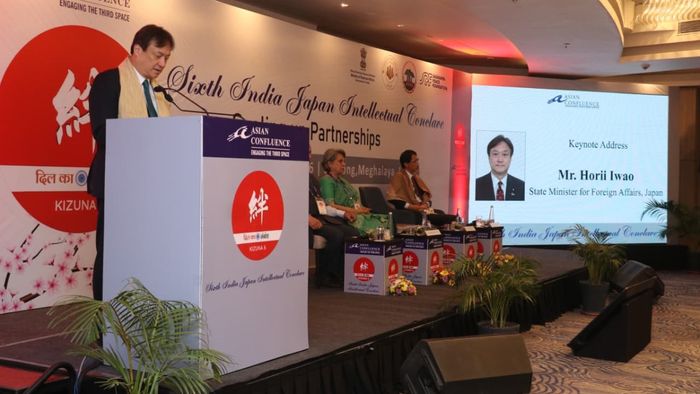
Japan has reaffirmed its commitment to supporting connectivity projects linking Northeast India to the Bay of Bengal and the Indian Ocean, underscoring the growing strategic partnership between the two countries. The assurance was given during the second day of the 6th India–Japan Intellectual Conclave, KIZUNA-6: Scaling up Partnerships, held on February 27.
- Feb 27, 2026,
- Updated Feb 27, 2026, 7:48 PM IST
Japan has reaffirmed its commitment to supporting connectivity projects linking Northeast India to the Bay of Bengal and the Indian Ocean, underscoring the growing strategic partnership between the two countries. The assurance was given during the second day of the 6th India–Japan Intellectual Conclave, KIZUNA-6: Scaling up Partnerships, held on February 27.
The two-day conclave is being organised by Asian Confluence in collaboration with the Ministry of External Affairs, the Embassy of Japan, the Government of Meghalaya and the Sasakawa Peace Foundation.
Day two opened with a think tank panel on the theme “India–Japan Cooperation in a Turbulent World”, focusing on how the special strategic and global partnership between India and Japan can act as a stabilising force amid increasing global fragmentation. The discussions later centred around three key pillars through dedicated business sessions on the semiconductor ecosystem, circular economy and clean energy, and skilling and talent mobility.
Delivering the keynote address, Horii Iwao, Minister of State for Foreign Affairs, Government of Japan, said Japan would support connectivity initiatives linking Northeast India with the Bay of Bengal and the Indian Ocean. He also stated that Japan would encourage private-sector cooperation in areas such as economic security, semiconductors and clean energy, while continuing to actively promote people-to-people ties.
In a high-level panel, Indra Mani Pandey, Secretary General of BIMSTEC, said the grouping remains committed to its vision of a free and open Indo-Pacific as outlined in its 2030 charter, with blue economy and maritime security as priority areas. Riaz Hamidullah, Bangladesh High Commissioner to India, highlighted that India–Bangladesh relations are rooted in friendship and engagement, noting the resumption of the Agartala–Dhaka–Kolkata bus service under the new government in Bangladesh.
Representing Bhutan, Sherub Dorji of Gelephu Mindfulness City outlined Bhutan’s focus on eight core industries, including health and wellness, edutech, forestry, finance and civil aviation, to drive sustainable growth and regional connectivity. Santoshi Shahi highlighted Nepal’s vast hydropower potential and said the energy sector remains a major pillar for future investment.
At the policymakers’ panel, Tapir Gao called for greater engagement with Myanmar and stressed that Indian youth should imbibe Japanese values alongside learning the Japanese language. Wanwieroy Kharlukhi said that for Meghalaya, the “Look South” initiative and revival of ties with Bangladesh should assume greater importance. Former Nagaland minister Mmhonlumo Kikon emphasised the shared history between Northeast India and Japan and noted India’s growing global stature in producing skilled talent for the semiconductor industry.
The conclave concluded with a strong resolve to convert dialogue into actionable partnerships aimed at strengthening connectivity, resilience and inclusive growth across the Indo-Pacific, with renewed emphasis on deepening cooperation between Northeast India and Japan.