Meghalaya CM presents Rs 32,023-crore budget for 2026–27, projects 3.5 per cent fiscal deficit
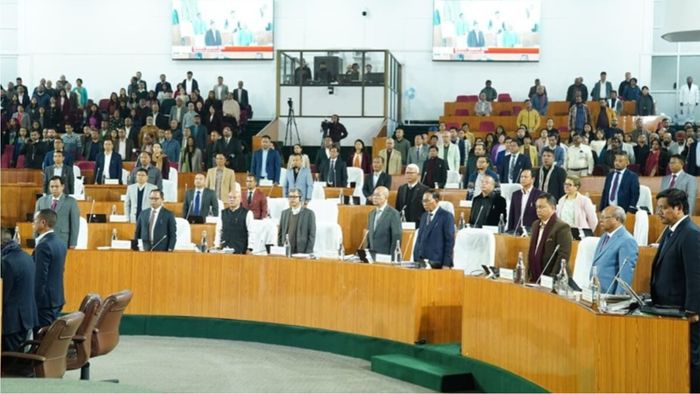
Conrad K Sangma on February 23 presented a Rs 32,023-crore budget for the 2026–27 financial year in the Assembly, projecting a fiscal deficit of around 3.5 per cent of the Gross State Domestic Product (GSDP) and announcing no new taxes.
- Feb 23, 2026,
- Updated Feb 23, 2026, 8:24 PM IST
Conrad K Sangma on February 23 presented a Rs 32,023-crore budget for the 2026–27 financial year in the Assembly, projecting a fiscal deficit of around 3.5 per cent of the Gross State Domestic Product (GSDP) and announcing no new taxes.
Presenting his ninth consecutive budget, the chief minister, who also holds the finance portfolio, said the government aims to balance fiscal discipline with accelerated growth under its “Vision 2032” roadmap, targeting a three-fold expansion of Meghalaya’s economy during what he termed the “Meghalayan Decade.”
The budget estimates revenue receipts at ₹26,583 crore and capital receipts at ₹5,417 crore. Excluding borrowings of ₹5,379 crore, total receipts are pegged at ₹26,621 crore. Total expenditure is projected at ₹32,023 crore, including revenue expenditure of ₹21,812 crore and a capital outlay of ₹10,211 crore. Sangma said capital expenditure has crossed the ₹10,000-crore mark for the first time. After excluding loan repayments of ₹2,731 crore, total effective expenditure is estimated at ₹29,293 crore.
Interest payments for 2026–27 are estimated at ₹1,540 crore, while pension liabilities are projected at ₹1,980 crore. Total transfers from the Centre are expected to rise to ₹21,229 crore, and the state’s own tax revenue is projected to increase to ₹4,720 crore. Sangma said improved tax mobilisation, strategic use of centrally sponsored schemes and externally aided projects have enabled a sharp rise in capital expenditure while maintaining fiscal prudence within the permissible 3.5 per cent deficit limit.
Highlighting economic performance, Sangma said Meghalaya is currently the country’s second-fastest growing state with a real GSDP growth rate of 9.66 per cent and has sustained nearly 10 per cent growth for three consecutive years. The state’s GDP is projected to reach ₹76,320 crore in 2026–27, with targets of ₹85,000 crore by 2028 and ₹1.35 lakh crore by 2032.
A new 1,000-day mission to tackle child malnutrition has been announced with an allocation of ₹127 crore, while ₹244 crore has been earmarked for broader nutrition programmes. Under the “Mission 10” strategy, agriculture and high-value horticulture remain key growth drivers with an allocation of ₹664 crore. The animal husbandry and fisheries sectors will receive ₹247 crore and ₹130 crore, respectively.
Tourism, arts and culture have been allocated ₹376 crore, a 57 per cent increase. The government plans to develop global-scale destinations at Umiam, Sohra, Dawki-Shnongpdeng and Nokrek, and support 1,000 homestays under the Chief Minister’s Meghalaya Homestay Mission.
Sports received a major push ahead of the 39th National Games to be hosted by Meghalaya in 2027. An allocation of ₹844 crore has been proposed for sports and youth affairs, including ₹210 crore for organising the Games and ₹400 crore for infrastructure such as the Mawkhanu Football Stadium and international-standard facilities at Umsawli.
Entrepreneurship and skilling initiatives will receive ₹241 crore, with new schemes under CM-Elevate covering green taxis, adventure tourism and agriculture infrastructure. The state is also targeting overseas placements and village-level skill training to expand employment opportunities.
In the urban sector, ₹1,540 crore has been allocated for projects including New Shillong City, waste management and administrative infrastructure. Road connectivity will continue under the Meghalaya Logistics and Connectivity Improvement Project with ₹1,982 crore earmarked. The government has allocated ₹571 crore for major water supply schemes and ₹300 crore for works under the Jal Jeevan Mission.
The power sector will receive ₹1,123 crore to strengthen transmission networks and hydropower projects, while ₹149 crore has been allocated for IT and digital connectivity. Health has been allotted ₹2,472 crore, including expansion of medical infrastructure such as Shillong Medical College and maternal and child health facilities. Education will receive ₹3,347 crore for scholarships, infrastructure upgrades and a structured pay framework for fixed-pay teachers.
Housing initiatives will include completion of targets under the Pradhan Mantri Awas Yojana (Gramin) and development of new affordable housing complexes in urban areas. Welfare programmes such as CM-CARE, FOCUS and SHG support will continue, alongside a new Chief Minister’s Model Village Scheme aimed at transforming rural economies.
“The gains of growth must reach every Meghalayan,” Sangma said, adding that sustained public investment, digital service delivery and community-led development will remain central to the state’s strategy as it advances towards its Vision 2032 goals.