Meghalaya HC acquits woman convicted of killing husband and son, cites botched confession and weak evidence
Meghalaya High Court acquits woman in murder case due to flawed confession and weak evidence. The judgement highlights the importance of reliable proof and benefit of doubt in criminal trials
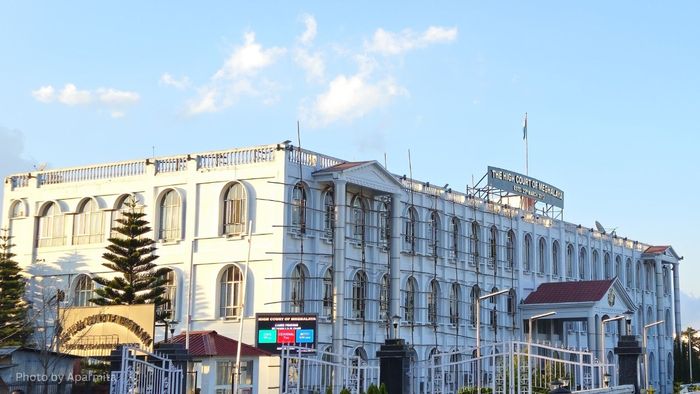
- Mar 19, 2026,
- Updated Mar 19, 2026, 9:35 AM IST
A 51-year-old woman from West Jaintia Hills has walked free after the Meghalaya High Court overturned her conviction for the murder of her husband and causing grievous hurt to her infant daughter — offences for which she had been sentenced to life imprisonment.
The court, comprising Chief Justice Revati Mohite Dere and Justice W Diengdoh, delivered its verdict on 18 March 2026, quashing the trial court's judgment of 31 August 2021 that had found Porthmi Bthuh guilty under Sections 302 and 326 of the Indian Penal Code.
The case traces back to 28 March 2003, when Porthmi allegedly attacked her husband, Kor, with a dao following a domestic quarrel, fatally wounding him. Her four-year-old son, Donmi, also died from injuries sustained during the incident. Her daughter, aged two years and eight months, survived but with grievous injuries. The appellant herself suffered self-inflicted wounds. The FIR was lodged not by the family — who had reportedly settled the matter — but by the village headman.
The trial took over a decade to conclude. When it did, the additional deputy commissioner (judicial) at Jowai convicted Porthmi on the basis of a confession she had allegedly made before a magistrate under Section 164 of the CrPC, while acquitting her of the murder of her son.
The High Court found the entire prosecution case resting on shaky ground. Eight witnesses were examined, yet not one had directly witnessed what happened inside the house. The court noted that there was "absolutely no evidence to show what happened inside the house and who all were there."
The confession, which was the centrepiece of the trial court's reasoning, was found to be riddled with procedural defects. The High Court identified at least six serious infirmities.
The confession was recorded on 29 March 2003 — the very day after the appellant's arrest — with no indication that she was given adequate time to reflect on whether she wished to confess. Columns 3 and 4 of the standard confession form, which require the magistrate to record where the accused was kept during the reflection period and confirm the absence of any police officer, were left blank. The mandatory endorsement required under Section 164(4) of the CrPC was absent. The appellant had been administered an oath, which is contrary to law. The confession was never formally exhibited through any witness during trial. And critically, there was no evidence on record showing that the confession had ever been opened or a copy handed to the accused — who, according to her counsel, learnt of its existence only after she was convicted.
"There is nothing to indicate from the confession so recorded that the appellant was given any time to reflect as to whether she wanted to make the confession," the bench observed.
The state's counsel argued that the magistrate's note describing the confession as "spontaneous" was sufficient to establish its voluntary nature, and relied on Section 80 of the Evidence Act and the Supreme Court's ruling in Madi Ganga v. State of Orissa. The High Court rejected this, pointing out that in Madi Ganga, the confession had been duly recorded in accordance with law — a fact conspicuously absent here.
The bench applied the five golden principles for circumstantial evidence laid down by the Supreme Court in Sharad Birdhichand Sarda v. State of Maharashtra (1984), which require, among other things, that the circumstances be fully established, consistent only with the hypothesis of guilt, and form a complete chain leaving no reasonable ground for innocence.
By that standard, the prosecution fell well short. Witnesses PW1 and PW5 saw Porthmi holding a dao after the incident, but neither claimed to have seen her commit any act of violence. PW4, the deceased's sister, admitted she had not personally witnessed the incident. The two bloodstained daos recovered from the scene were never sent to the forensic science laboratory. The headman who filed the FIR admitted in cross-examination that he had signed it without reading its contents.
The court also noted that the confession itself hinted at the presence of a non-tribal person during the incident — a lead the police never pursued.
The state additionally argued that the appellant's failure to explain what happened in the house invoked Section 106 of the Evidence Act, which places the burden of proof on a party with special knowledge. The court dismissed this, reiterating the settled position that Section 106 "cannot be invoked to make up the inability of the prosecution to produce evidence of circumstances pointing to the guilt of the accused." It further cited the Supreme Court's ruling in Nagendra Sah v. State of Bihar (2021): "When the chain is not complete, falsity of the defence is no ground to convict the accused."
The High Court quashed the conviction and ordered Porthmi's immediate release, concluding that "the prosecution has miserably failed to prove its case... by leading cogent, legal and admissible evidence and that the chain of evidence is far from complete."
She had spent years in custody for a crime the state could not, in the end, legally prove she committed.