Meghalaya, Tripura among states with high ineligible beneficiaries in free ration scheme: Centre survey
A Union Food Ministry survey found high rates of ineligible PMGKAY beneficiaries in Meghalaya and Tripura. The findings highlight targeting gaps despite strong satisfaction with ration delivery and foodgrain quality.
- Nov 24, 2026,
- Updated Nov 24, 2026, 11:39 AM IST
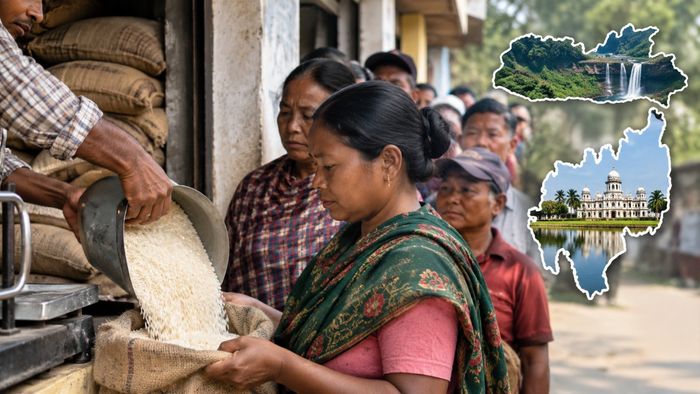
Meghalaya and Tripura have recorded some of the highest rates of ineligible beneficiaries receiving free foodgrains under the Centre's Pradhan Mantri Garib Kalyan Anna Yojana (PMGKAY), according to a Union Food Ministry survey.
The evaluation found that 39.2 per cent of beneficiaries surveyed in Tripura and 28.5 per cent in Meghalaya did not meet the eligibility criteria for the scheme. The figures are significantly higher than the national average inclusion error of 13.2 per cent.
West Bengal recorded the highest inclusion error at 39.5 per cent, followed by Tripura and Tamil Nadu at 38.7 per cent. The findings were published in the Department of Food and Public Distribution's report on the concurrent evaluation and monitoring of the National Food Security Act (NFSA) and PMGKAY for 2025-26.
An inclusion error refers to the identification of households as beneficiaries despite their failure to meet the eligibility criteria prescribed by the respective state governments.
The survey assessed 51,303 beneficiary households across all 36 states and Union Territories, covering both rural and urban areas. It also examined 4,939 Fair Price Shops (FPS), 2,036 Vigilance Committee members and 245 godowns.
Under PMGKAY, eligible individuals belonging to priority households receive five kg of foodgrains per person every month free of cost. Households covered under the Antyodaya Anna Yojana (AAY), which targets the poorest families, are entitled to 35 kg of foodgrains per household each month.
The scheme operates under the NFSA, which currently covers around 80 crore people across the country.
The report found that inclusion errors were higher in urban areas, at 15.6 per cent, compared to 12.5 per cent in rural areas. Among beneficiary categories, AAY households recorded a lower inclusion error of 12.2 per cent, while priority households registered 13.4 per cent.
Despite concerns over beneficiary identification, the evaluation found high levels of satisfaction with the scheme's delivery mechanisms.
Around 90.6 per cent of beneficiaries expressed satisfaction with services at Fair Price Shops, while 94.9 per cent were satisfied with the quality of foodgrains supplied. Nearly 99 per cent said the foodgrains received were consumed within their households, indicating that the provisions were largely being used for their intended purpose.
The evaluation examined several aspects of implementation, including beneficiary identification, foodgrain distribution, grievance redressal mechanisms, digitisation, portability of ration cards, infrastructure and awareness among beneficiaries.
According to the report, the scheme continues to demonstrate strong performance in entitlement delivery, Fair Price Shop operations and digital systems, backed by its extensive national coverage.
However, the findings also point to gaps in beneficiary targeting, particularly in states such as Meghalaya and Tripura, where a considerable proportion of those receiving free foodgrains were found to be outside the prescribed eligibility criteria.