Mizoram must become self-reliant and globally competitive: Education Minister Vanlalthlana
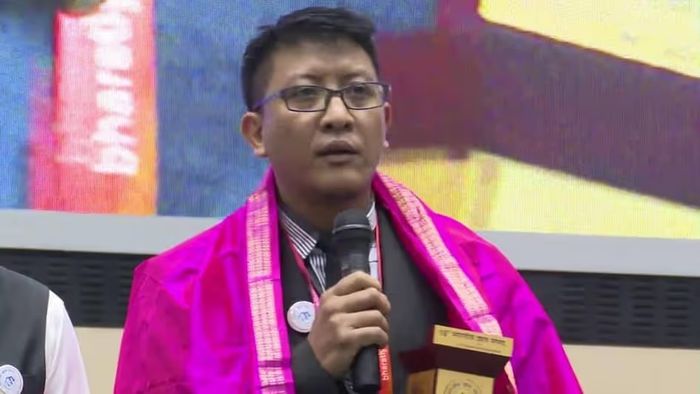
Mizoram Education Minister and senior Zoram People's Movement (ZPM) leader Vanlalthlana on July 13 urged people to play an active role in building a self-reliant and globally competitive state, saying the next phase of the state's development depends on collective responsibility and honest self-assessment.
- Jul 13, 2026,
- Updated Jul 13, 2026, 8:39 PM IST
Mizoram Education Minister and senior Zoram People's Movement (ZPM) leader Vanlalthlana on July 13 urged people to play an active role in building a self-reliant and globally competitive state, saying the next phase of the state's development depends on collective responsibility and honest self-assessment.
Speaking at a party function at the ZPM office in Aizawl, the minister said that as Mizoram marks four decades of statehood, it is time to evaluate both its achievements and shortcomings to chart a stronger future.
Recalling the Mizo insurgency and the signing of the 1986 Peace Accord, Vanlalthlana said the sacrifices made during that period should continue to guide the state's progress.
"The 1986 Peace Accord was not written with ink alone. It was written with the tears of those who lost their loved ones, homes and livelihoods. This land was built with tears and blood, and today it is calling upon every citizen to serve it," he said.
He said the decision of the Mizo people to choose reconciliation over revenge after years of conflict laid the foundation for lasting peace in the state.
While acknowledging the gains made since attaining statehood, Vanlalthlana said Mizoram still relies heavily on financial assistance from the Centre. He urged citizens to adopt a wider outlook and work towards making the state competitive not only within India but internationally.
The minister also defended the present government's decision to revoke provincialisation orders for ad hoc schools issued by the previous administration. He alleged that the process initiated in September 2023 was carried out without mandatory legal and administrative clearances.
According to Vanlalthlana, the earlier government framed rules for converting ad hoc schools into government institutions without obtaining approvals from the Department of Personnel and Administrative Reforms (DP&AR), the finance department and the law and judicial department.
He said the original policy had laid down eligibility conditions, including minimum student enrolment and pass percentage requirements for higher secondary, high and middle schools. However, he alleged that the previous council of ministers approved the provincialisation of several schools within days of notifying the rules, despite those institutions failing to meet the prescribed criteria.
Describing the resulting notifications as "paper orders", Vanlalthlana said they were not legally implementable, leaving the present government with no option but to withdraw them.
He said the government later constituted a high-level committee led by the DP&AR minister, comprising two other ministers, an MLA, an education consultant and four senior secretaries, to review the grant-in-aid rules and prepare a legally sustainable framework.
Following the review, the government provincialised 51 schools after extensive deliberations, with the matter being discussed five times by the council of ministers, he added.
Vanlalthlana further criticised the previous administration for attempting to regularise the services of more than 1,300 teachers despite, according to him, facing difficulties in paying salaries to existing government employees.