New montane toad species discovered in Mizoram’s Phawngpui National Park
A new species of montane toad has been discovered in Mizoram, adding to the state’s growing record of unique amphibian diversity.
- Sep 14, 2026,
- Updated Sep 14, 2026, 5:37 PM IST
A new species of montane toad has been discovered in Mizoram, adding to the state’s growing record of unique amphibian diversity.
Named Duttaphrynus phawngpui, the newly described species was found in the high-elevation forests of Phawngpui National Park, also known as Blue Mountain, in Lawngtlai district. The species was formally described in a research paper published in Taprobanica on September 13, 2026.
Researchers encountered the toad at an elevation of around 2,144 metres above sea level along a montane trail leading towards the summit of Phawngpui. The specimens were found on leaf litter in a humid, shrub-dominated forest with bamboo patches.
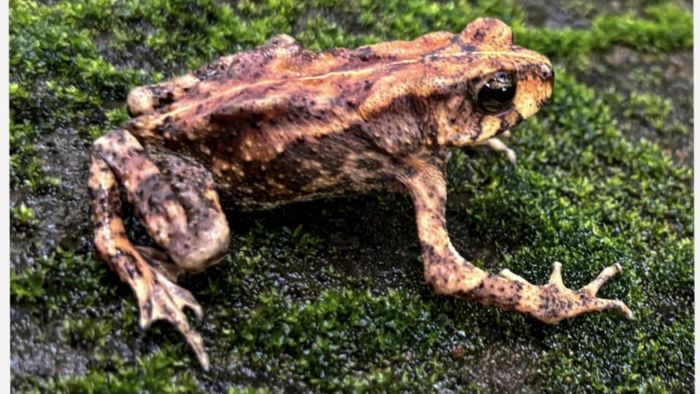
The new species is relatively small, measuring around 47.72–56.26 mm in body length. It has an indistinct tympanum, distinctive finger and toe proportions, moderate toe webbing and numerous glandular warts.
In life, the toad has a yellowish to earthy-brown body with irregular dark blotches and a thin, distinctive pale stripe running along the middle of its back.
The researchers used an integrative taxonomic approach, combining physical characteristics, statistical analysis of body measurements and mitochondrial 16S rRNA DNA sequencing to establish the species as distinct.
Genetic analysis placed the Mizoram population within the Duttaphrynus stuarti species group, but showed that it represents a distinct evolutionary lineage. Its genetic divergence from closely related recognised species ranged between 3.8% and 5.5%.
Morphometric analysis also clearly distinguished the new species from closely related species, including D. stuarti, D. chandai and D. dhara.
The species has been named phawngpui after Phawngpui National Park, highlighting the biological importance of Mizoram’s high-elevation ecosystems.
Researchers said the discovery is significant not only because it adds a new species to the region's biodiversity record, but also because it highlights how little explored Mizoram's high-elevation and forest habitats remain.
The finding suggests that amphibian diversity in Mizoram and the wider Indo-Burma region could be considerably greater than currently documented.
The study also underlines the conservation importance of Phawngpui's montane ecosystem. High-elevation habitats can function as isolated “sky islands”, allowing species to evolve independently. However, species restricted to such habitats can also be particularly vulnerable to climate change as rising temperatures reduce the availability of suitable environments at higher elevations.
At present, Duttaphrynus phawngpui is known only from its type locality in Phawngpui National Park. Researchers said further surveys are required to determine whether the species is restricted to the park or occurs more widely across southern Mizoram and adjoining upland areas.
Its population size and conservation status also cannot yet be assessed with confidence because only a limited number of specimens are currently known.