Centre, Nagaland Government and ENPO sign historic pact to establish Frontier Nagaland Territorial Authority. What it means for Nagaland?
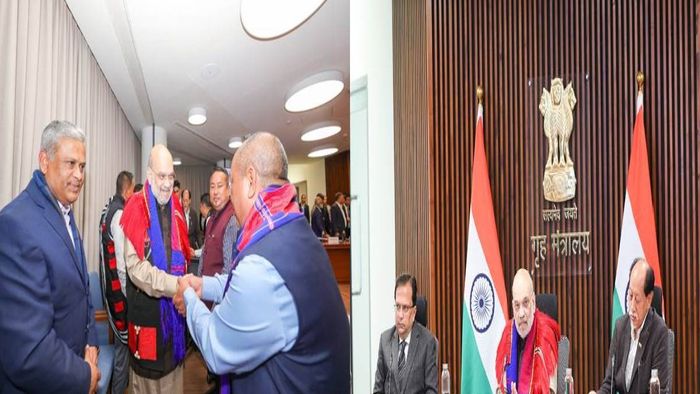
In a major breakthrough aimed at resolving one of Nagaland’s longest-standing political demands, the Union Government, the Nagaland Government and the Eastern Nagaland People’s Organisation (ENPO) on February 5, 2026 signed a historic tripartite agreement to establish the Frontier Nagaland Territorial Authority (FNTA). The move grants legislative, executive and financial autonomy to six eastern districts of the state, while firmly preserving Nagaland’s geographical and constitutional integrity
- Feb 12, 2026,
- Updated Feb 12, 2026, 3:48 PM IST
In a major breakthrough aimed at resolving one of Nagaland’s longest-standing political demands, the Union Government, the Nagaland Government and the Eastern Nagaland People’s Organisation (ENPO) on February 5, 2026 signed a historic tripartite agreement to establish the Frontier Nagaland Territorial Authority (FNTA). The move grants legislative, executive and financial autonomy to six eastern districts of the state, while firmly preserving Nagaland’s geographical and constitutional integrity.
The agreement marks a decisive step toward addressing decades-old grievances of perceived socio-economic neglect and underdevelopment in Eastern Nagaland. It is also one of 12 key accords signed in the Northeast since 2019 as part of the Centre’s broader effort to usher in lasting peace and stability across the region.
Background of a long-standing demand
The ENPO, the apex body representing eight recognised Naga tribes from the districts of Mon, Tuensang, Longleng, Kiphire, Noklak and Shamator, has been demanding a separate state since 2010. The organisation argued that Eastern Nagaland remained developmentally backward and underrepresented in governance compared to the rest of the state.
Over the years, the demand evolved from full statehood to the creation of a “Frontier Nagaland Territory.” However, both the Centre and the Nagaland government maintained that bifurcation of the state was not feasible. Such a move, they argued, would require redrawing state boundaries, altering the political structure, and potentially impacting Article 371(A) of the Constitution, a provision safeguarding Naga customary laws, land ownership rights, and religious and social practices.
Instead of division, the Centre proposed an alternative institutional mechanism, the Frontier Nagaland Territorial Authority, designed to ensure autonomy without fragmentation.
Key features of the FNTA
Under the agreement, the FNTA will exercise executive and legislative powers over 46 subjects, including land, rural development, agriculture and other key sectors critical to local governance and economic advancement. This effectively allows the region to manage its internal affairs with significantly enhanced decision-making authority.
A dedicated mini-Secretariat will be established within Eastern Nagaland to administer the Authority. The administrative structure will be headed by an officer of the rank of Additional Chief Secretary or Principal Secretary, ensuring high-level bureaucratic oversight.
Financial autonomy forms a central pillar of the arrangement. Development funds will be allocated in proportion to the region’s population and geographical area. Importantly, the Ministry of Home Affairs (MHA) will provide the initial establishment expenditure and ensure that earmarked funds are not delayed or diverted through the state capital.
The agreement explicitly clarifies that it does not, in any manner, affect Article 371(A) of the Constitution. The special protections granted to Nagaland under this provision remain intact, with the FNTA operating fully within its framework.
Union Home Minister Amit Shah described the agreement as a moment of “immense satisfaction,” recalling that during 2021–22 he had assured ENPO representatives that the Narendra Modi-led government was committed to resolving every dispute in the Northeast through dialogue and democratic engagement.
Shah stated that he had urged ENPO leaders to maintain faith in the democratic process and promised that they would receive fair justice and due respect. “I feel immense joy that after sustained efforts by officers of the Ministry of Home Affairs, who acted as a bridge between ENPO and the Government of Nagaland, we have been able to resolve this issue,” he said.
He further assured that a fixed annual financial allocation would be determined for Eastern Nagaland, and that the MHA would shoulder the initial expenditure for establishing the FNTA.
A unique governance model
The Frontier Nagaland Territorial Authority represents a calibrated political solution — one that balances regional aspirations with state unity. By granting substantial legislative and financial powers while retaining Nagaland’s territorial integrity, the agreement seeks to avoid the administrative and constitutional complexities that a state bifurcation would have entailed.
The arrangement envisages accelerated infrastructure development, improved resource utilisation, and enhanced economic empowerment for the region. With direct financial channels and localized decision-making, the government expects the new structure to fast-track development initiatives that had long been delayed.
The signing of the accord is being viewed as a significant milestone in the Centre’s sustained push to make the Northeast dispute-free and development-driven. Whether the FNTA model becomes a template for resolving similar regional aspirations elsewhere remains to be seen, but for Eastern Nagaland, the agreement marks a transformative moment after more than a decade of political mobilisation.