Meghalaya: North East Festival of Rice celebrated in Chumoukedima, focus on heritage and sustainability
The North East Festival of Rice in Meghalaya highlighted the region's cultural heritage and sustainable farming. It promoted traditional rice varieties and eco-friendly agricultural practices.
- Feb 26, 2026,
- Updated Feb 26, 2026, 5:14 PM IST
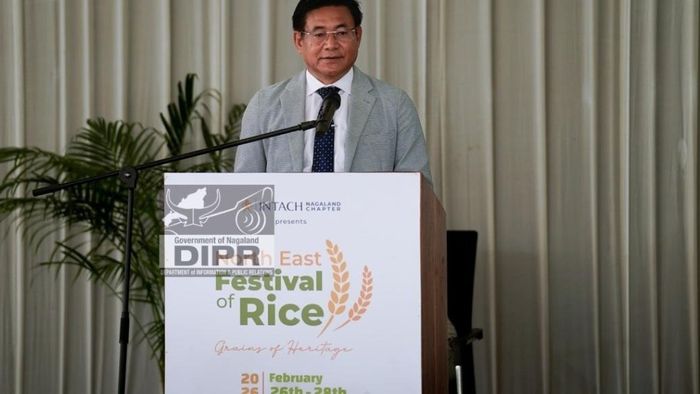
The North East Festival of Rice – Grains of Heritage was celebrated on February 26, 2026, at the Exposition Hall, Agri Expo, Chumoukedima. The event was funded by the North Eastern Council (NEC), Shillong, and organised by the Indian National Trust for Art and Cultural Heritage (INTACH), Nagaland Chapter.
The festival was held in collaboration with the Department of Agriculture, Government of Nagaland; North East Zone Cultural Centre (NEZCC), Dimapur; ICAR Research Complex for NEH Region; ICAR Research Complex for NEH Region; ICAR-Indian Institute of Rice Research; ICAR-Central Rice Research Institute; and the School of Agricultural Sciences, Nagaland University, Medziphema.
Advisor for Agriculture, Nagaland, Mhathung Yanthan, inaugurated the festival and described it as a historic and visionary initiative. He appreciated INTACH Nagaland for organising a large regional agriculture-focused event and said such efforts require dedication and foresight.
He said rice is not just a crop but an important part of the culture and identity of the people of the Northeast. He noted that rice plays a role in festivals, traditions and daily life.
Highlighting the region’s agricultural richness, he said the Northeast is known for its agro-biodiversity. Nagaland alone has more than 200 indigenous rice varieties adapted to different climates and terrains. However, he warned that many traditional varieties are slowly disappearing and stated the need for conservation and scientific research.
Speaking about climate change, he said irregular rainfall, floods, droughts and pest attacks are affecting agriculture. He called for the development of climate-resilient and short-duration rice varieties that can improve productivity while preserving traditional seeds.
He also stressed that protecting rice means protecting farmers and rural livelihoods, including artisans and small food producers. Encouraging youth participation, he urged students to understand the value of seeds, soil and farming communities.
The Advisor informed that the state has framed a new Agriculture Policy 2026, which has been approved by the Cabinet and will soon be implemented. He expressed hope that suggestions from the festival would help in effectively implementing the policy.
Sentila T. Yanger, Padma Shri awardee and State Convenor of INTACH Nagaland Chapter, delivered the welcome address. The programme began with a symbolic sowing of rice seeds. An opening prayer was offered by Rev. Lipok Jamir, Pastor of Ao Baptist Church, Diphupar.
Special remarks were delivered by Dr Sandeep Ghatak, Director, ICAR Umiam; Dr A.K. Mohanty, Director, ICAR-ATARI Umiam; Sanuzo Nuinei, Director of Agriculture, Nagaland; and Dr Prashanna Gogoi, Director of NEZCC and Sangeet Natak Akademi awardee. The speakers highlighted the importance of sustainable farming practices, research support for farmers, and promotion of traditional grains in changing times.