MSMEs can solve 80 per cent of Nagaland’s economic challenges: Advisor Hekani Jakhalu
At an interactive session on UNNATI 2024 and PM Vishwakarma, Hekani Jakhalu asked legislators to back MSMEs and traditional artisans. The push linked entrepreneurship, food processing, handloom and crafts to jobs, market access and rural growth.
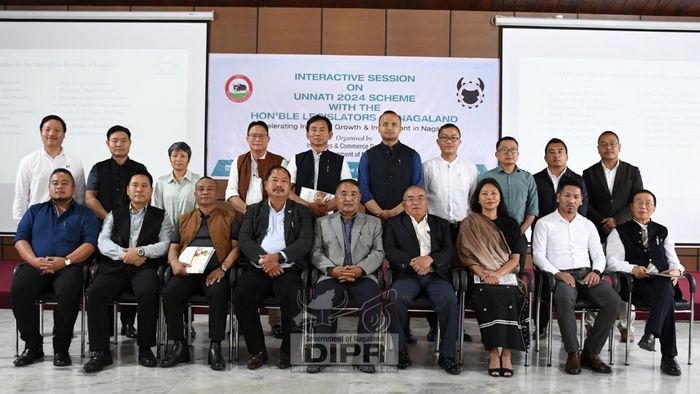
- May 27, 2026,
- Updated May 27, 2026, 12:38 PM IST
Nagaland Advisor for Industries and Commerce Hekani Jakhalu on May 27 said strengthening micro, small and medium enterprises (MSMEs) and supporting the business community are key to the state’s long-term economic growth and job creation.
Addressing an interactive session on the UNNATI 2024 Scheme and PM Vishwakarma organised by the Department of Industries and Commerce, Jakhalu said properly established MSMEs could address “70-80 per cent” of Nagaland’s economic challenges.
She urged legislators to play a more active role in spreading awareness about government schemes and alternative livelihood opportunities, saying every constituency should be informed so that genuine beneficiaries can access available support.
Highlighting the Raising and Accelerating MSME Performance (RAMP) scheme, a World Bank-assisted programme under the Ministry of MSME, Jakhalu said officials had travelled across Nagaland to create awareness and identify potential entrepreneurs. She added that 750 high-potential MSMEs would be mentored under the initiative and appealed to legislators to identify deserving entrepreneurs who could become role models in their constituencies.
She also stressed the growing importance of the food processing sector under the Prime Minister Formalisation of Micro Food Processing Enterprises (PMFME) scheme, stating that the sector has strong potential for employment generation and entrepreneurship in the state.
Jakhalu identified textiles, handloom, handicrafts and food processing as priority sectors for Nagaland’s economy. She called for better infrastructure support for grassroots weavers and urged women engaged in handloom work to register genuine beneficiaries for Individual Weaver’s Sheds.
Speaking on PM Vishwakarma, she described the scheme as a transformative initiative aimed at supporting traditional artisans and craftspeople through financial assistance, skill development and market access.
Secretary for Industries and Commerce Kumar Ramnikant said 55 units in Nagaland are currently covered under the UNNATI scheme, which he described as a major driver of entrepreneurship across the Northeast. He added that the scheme could help expand traditional crafts, improve market linkages and promote rural tourism activities.
Ramnikant said six traditional trades had been identified for training programmes in Nagaland and informed that 1,939 artisans had been trained under PM Vishwakarma as of May 25, 2026. He said the schemes help integrate traditional practices into the formal and digital economy and urged legislators to support implementation at the grassroots level.
Director of Industries and Commerce P Tokugha Sema said awareness campaigns on UNNATI had already been conducted across all districts and appealed to legislators to identify entrepreneurs capable of driving local economic growth.
Additional Director Lipongse Thongtsar said the department is focusing on finance access, technology support and grievance redressal while expanding textile sector promotion to strengthen the rural economy.
Officials at the session said the UNNATI 2024 scheme aims to strengthen the industrial ecosystem in the Northeast through incentives for manufacturing, services and micro industries, including capital investment support and sector-linked incentives. Under PM Vishwakarma, active trades in Nagaland currently include basket weaving, tailoring, carpentry, masonry, barbering, and doll and toy making.
According to the presentation, 1,884 artisans had been trained and assessed under PM Vishwakarma by March 31, 2026, while loans worth Rs 3.91 crore and 773 toolkits had been distributed under the scheme.