Nagaland: Active flames near Mt. Japfü in Dzukou Valley raise alarm, authorities seek Air Force intervention
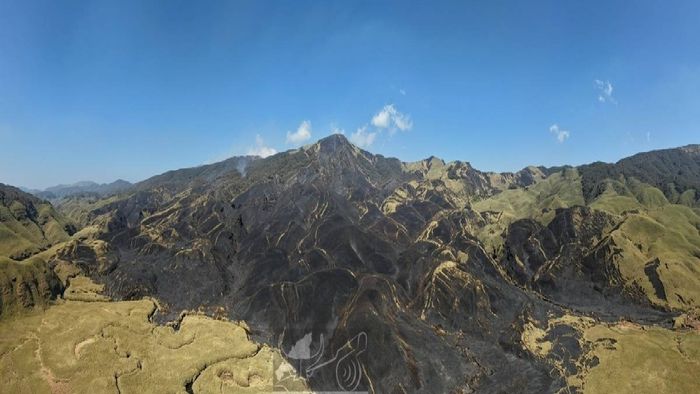
With vast stretches of Dzükou Valley already reduced to charred terrain and active flames advancing dangerously along the northern face of Mt. Japfü, authorities in Nagaland have recommended the immediate deployment of Indian Air Force (IAF) helicopters to contain the escalating forest fire crisis. An aerial survey conducted on February 11 has revealed alarming ground realities, prompting urgent calls for aerial intervention to prevent further ecological devastation.
- Feb 12, 2026,
- Updated Feb 12, 2026, 5:01 PM IST
With vast stretches of Dzükou Valley already reduced to charred terrain and active flames advancing dangerously along the northern face of Mt. Japfü, authorities in Nagaland have recommended the immediate deployment of Indian Air Force (IAF) helicopters to contain the escalating forest fire crisis. An aerial survey conducted on February 11 has revealed alarming ground realities, prompting urgent calls for aerial intervention to prevent further ecological devastation.
The high-level assessment team was led by Kohima Deputy Commissioner B. Henok Buchem and included District Commandant HG, CD & SDRF Wopenthung; District Disaster Management Authority (DDMA) Nodal Officer Thejangulie Zao; and President of the Southern Angami Youth Organization (SAYO), Zasitsolie Beio.
The aerial reconnaissance confirmed that the southern, eastern, western and adjoining mountain ranges of Dzükou Valley have already suffered extensive burn damage. While active flames have largely subsided in these regions, residual smoke continues to rise from isolated pockets, indicating lingering heat and potential re-ignition risks.
However, the situation remains critical along the northern face around Mt. Japfü, where active fires are still burning. Officials warned that the flames pose a serious threat of spreading towards Mt. Kahu and could re-enter unburnt sections of Dzükou Valley through dense pine forests — potentially undoing containment efforts and expanding the scale of destruction.
Particular concern has been raised over the Kigwema mountain slope, a heavily forested stretch dominated by tall, dry trees. Authorities cautioned that such conditions significantly heighten the risk of crown fires — where flames spread rapidly through the forest canopy — as well as falling embers and secondary ignitions. These factors could trigger fast-moving, unpredictable fire behaviour across steep and inaccessible terrain.
Experts accompanying the survey indicated that once crown fires take hold in dry pine forests, containment becomes exponentially more challenging and dangerous.
The assessment team concluded that conventional ground-based firefighting operations are not viable in the most critical areas. The combination of extreme inaccessibility, steep mountain gradients, absence of motorable roads, and the vast expanse of affected land has rendered manual containment efforts impractical and risky for personnel.
Given the scale of the terrain and the continuing spread of fire, authorities stressed that aerial water-dousing operations are the only immediate and effective option.
In view of the potential ecological and environmental consequences, the team has formally recommended the urgent deployment of Indian Air Force helicopters equipped with Bambi Buckets to undertake aerial water drops. Such operations, officials believe, would be crucial in preventing further spread towards ecologically sensitive and unburnt zones of Dzükou Valley.
The forest fire, which reportedly began in the last week of January, continues to burn despite local containment efforts. The prolonged blaze has raised concerns about long-term environmental damage to one of Nagaland’s most iconic landscapes, known for its rich biodiversity and tourism significance.
Meanwhile, a team from the Department of Information and Public Relations (DIPR) also visited Dzükou Valley to document the extent of the destruction caused by the ongoing fire.