Nagaland fabricates first 3D-printed complete dentures
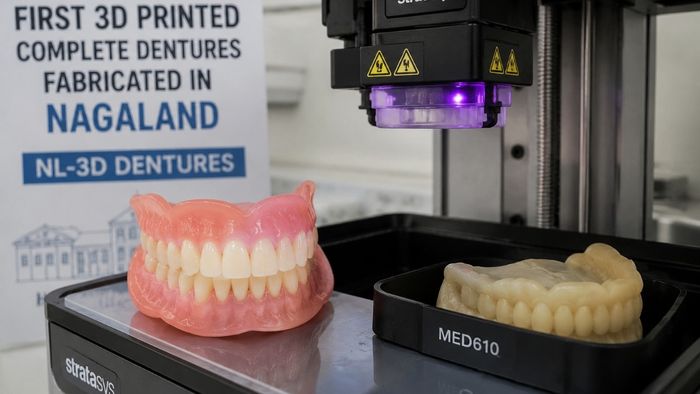
Nagaland produced its first 3D-printed monolithic complete dentures at a workshop in Kohima. The move marks a step in expanding digital dentistry across the State.
- Jul 05, 2026,
- Updated Jul 05, 2026, 3:53 PM IST
Nagaland has fabricated its first 3D-printed monolithic complete dentures, marking a milestone in the adoption of digital dentistry in the State.
The dentures were produced during a workshop on the fabrication of monolithic complete dentures using a PolyJet 3D printer at the Naga Hospital Authority Kohima (NHAK) on Saturday, July 5. Around 30 dental professionals participated in the training programme.
The procedures were carried out by Thungbeni P. Ngullie, Senior Resident at the Nagaland Institute of Medical Sciences and Research, who demonstrated the complete digital workflow and delivered the first five 3D-printed monolithic dentures to patients in the State.
Ngullie said a monolithic complete denture is printed as a single unit rather than being assembled from multiple components. The workflow included conventional impression-taking, scanning, computer-aided design and fabrication using PolyJet 3D printing technology. While clinical procedures such as border moulding and recording jaw relations were retained for accuracy, the remaining stages were digitised.
According to Ngullie, the PolyJet printer can produce up to 32 dentures in about 14 hours, while the five dentures fabricated during the workshop were printed in approximately five to six hours.
She said the technology reduces the conventional denture fabrication process from around 15 manual steps to six or seven, lowering the risk of human error, reducing the number of patient visits and enabling faster delivery. Digital records also allow lost or damaged dentures to be reproduced without repeating the entire clinical process.
Unlike conventional systems that require teeth and gum components to be printed separately, the PolyJet process produces the denture as a single multi-material unit, improving strength, aesthetics and efficiency, she said, adding that the technology is expected to particularly benefit elderly patients requiring complete dentures.
Addressing the workshop, Health and Family Welfare Commissioner and Secretary Anoop Khinchi said digital technologies were transforming healthcare, including dentistry, by improving precision, shortening treatment time and enhancing patient comfort.
He said the State government considers digital dentistry an important step towards making healthcare more accessible and efficient across Nagaland and reaffirmed its commitment to strengthening the skills of healthcare professionals in emerging technologies.
Khinchi also called for collaboration among hospitals, academic institutions, industry and the government to expand the use of digital dentistry and 3D-printing technology beyond specialised centres to district hospitals, dental colleges and community clinics across the State.