Nagaland MLA raises objection over mandatory ‘Vande Mataram’ order in Assembly, cites constitutional protections
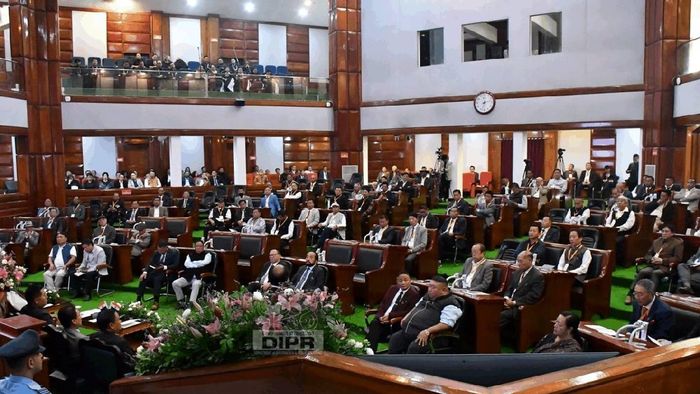
A significant constitutional debate unfolded in the Nagaland Legislative Assembly after MLA Dr Tseilhoutuo Rhütso raised strong objections to the compulsory singing of Vande Mataram under a recent directive from the Ministry of Home Affairs (MHA), calling for an urgent review in light of Nagaland’s unique religious and constitutional protections.
- Mar 03, 2026,
- Updated Mar 03, 2026, 4:04 PM IST
A significant constitutional debate unfolded in the Nagaland Legislative Assembly after MLA Dr Tseilhoutuo Rhütso raised strong objections to the compulsory singing of Vande Mataram under a recent directive from the Ministry of Home Affairs (MHA), calling for an urgent review in light of Nagaland’s unique religious and constitutional protections.
Participating in the Motion of Thanks to the Governor’s Address during the Eighth Session of the Assembly, the 9 A/C Kohima Town legislator endorsed the government’s developmental achievements but struck a serious note over what he termed as “constitutional and conscientious concerns” arising from the MHA notification dated January 28, 2026, which mandated the singing or playing of the National Song across States and Union Territories.
While acknowledging the historical and emotional significance of Vande Mataram in India’s freedom struggle, Dr Rhütso questioned the enforceability of the directive in Nagaland, a predominantly Christian State protected under special constitutional provisions.
The MLA argued that making the National Song mandatory risks conflating patriotism with uniformity, potentially infringing upon Articles 25 and 29 of the Constitution that guarantee freedom of religion and protection of cultural rights.
“Patriotism in Nagaland is evident in the service of our youth, the integrity of our institutions, and our unwavering contribution to the Union. It need not be measured by a compelled hymn,” he said on the floor of the House.
Dr Rhütso urged the state government to review the directive in consultation with the Assembly, ensuring that national unity remains “voluntary and respectful of conscience, not imposed by circular.”
Vande Mataram was composed between 1870 and 1875 by Bankim Chandra Chatterjee and first published in his 1882 novel Anandamath. The poem consists of six stanzas. However, due to explicit references to Hindu goddesses in the later verses, only the first two stanzas — devoid of overt religious imagery — were endorsed in 1937 by national leaders including Mahatma Gandhi, Jawaharlal Nehru, Subhas Chandra Bose and Rabindranath Tagore.
On January 24, 1950, the first two stanzas were adopted as the National Song, while Jana Gana Mana was adopted as the National Anthem.
Dr Rhütso further noted that unlike the National Anthem, no statutory rules govern the singing of the National Song. He referenced the 1986 observation of the Supreme Court of India, which held that singing Vande Mataram is not compulsory and that compelling an individual to do so would infringe upon the freedom of religion guaranteed under Article 25(1).
Emphasising Nagaland’s constitutional safeguards, the MLA invoked Article 371A, which protects the State’s religious and customary practices. He argued that mandatory recitation—particularly if extended to all six stanzas—would be incompatible with the conscience of the Christian-majority population.
“In a State that professes belief in one living God, to require the recitation of verses naming Hindu deities and idols is incompatible with our deepest convictions,” he stated.
He asserted that refusal to sing the National Song does not undermine the sovereignty or integrity of India, adding that loyalty to the Constitution and service to the nation are the true markers of patriotism.
Despite raising objections to the directive, Dr Rhütso reaffirmed his full support for the Governor’s Address and lauded the leadership of Chief Minister Neiphiu Rio. The Address had highlighted progress on the Naga political issue, the Foothill Naga Territorial Administration, infrastructure expansion, sports achievements, human resource development, and advancements in agriculture and allied sectors.
Calling for sensitivity to Nagaland’s “unique heritage,” the MLA concluded with an appeal for an inclusive and secular understanding of patriotism.
“A secular India is a vibrant India,” he said. “No citizen must pray to a particular deity to prove love for the motherland.”
The intervention is expected to spark wider debate on the balance between national symbolism and constitutional pluralism, particularly in States with special protections and distinct cultural identities.