Nagaland University-led study uncovers cancer-fighting potential of Konyak tribal herbal medicine
Nagaland University finds cancer-fighting compounds in Konyak tribe's herbal medicine. The study emphasises the potential of indigenous remedies for modern healthcare.
- Apr 13, 2026,
- Updated Apr 13, 2026, 7:13 PM IST
In a significant scientific breakthrough, researchers from Nagaland University, in collaboration with Berhampur University and Saveetha Medical College, have identified the cancer-fighting potential of a traditional herbal formulation used by the Konyak tribe of Nagaland. The preliminary investigation provides valuable scientific validation of indigenous medicinal practices.
The multi-institute research team examined a five-plant polyherbal formulation traditionally used by Konyak tribal healers. Using advanced analytical and computational techniques, including Gas Chromatography–Mass Spectrometry (GC-MS) and molecular simulations, the researchers discovered that the formulation’s bioactive compounds effectively target VEGFR2 (Vascular Endothelial Growth Factor Receptor 2)—a key protein responsible for tumour blood vessel formation (angiogenesis). Inhibiting this protein can potentially restrict tumour growth.
The findings of the study were published in the peer-reviewed Microchemical Journal, which focuses on advanced analytical methods for detecting and measuring chemical substances at micro and trace levels.
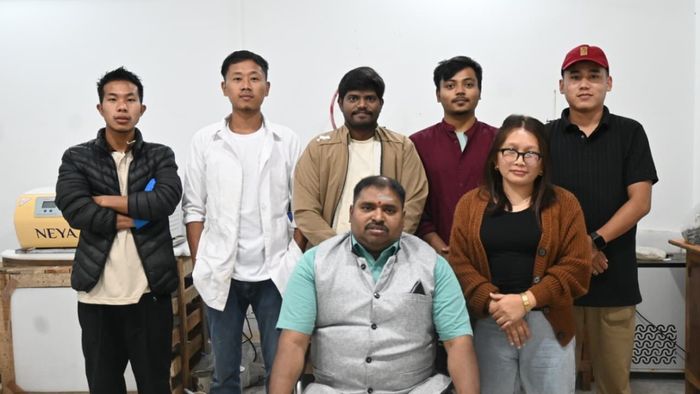
The research paper was co-authored by Longnyu M. Konyak, Giridharan Bupesh, Parthasarathy Sudharsan, Nokenketla Jamir, and Sidhartha Saikia from the Department of Forestry, Nagaland University, along with collaborators from Berhampur University and Saveetha Medical College.
Applauding the research team, Prof. Jagadish K. Patnaik, Vice Chancellor of Nagaland University, stated, “By integrating indigenous knowledge with advanced molecular simulations, the study identifies promising compounds that match the efficacy of existing drugs while indicating lower toxicity. This achievement reflects the university’s dedication to innovative, impactful research rooted in local wisdom and global scientific advancement.”
Highlighting the uniqueness of the study, Dr. G. Bupesh, Assistant Professor (Natural Products and Tribal Health Research) at Nagaland University, said, “This is the first time a specific five-plant formulation used by Konyak tribal healers has been scientifically analysed and validated using advanced computational methods. The identified compounds demonstrated strong anti-cancer potential with performance comparable to existing drugs while indicating lower toxicity.”
The study further revealed that the identified compounds exhibited stable molecular interactions, favourable pharmacokinetic properties, and low toxicity, suggesting their potential as natural anti-angiogenic agents. Importantly, these compounds selectively target VEGFR2 over similar proteins, which could help minimise side effects in future therapeutic applications.
While the findings are currently based on computational analysis, the researchers emphasised the need for further laboratory and clinical studies to validate the results, particularly in the context of colon cancer treatment. The study opens new avenues for cost-effective and nature-based drug discovery, while also reinforcing the importance of preserving indigenous knowledge systems.
Established under an Act of Parliament in 1989 and operational since September 6, 1994, Nagaland University is the 13th Central University of India and the only central university in the state. The university has three campuses: the Headquarters at Lumami in Zunheboto district, the Kohima Campus at Meriema, and the Medziphema Campus (School of Agricultural Sciences) in Dimapur district. Currently, the university comprises 43 departments offering undergraduate, postgraduate, and Ph.D. programmes across diverse disciplines and has 76 affiliated colleges across Nagaland.