‘Answer lies in Assam’: Rahul Gandhi alleges BJP wants to redraw India’s electoral map through delimitation
Congress leader and Leader of Opposition in the Lok Sabha Rahul Gandhi has alleged that the Centre’s proposed expansion of the Lok Sabha from 543 to 850 seats is aimed at giving the BJP greater control over the redrawing of India’s electoral map, specifically pointing to Assam and Jammu and Kashmir as key areas of concern.
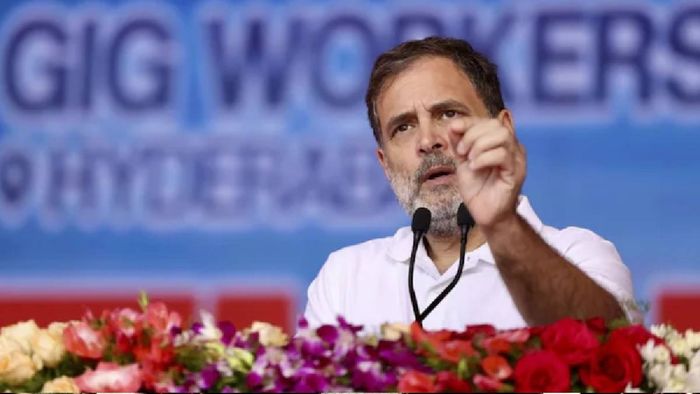
- Nov 28, 2026,
- Updated Nov 28, 2026, 6:00 PM IST
Congress leader and Leader of Opposition in the Lok Sabha Rahul Gandhi has alleged that the Centre’s proposed expansion of the Lok Sabha from 543 to 850 seats is aimed at giving the BJP greater control over the redrawing of India’s electoral map, specifically pointing to Assam and Jammu and Kashmir as key areas of concern.
Questioning the government's justification for linking women's reservation with the proposed delimitation exercise, Gandhi said the reservation legislation had already been passed and could be implemented without increasing the strength of Parliament.
“Their belief is that the Lok Sabha, instead of having 543 members, should have 850 members, and they use this excuse of women's reservation. The women's reservation bill has already been passed. It can be implemented tomorrow. So the question is, why 850?” Gandhi said.
He then identified Assam and Jammu and Kashmir as central to the Opposition's concerns over the proposed exercise.
“The answer lies in Assam, and it lies in Jammu and Kashmir because when you have 850 seats to play with, the amount of changes that you can make, the amount of redesigning that you can do to the electoral map of India is massive,” he said.
Gandhi alleged that the proposed expansion would give the BJP an opportunity to redraw constituencies to its political advantage, weaken the representation of communities opposed to the ruling party and target specific Opposition leaders.
His remarks come amid an intensifying political confrontation over the revised delimitation package, which the Union Cabinet has cleared ahead of a special session of Parliament beginning November 30.
The proposed Constitution (132nd Amendment) Bill, 2026, seeks to increase the maximum strength of the Lok Sabha to 850 members, comprising up to 815 representatives from states and 35 from Union Territories. It also proposes a 50 per cent increase in the number of seats in state Legislative Assemblies.
Under the proposed framework, the 2011 Census would be used for redrawing constituency boundaries, while the existing relative allocation of Lok Sabha seats among states, based on the 1971 Census, would be retained until 2051.
The government has said the legislative changes are intended to facilitate the implementation of 33 per cent reservation for women in the Lok Sabha and state Legislative Assemblies from 2029.
However, the Congress and other Opposition parties have questioned why women's reservation cannot be implemented within the existing strength of the Lok Sabha, without linking it to a fresh delimitation exercise.
The concerns raised by Gandhi also draw attention to previous delimitation exercises in Assam and Jammu and Kashmir. The delimitation exercise in Jammu and Kashmir was completed in 2022, while Assam's constituency boundaries were redrawn in 2023. Opposition leaders have cited these exercises while raising questions about the independence of delimitation authorities and the possibility of politically motivated constituency restructuring.
Under the proposed national exercise, the Delimitation Commission would play a central role in deciding constituency boundaries and the distribution of reserved seats. While the revised proposal seeks to address concerns over the relative representation of states, questions remain over how individual constituencies would be reorganised.
The INDIA bloc on November 28 discussed a coordinated response to the proposed legislation at a meeting of Opposition leaders convened by Congress president Mallikarjun Kharge in New Delhi. The alliance reiterated three key demands: retaining the existing strength of the Lok Sabha, implementing women's reservation within the present House composition and protecting the existing allocation of seats among states for the next 25 years.
The government is scheduled to introduce the fresh legislative package in the Lok Sabha on November 30. The special sitting of the Lower House is scheduled to begin on that day, with the Rajya Sabha set to meet from December 2.
The earlier constitutional amendment package, which sought to link women's reservation with delimitation, failed to secure the required two-thirds majority in the Lok Sabha in April this year.