BJP’s first Bengal polls list out: Suvendu to take on Mamata in Bhabanipur
The Bharatiya Janata Party (BJP) on Monday released its first list of 144 candidates for the upcoming 2026 West Bengal Legislative Assembly election, setting the stage for a high-stakes contest with the ruling All India Trinamool Congress (TMC).
- Mar 16, 2026,
- Updated Mar 16, 2026, 8:23 PM IST
The Bharatiya Janata Party (BJP) on Monday released its first list of 144 candidates for the upcoming 2026 West Bengal Legislative Assembly election, setting the stage for a high-stakes contest with the ruling All India Trinamool Congress (TMC).
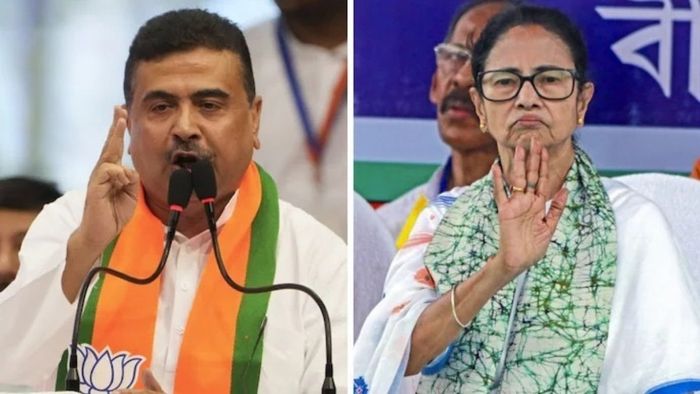
In its most striking move, the party has fielded Leader of the Opposition Suvendu Adhikari from both Nandigram and Bhabanipur. The Bhabanipur seat is currently represented by Chief Minister Mamata Banerjee, setting up the possibility of a direct electoral showdown between the two political rivals.
The announcement, made in New Delhi, signals the BJP’s attempt to sharpen the political narrative around a Mamata-versus-Adhikari contest while largely retaining its sitting legislators and introducing candidates from diverse professional backgrounds.
Adhikari’s candidature from both constituencies is widely viewed as the party’s most high-profile decision in the first list, underlining his central role in the BJP’s campaign strategy in the state.
Nandigram holds strong political symbolism in West Bengal politics as the epicentre of the 2007 anti-land acquisition movement that helped propel Banerjee to power. The constituency also witnessed one of the most dramatic contests in recent years when Adhikari defeated the chief minister there in the 2021 assembly election by a narrow margin of around 1,900 votes.
In contrast, Bhabanipur is widely regarded as Banerjee’s political stronghold. She returned to the assembly from the seat in a 2021 bypoll with a margin exceeding 58,000 votes.
Expressing confidence after the announcement, Adhikari said he would win both seats and defeat Banerjee once again.
Political observers say the decision to field him in Bhabanipur is intended to symbolically challenge the chief minister on her home turf while consolidating the BJP’s organisational networks in coastal Bengal and the Jungle Mahal region, where Adhikari retains significant influence.
The first list indicates the BJP’s preference for continuity, with 41 sitting MLAs being renominated. Among them are Agnimitra Paul from Asansol South, Chandana Bauri from Saltora and Shikha Chatterjee from Dabgram-Phulbari.
Former state BJP president Dilip Ghosh will again contest from Kharagpur Sadar, while former Rajya Sabha MP Swapan Dasgupta has been fielded from the Rashbehari assembly constituency in south Kolkata.
The party has also included candidates from varied professional backgrounds to widen its social outreach. Of the 144 nominees, 57 come from fields such as teaching, law, medicine, social work and the armed forces. Teachers form the largest group with 23 candidates.
Among notable names are actor Rudranil Ghosh and former India cricketer Ashok Dinda, who has been renominated from Moyna. The BJP has also fielded Soumitra Chattopadhyay from Naihati.
In terms of age profile, the party has fielded 36 candidates below 40 years of age, while 72 nominees fall in the 41–55 age bracket. Thirty-two candidates are between 56 and 70 years old, and four are above 70.
Women candidates have been given representation in 11 constituencies.
The announcement comes amid intense political debate over the Special Intensive Revision (SIR) of electoral rolls, which has sparked controversy following large-scale deletions in several constituencies.
In Bhabanipur alone, more than 47,000 names have reportedly been removed from the voters’ list, with over 14,000 still under adjudication. In Nandigram, about 11,000 names have been struck off during the revision process.
The BJP has defended the exercise as necessary to eliminate alleged “bogus voters”, while the TMC has accused the party of attempting to manipulate the electorate ahead of the polls.
Despite the criticism, BJP leaders expressed confidence about their prospects in the state, pointing to the party’s rapid rise in West Bengal politics—from a marginal vote share of around four per cent in the 2011 assembly polls to more than 38 per cent in 2021, when it emerged as the principal opposition.