Cockroach Janta Party’s X account withheld in India, founder alleges recent attempt to hack Instagram page
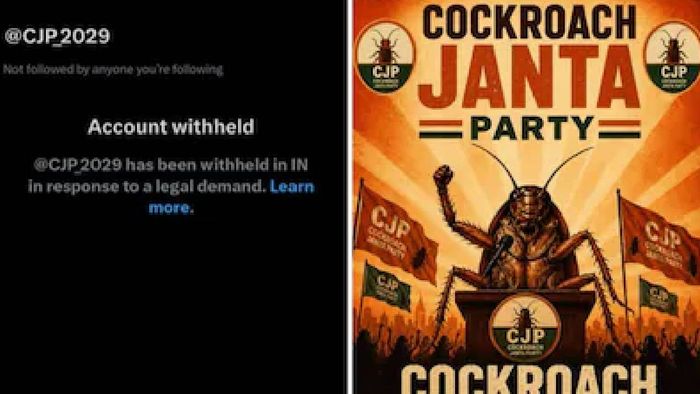
The X account of the viral satirical “Cockroach Janta Party” (CJP) has been withheld in India on May 21, days after the online movement emerged as one of the country’s biggest social media phenomena.
- May 21, 2026,
- Updated May 21, 2026, 4:16 PM IST
The X account of the viral satirical “Cockroach Janta Party” (CJP) has been withheld in India on May 21, days after the online movement emerged as one of the country’s biggest social media phenomena.
The social media campaign gained momentum after controversial remarks made by Surya Kant during a hearing on May 15 which triggered outrage across social media platforms.
During the hearing, the Chief Justice, stated, “There are youngsters, like cockroaches, who don't get any employment or have any place in the profession. Some of them become media, some of them become social media, RTI activists, and other activists, and they start attacking everyone.”
The comments immediately sparked backlash online, with many social media users interpreting the statement as insensitive towards unemployed youth and independent voices online. Although the CJI later clarified that his remarks were specifically directed at individuals with “fake and bogus degrees” and not the youth of the country in general, the controversy had already escalated by then.
Soon after the statement went viral, the Cockroach Janta Party emerged online as a satirical response to the controversy. The collective, which refers to itself as a political movement for “the lazy, unemployed, chronically online and professionally frustrated,” quickly became a trending topic across social media.
The movement was launched by Abhijeet Dipke, a political communications strategist and student at Boston University. Before moving to the United States, Dipke had worked with Aam Aadmi Party, a party known for its aggressive digital outreach and anti-establishment messaging.
In interviews following the controversy, Dipke said the comments by the Chief Justice became especially triggering because they came from someone occupying the country’s highest judicial office.
“I think the remarks were more hurtful because they came from the Chief Justice of India, who is the custodian of the Constitution and freedom of expression. Someone who is supposed to protect our right to express opinions was comparing people to cockroaches and parasites,” Dipke said.
He further argued that had similar comments come from politicians, the reaction may not have been as intense. According to him, the outrage reflected growing frustration among young Indians who feel increasingly disconnected from institutions and political leadership.
Within just a few days of its launch, the CJP witnessed explosive growth online. In under a week, its Instagram page has accumulated more than 14 million followers despite having only around 60 posts. The collective’s X account had gained nearly 200,000 followers before it was withheld in India.
There was widespread attention after it overtook several mainstream political organisations in terms of engagement and follower growth. In one viral Instagram post, after surpassing the follower count of 8.8 million of Bharatiya Janata Party (BJP)'s instagram page, CJP mocked the ruling party’s long-standing image with the caption “World’s largest party, they said.”
The CJP’s messaging combines humour, satire, memes and political criticism. Its website describes the movement as “a political party for the people the system forgot to count,” adding: “Five demands. Zero sponsors. One large, stubborn swarm.”
The website also provides a satirical manifesto outlining several controversial and attention-grabbing proposals. Among them is a demand that no Chief Justice should receive a Rajya Sabha seat after retirement. Other points include 50 per cent reservation for women in Parliament, strict punishment for elected representatives who defect between parties, action against alleged vote deletion, and cancelling licenses of media houses owned by major corporate groups.
While the movement is not a registered political party, its sharp criticism of institutions and viral online presence have made it one of the most talked-about digital campaigns.
Dipke, the founder of CJP, he claimed the action of the campaign’s X account being withheld was “expected” and described it as evidence that authorities were becoming uncomfortable with the movement’s growing popularity. He also called the blocking an “own goal,” suggesting that attempts to restrict the account would only generate more attention and support for the campaign.
Soon after the X account restriction, Dipke shared another update through a post, alleging that suspicious attempts were being made to access or hack the party’s Instagram account. A screenshot showing unusual login activity were shared alongside the caption, “hacker govt”.
These allegations quickly triggered fresh debate online, with supporters of the movement claiming the actions reflected attempts to silence dissenting voices on social media.
Meanwhile, the Chief Justice had earlier issued a detailed clarification over the controversy, stating that sections of the media had “misquoted” his oral observations. In his clarification, he said his criticism was specifically aimed at individuals using fake credentials to enter professions including law, media and activism.
“It is totally baseless to suggest that I criticised the youth of our nation,” the CJI stated.
Despite the clarification, the online outrage did not subside. Instead, the Cockroach Janta Party continued to expand rapidly, tapping into broader concerns among young Indians over unemployment, rising competition, exam paper leaks, economic insecurity and the role of social media in political discourse.
What initially appeared to be another short-lived meme page has now evolved into a larger digital protest movement, reflecting how satire, humour and internet culture are increasingly shaping political conversations in India.