INSV Kaundinya reaches Muscat, rekindling 5000-year-old India–Oman maritime legacy
The Indian Naval Sailing Vessel (INSV) Kaundinya arrived at Port Sultan Qaboos in Muscat after completing its maiden voyage from Porbandar. The historic arrival marks a symbolic revival of the 5,000-year-old maritime relationship between India and Oman and coincides with the celebration of 70 years of diplomatic relations between the two nations.
- Jan 14, 2026,
- Updated Jan 14, 2026, 10:20 PM IST
The Indian Naval Sailing Vessel (INSV) Kaundinya arrived at Port Sultan Qaboos in Muscat after completing its maiden voyage from Porbandar. The historic arrival marks a symbolic revival of the 5,000-year-old maritime relationship between India and Oman and coincides with the celebration of 70 years of diplomatic relations between the two nations.
The traditionally built stitched-sail vessel and its crew were formally received by Union Minister of Ports, Shipping and Waterways, Sarbananda Sonowal, underscoring the strategic and cultural significance of the expedition. The voyage highlights the oceans’ historic role as connective corridors that fostered trade, cultural exchange and sustained interaction between India and the Arabian Peninsula over millennia.
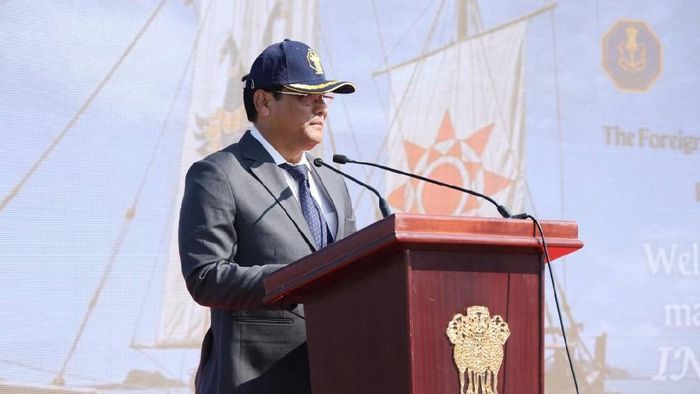
Addressing the gathering at the port, Sonowal described the arrival of INSV Kaundinya as a celebration of shared history and mutual respect. “This is not merely a voyage, but a tribute to a deep-rooted civilisational bond. The arrival of this stitched ship in Muscat symbolises the timeless friendship between India and Oman—anchored in history, enriched by trade and strengthened by trust,” he said. The minister also credited Prime Minister Narendra Modi’s vision for reviving India’s ancient shipbuilding traditions and presenting them to the world with pride.
Named after the legendary Indian mariner Kaundinya, the vessel is a living showcase of India’s indigenous maritime knowledge and sustainable shipbuilding practices. Envisioned by Prime Minister Modi and executed by the Indian Navy, the project involved naval architects, archaeologists, traditional ship designers and master shipwrights. Inspired by a fifth-century CE vessel depicted in the Ajanta Cave paintings, INSV Kaundinya was constructed using ancient stitched-plank techniques without modern nails or metal fastenings.
The official welcome ceremony was attended by H.E. Azzan Al Busaidi, Undersecretary for Tourism at Oman’s Ministry of Heritage and Tourism, along with senior officials from the Indian Navy, the Royal Navy of Oman, the Royal Oman Police Coast Guard and other ministries. Members of the Indian diaspora, including students and professionals, turned out in large numbers to welcome the ship, while traditional Indian and Omani cultural performances added colour to the event.
During his visit, Sonowal held bilateral talks with Oman’s Minister of Transport, Communications and Information Technology, H.E. Eng. Said bin Hamood bin Said Al Mawali. The discussions focused on expanding maritime cooperation, enhancing port connectivity and deepening collaboration across shipping, logistics and shipbuilding sectors.
Highlighting India’s rapidly growing maritime ecosystem, Sonowal invited Omani companies to participate in major port-led infrastructure projects under the Public-Private Partnership framework. He outlined opportunities in the $9 billion Vadhavan Port project in Maharashtra, designed to handle 23 million TEUs, and the $1.3 billion Tuticorin Outer Harbour Project in Tamil Nadu, with a capacity of 4 million TEUs.
The minister also detailed India’s $8.4 billion maritime development package aimed at strengthening the shipbuilding ecosystem through the creation of industrial clusters, enhanced R&D support, a Maritime Development Fund and shipbuilding-led industrialisation. As a key future initiative, Sonowal proposed the establishment of an India–Oman Green Shipping Corridor to promote sustainable maritime practices and decarbonised shipping.
Welcoming the signing of a memorandum of understanding on maritime heritage and museums, Sonowal said the agreement would further enrich cooperation and preserve the shared maritime history of both nations.