Lok Sabha expansion and delimitation: Arguments for and against the proposed 50% increase in seats
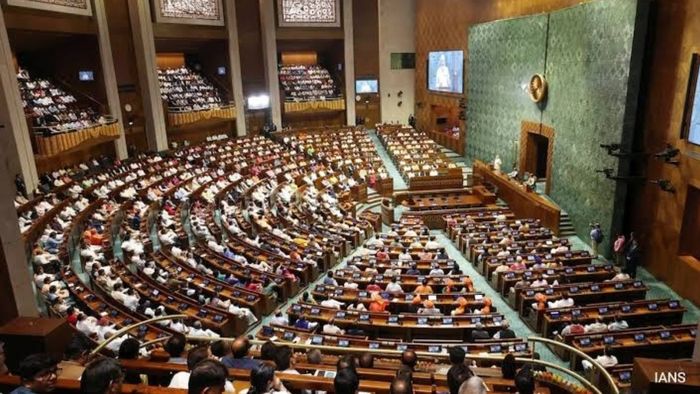
The Centre's proposal to expand the Lok Sabha by 50 per cent and undertake a fresh delimitation exercise has triggered a wider debate over political representation, federal balance and the implementation of women's reservation.
- Nov 27, 2026,
- Updated Nov 27, 2026, 6:02 PM IST
The Centre's proposal to expand the Lok Sabha by 50 per cent and undertake a fresh delimitation exercise has triggered a wider debate over political representation, federal balance and the implementation of women's reservation.
While the government has argued that increasing the strength of the Lower House would make MPs more accessible to voters and facilitate the rollout of the women's quota in 2029, critics have raised concerns over the possible impact on the balance of representation among states, particularly between the north and south.
The Union Cabinet on November 27 cleared a fresh delimitation-linked women's reservation Bill, which is likely to be introduced during a special sitting of Parliament next week. The proposal envisages a uniform 50 per cent increase in Lok Sabha seats across all states.
Here are the key arguments for and against the proposal:
1. Why does the Lok Sabha need expansion?
The allocation of Lok Sabha seats among states is broadly based on the 1971 Census, when India's population was around 55 crore. Since then, the country's population has nearly tripled, but the strength of the Lower House has not increased correspondingly.
According to a paper published by the Carnegie Endowment for International Peace in May 2026, Lok Sabha MPs represent more people on average than members of the lower houses of legislatures in any other country. An average Lok Sabha constituency currently has a population of around 27 lakh.
A 50 per cent expansion could bring the average constituency population down to approximately 18 lakh.
Supporters of the proposal argue that smaller constituencies would allow MPs to engage more closely with voters, address local concerns and improve accessibility. However, even after the proposed expansion, the average Indian parliamentary constituency would have more than twice the population of a US congressional district, according to the Carnegie paper.
2. Why are southern states concerned about the north-south divide?
Article 81 of the Constitution envisages, as far as practicable, a uniform population-to-seat ratio across states.
However, in 1976, the Indira Gandhi government froze the allocation of Lok Sabha seats based on the 1971 Census to ensure that states implementing population-control measures would not lose political representation.
The Atal Bihari Vajpayee government extended the freeze in 2001 until the publication of figures from the first Census conducted after 2026.
Uneven population growth has since created significant differences in the number of people represented by MPs across states.
According to the 2011 Census, an MP from Bihar represents around 26 lakh people, while an MP from Uttar Pradesh represents approximately 25 lakh. In comparison, the figure is around 18.5 lakh in Tamil Nadu and 16.7 lakh in Kerala.
Those supporting population-based redistribution argue that these disparities undermine the principle of equal representation.
However, political parties in southern states fear that such redistribution could penalise states that successfully implemented population-control programmes. They argue that their share of seats in the Lok Sabha could decline, reducing their influence over national policymaking, including decisions on the distribution of financial resources between the Centre and states.
The government's latest proposal seeks to address these concerns by providing a uniform 50 per cent increase in seats across all states and extending the freeze on their relative share in the Lok Sabha until 2051.
Neither safeguard was included in the constitutional amendment Bill defeated in April, despite assurances from the government that the existing proportion of seats among states would be maintained.
3. What are the concerns over gerrymandering?
Opposition parties have raised concerns over gerrymandering, which refers to the manipulation of constituency boundaries to secure electoral advantage.
They have cited delimitation exercises in Assam and Jammu and Kashmir to question whether the redrawing of constituencies could favour particular political parties.
Leader of Opposition Rahul Gandhi has accused the BJP of attempting to redraw India's electoral map to its advantage ahead of the 2029 Lok Sabha elections. The government has rejected these allegations.
Even if the relative share of seats allocated to each state remains unchanged, the process of redrawing constituency boundaries within individual states could remain contentious.
4. Why is even a uniform 50% increase facing criticism?
The government's proposal for a uniform expansion has been presented as a way to address concerns raised by southern states.
However, Congress general secretary Jairam Ramesh had questioned the fairness of the formula in April, pointing to the widening numerical gap between states.
Under the proposed formula, Uttar Pradesh's Lok Sabha strength would increase from 80 to 120, while Kerala's would rise from 20 to 30. The difference between the two states would consequently increase from 60 to 90 seats.
The counterargument is that the expansion would not change Uttar Pradesh's relative political weight, as the total strength of the Lok Sabha and the majority mark would also increase proportionately.
The Carnegie paper, authored by Louise Tillin, Milan Vaishnav and Andy Robaina, has also highlighted a limitation of the formula. While a uniform expansion would reduce constituency sizes, it would not address existing disparities in the number of people represented by MPs from different states.
An MP from Bihar or Uttar Pradesh would continue to represent considerably more people than an MP from Kerala or Tamil Nadu.
5. Why is women's reservation being linked to Lok Sabha expansion?
The government has argued that expanding the Lok Sabha would make it easier for political parties to implement the 33 per cent women's reservation without displacing a large number of sitting male MPs or other aspirants.
In the existing 543-member Lok Sabha, implementing the quota would leave approximately 362 seats open to candidates of either gender.
If the House is expanded to around 815 seats, nearly 543 seats would remain open to both men and women even after the implementation of the quota.
The Congress, however, has questioned the need to link women's reservation with the expansion of the Lok Sabha, arguing that the quota should be implemented within the existing strength of the House.
The Samajwadi Party has also sought representation for women from Other Backward Classes (OBCs) and Muslim communities within the reservation framework.
6. The 2011 versus 2027 Census debate
The timing and population data to be used for delimitation have emerged as another major point of disagreement.
The government has argued that waiting for fresh Census figures and completing the subsequent delimitation exercise could jeopardise the implementation of women's reservation in the 2029 Lok Sabha elections.
The Opposition, however, has questioned the rationale of undertaking an exercise with long-term implications for political representation using population data that could be 18 years old by the next general elections.
The debate, therefore, goes beyond increasing the number of MPs. It concerns how India's electoral representation should evolve, how the interests of states should be protected and whether the proposed changes can ensure a balance between population-based representation and federal equity.