Parliament to reconvene after record 108-day gap as Centre prepares to revive delimitation push
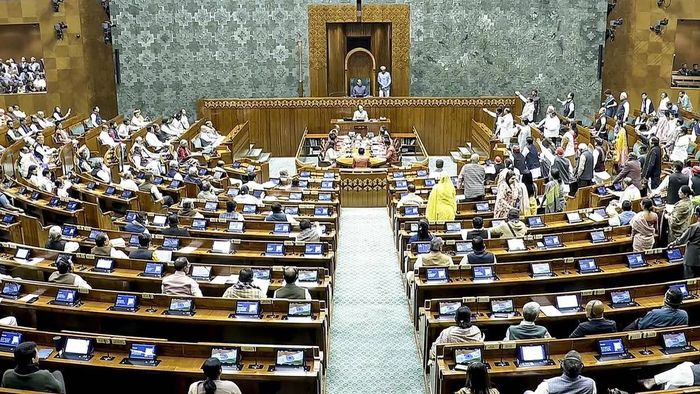
Parliament will reconvene on November 30, with the Lok Sabha resuming its sitting after a record gap of 108 days, as the BJP-led NDA government prepares to push its proposed delimitation exercise and implementation of the 33 per cent women's reservation quota.
- Nov 26, 2026,
- Updated Nov 26, 2026, 9:49 PM IST
Parliament will reconvene on November 30, with the Lok Sabha resuming its sitting after a record gap of 108 days, as the BJP-led NDA government prepares to push its proposed delimitation exercise and implementation of the 33 per cent women's reservation quota.
Parliamentary Affairs Minister Kiren Rijiju announced on Thursday, November 26 that the Lok Sabha would meet on Monday, November 30, while the Rajya Sabha would resume proceedings on Wednesday, December 2, to transact essential government business.
"The Government has requested Hon'ble Speaker, Lok Sabha and Hon'ble Chairman, Rajya Sabha to reconvene Lok Sabha on Monday, 30th November, 2026 and Rajya Sabha on Wednesday, 2nd December, 2026 respectively to transact essential Government Business," Rijiju said in a social media post.
Although the minister did not specify the legislative agenda, sources indicated that the proposed delimitation bill could be discussed at the Union Cabinet meeting scheduled for Friday.
The upcoming sittings will continue the Monsoon Session, which has remained suspended since August without being formally prorogued. By November 30, the gap since the last sitting will have reached 108 days, surpassing the previous record of 87 days set in 2008.
The sittings are expected to conclude on December 3, with four working days for the Lok Sabha and two for the Rajya Sabha.
Centre's delimitation proposal and women's quota
The government's proposed legislation seeks to increase the strength of the Lok Sabha from the existing 543 seats to 850, with approximately 283 seats reserved for women through rotation.
Under the proposed framework, constituencies would be redistributed among states based on the 2011 Census or another census selected by the Centre, instead of waiting for the completion of Census 2027.
The exercise is intended to facilitate the implementation of the 33 per cent women's reservation law enacted by Parliament in 2023.
However, the proposal faces a significant political challenge, with the government falling short of the two-thirds majority required to pass a constitutional amendment.
During the earlier attempt in April, Union Home Minister Amit Shah had verbally assured Parliament that the number of Lok Sabha seats in every state would increase by a uniform 50 per cent to maintain the existing political balance. However, the assurance was not incorporated into the proposed legislation.
NDA short of two-thirds majority
The NDA is estimated to have the support of 319 MPs, including 241 from the BJP. Support from the eight MPs of the NCP (Sharadchandra Pawar) could take the tally to 327.
NCP (Sharadchandra Pawar) leader Supriya Sule has indicated that her party could support the proposal if every state receives a uniform 50 per cent increase in its Lok Sabha seats, ensuring that no region is disadvantaged.
The addition of the DMK's 22 MPs could take the potential support to nearly 350, still short of the approximately 360 votes required, depending on the strength of the House and attendance during voting.
The government would therefore need support from other parties and independent MPs to secure the required numbers.
Opposition puts forward four conditions
The Congress-led INDIA bloc has opposed the proposed delimitation exercise and put forward four conditions for supporting legislation related to women's reservation.
The Opposition has demanded that the Lok Sabha's existing strength of 543 seats remain unchanged, that states retain their current representation, and that the 33 per cent women's reservation law be implemented immediately by reserving 182 of the existing seats for women.
It has also proposed a constitutional amendment to freeze the arrangement for 25 years.
Opposition sources have indicated that the bloc would support the necessary legislation if the government accepts these conditions. However, the demands would effectively require the Centre to abandon its proposed expansion and redistribution of parliamentary constituencies.
The Opposition maintains that the women's reservation law, already enacted in 2023, can be implemented independently of delimitation. It has accused the government of using women's reservation as a justification for redrawing constituencies to its political advantage.
Congress president Mallikarjun Kharge has repeatedly written to Prime Minister Narendra Modi seeking an all-party meeting to discuss the issue.
BJP accuses Congress of obstructing women's reservation
The BJP has accused the Congress of obstructing the implementation of women's reservation.
Speaking at a Constitution Day event on Thursday, Union Home Minister Amit Shah asserted that the BJP-led government was committed to ensuring 33 per cent reservation for women and accused the Opposition of attempting to prevent its implementation.
"I want to tell Rahul Gandhi: it is the resolve of the Bharatiya Janata Party (BJP) and our leader Narendra Modi that the women of this country will definitely get 33 per cent reservation; you cannot stop us," Shah said.
Prime Minister Narendra Modi also reiterated the government's commitment to women's reservation.
With the proposed legislation facing resistance from the Opposition and the NDA yet to secure the required numbers, the upcoming parliamentary sittings are expected to be crucial for the government's delimitation plans.