The onus of proof is on TVK: Why Joseph Vijay’s party can’t escape hard questions
An Opinion on Tamil Nadu’s Political Future, Hindu Apprehensions and the Responsibility of Power
- May 16, 2026,
- Updated May 16, 2026, 6:01 PM IST
Same script, new face?
Tamil Nadu has seen its own share of political reinventions. For seven decades, the Dravidian movement has been recycling itself. Several new parties, new names, new faces, but with an underlying ideological structure that has been surprisingly consistent: anti-Brahminism as social critique, anti-Hindi as linguistic assertion, anti-Hindutva as political positioning, and an increasingly transactional relationship with minority vote blocs, particularly organised Christian communities.
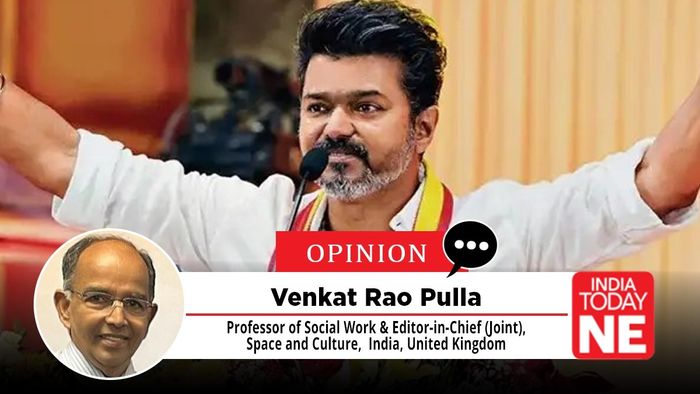
Enter Joseph Vijay, known simply as “Vijay” — the most bankable star of Tamil cinema for nearly three decades and the new face of Tamilaga Vettri Kazhagam. The buzz around him is real. You can sense the energy of youth. Electoral arithmetic is being reworked with lightning speed both in party offices in Chennai and, it seems, is being watched in Delhi as well.
But there is one question that no amount of celebrity charisma, carefully choreographed temple visits or festival greetings has yet answered — and that is the question that millions of Tamil Hindus, broadly secular and generally non-confrontational by temperament, are now beginning to ask in quiet urgency:
Who is TVK really representing, and what assurances does it offer the Hindu majority of Tamil Nadu?
Lessons on Tamil Hindus from the Stalin Years
To understand why Hindu suspicion of TVK is not irrational or manufactured, one must honestly reckon with what the DMK government under M.K. Stalin has symbolised for practising Hindus in Tamil Nadu. DMK ministers freely made fun of temple rituals and mocked Hindu festivals as backward. State control over thousands of temples through the Hindu Religious and Charitable Endowments (HR&CE) Department has been marked by a steady pattern of institutional neglect, siphoning off temple funds for non-Hindu purposes and a systematic denial of representation to devotees and scholars in temple governance, while freely allowing encroachment or alienation of temple lands. While systems and politicians siphoned off temple funds for other purposes, the Archakas and temple staff were denied their due wages.
Meanwhile, churches and mosques, which are not run and controlled by the same government, have enjoyed state patronage, land and political protection. Isn’t this a perception of asymmetry? Well, that has been the policy.
Add to this asymmetry of institutions the well-funded and systematically executed evangelical activity that targets specifically Hindu communities — Dalit Hindus, tribal Hindus, and economically vulnerable rural Hindus — with a mix of welfare inducements, social pressure and narrative manipulation. There is no room for conspiracy theories here; the rise of new churches in previously Hindu-dominated villages, and the well-documented networks of foreign-funded evangelical organisations working in the state, are matters of public record available to truth seekers.
The DMK government did not just tolerate this dynamic. The party’s senior ministers and spokespersons were actively involved in conversion agendas, with senior ministers acting as activist accomplices.
Tamil Hindus are not a single homogeneous group of aggressive nationalists. They are, in the main, deeply religious people, quietly devout and broadly culturally anchored. They go to Murugan temples at dawn, celebrate Pongal with real joy, read the Thirukkural as an ethical scripture and follow folk traditions that are millennia older than organised religion. They never sought a Hindu rashtra. They want a government that recognises their faith and protects their temples.
When that same community now turns to TVK — a party founded by a man who has publicly called himself a devout Christian, whose early platform events included associations with evangelical missionary networks, and whose ideological DNA is unmistakably Dravidian — they are not being paranoid. They are being historically aware.
You Can’t Replace Accountability with Optics
What TVK has given Tamil Hindus so far is aesthetics.
Vijay goes to temples. He shares Pongal greetings. He does not openly abuse Hindu traditions like some of his Dravidian predecessors. He has spoken against casteism and rightly called it a social evil. His party has some MLAs from the Tamil Brahmin community, which has been celebrated in some quarters as a sign of inclusion.
Such inclusion seems bordering on tolerance, none of which addresses a single structural concern. These are issues TVK has not addressed at all, and which the Hindu majority of Tamil Nadu has every right to demand answers for.
Will TVK promise to amend the HR&CE Act to return the administration of temples to the respective devotee communities and independent trusts without interference from state politics? Will it promise transparent, independent auditing of temple revenues, with funds used only for temple maintenance, archakas’ welfare and devotee services?
Will TVK pledge to protect temple lands from encroachment, rezoning or state acquisition? Will it restore alienated properties and create a statutory heritage protection mechanism?
Does TVK have a clear and constitutional position on religious conversion? Not a blanket condemnation — that would be impractical and illiberal — but a clear commitment to prosecute coercive conversions, regulate foreign-funded evangelical organisations under FCRA norms and ensure that welfare delivery in Tamil Nadu is not conditional on religious affiliation?
Has TVK promised to treat all religious institutions equally under the law of the state? Will the government that administers Hindu temples extend the same administrative oversight to churches and mosques? Or will the current asymmetry that favours minority institutions continue?
These are basic constitutional issues of equal treatment, institutional fairness and integrity of governance — all of them within the purview of a responsible state government.
TVK has not said a word about any of them.
The Funding Question: Who Pays for Hindu Regeneration?
One of the most dishonest aspects of the standard political advice given to Hindus in Tamil Nadu — including notably the framework produced in response to this enquiry — is the implicit assumption that the burden of cultural and religious regeneration lies entirely with Hindu civil society itself.
Build your own temples. Train your scholars. Finance your festivals. Increase your youth. Claim your heritage.
Right. All required. And where does the money come from if those very temple accounts are being drained to fund other priorities?
The bitter reality is that Tamil Nadu’s Hindu temples — collectively the world’s most valuable collection of religious endowment wealth — are managed by a state government that regularly siphons temple income for non-temple use. Taxes on hundis and land rents flow into general coffers. Executive officers are government appointees running ancient shrines, often without any connection to the faith. Temple schools have been closed. Agama scholars are not paid.
At the same time, Christian institutions — schools, colleges, hospitals and orphanages — are under church administration but receive government aid, land subsidies and minority welfare funds. They are not covered under the HR&CE regime. They build their communities with a combination of foreign funding, state patronage and institutional autonomy.
The playing field is uneven. It hasn’t been even for decades. And telling Tamil Hindus to “build cultural confidence” without addressing this structural dispossession is gaslighting them.
The questions for a responsible TVK government are:
- What will you do about temple funds?
- Will you return them to the temples and audit decades of diversion?
- Will you make religious institutions equal in the eyes of the law across all faiths?
The Missionary Question
In liberal commentaries, any concern about organised missionary activity is reflexively dismissed as communal bigotry. This must be challenged.
Concern about coercive conversion — the targeting of economically vulnerable people with material inducements in exchange for religious affiliation — does not amount to Islamophobia or Christianophobia. It is a human rights matter. International bodies have acknowledged it as such. The Indian Parliament, with secular, socialist and minority members, has recognised that conversion by inducement or fraud is an abuse of the vulnerable, not an exercise of genuine spiritual choice. This is why India has Freedom of Religion Acts in several states.
Tamil Christianity certainly has deep roots, authentic theological traditions and many Tamil Christian citizens have contributed to the culture, literature and public life of the state.
The fear is of structured, externally foreign-financed, conversion-driven evangelism that aims to destabilise Hindu demographic majorities in rural and tribal areas. This is not hypothetical.
The concern over TVK is very specific: that a Vijay-led government, with its known associations with evangelical networks — most visibly demonstrated at the 2025 Equality Christmas event, where TVK shared platforms with missionaries from multiple denominations — would give political protection and administrative cover to this organised activity, just as the Stalin government allegedly has.
This is not a suspicion conjured from thin air. This is a well-documented trend. Tamil Hindus are not being paranoid. They are studying history.
A TVK government cannot pass off vague statements about religious harmony. It must consider serious policy options: enforcing FCRA compliance, transparent auditing of foreign-funded religious organisations, strict implementation of anti-coercion provisions and a clear public commitment that state welfare delivery will remain faith-blind.
The Myth of ‘Secular Brahmin MLAs’
Much has been said about the presence of Tamil Brahmin MLAs in TVK’s electoral slate. This has been offered by some Hindu commentators as reassurance.
It should not be.
Historically, a marginalised community in Tamil Nadu’s Dravidian political economy, Brahmins, despite their cultural and professional prominence, have entered TVK’s orbit for the same reasons professionals enter any rising political formation: opportunity, visibility and upward mobility within a changing system.
Their presence does not indicate anything about TVK’s position on temple administration, conversion politics or Hindu cultural rights. In fact, the historical record suggests that Dravidian parties have repeatedly used upper-caste or minority-Hindu inclusion as symbolic cover while pursuing policies hostile to Hindu institutional interests.
The question is not who the MLAs of TVK are. The question is what kind of government TVK will form.
If TVK is a real all-community party and not, as mounting evidence suggests, a soft front for organised minority political consolidation, it must make its position clear on temples, religious equality, conversions and separatist tendencies.
He needs to make it clear that he is committed to constitutional politics within the Indian Union. He also needs to make a public promise that church bodies will not be involved in the making of government policy.
These are not demands from a sectarian fringe. These are baseline expectations of a Hindu majority that has seen its institutions systematically weakened over seven decades of Dravidian rule and is now being asked to place its trust in yet another Dravidian successor.
The Deeper Stakes
TVK needs to assure voters that it will not treat Hindu temples as cash cows, Hindu festivals as law-and-order problems, and Hindu civic concerns as communalism.
The post-Dravidian political shift is happening. There is a new generation of voters, less beholden to the ideological certainties of the 1960s and 70s, looking for something that combines Tamil pride, social justice, economic competence and genuine pluralism — pluralism that includes Hindus and not just the minorities that Dravidian politics has traditionally prioritised.
TVK has the opportunity — and the democratic obligation — to become that formation. But opportunity and obligation demand honesty.
Trust Has to Be Earned
Tamil Hindus are not seeking a theocracy. They are not asking for minorities to be excluded from political life. They are not trying to avenge decades of cultural marginalisation.
They need a level playing field.
Joseph Vijay has incredible charisma, a real connection with Tamil youth and a political agenda yet to be fully written.
It is for TVK to prove itself — not for Tamil Hindus to dispel their doubts, and not for Hindu civil society to bootstrap itself with funds already siphoned out by the state.
Hindus of Tamil Nadu have been patient. They have been secular. They have been generous in their pluralism. They deserve, at the very least, straight answers.
(This editorial represents an opinionated assessment of Tamil Nadu’s evolving political landscape. It draws on documented public events, policy records and observable political patterns. Factual claims are subject to the publicly available record.)