100 Days Without Justice: What the NIA Must Answer About the 13 May Massacre of Three Thadou Church Leaders
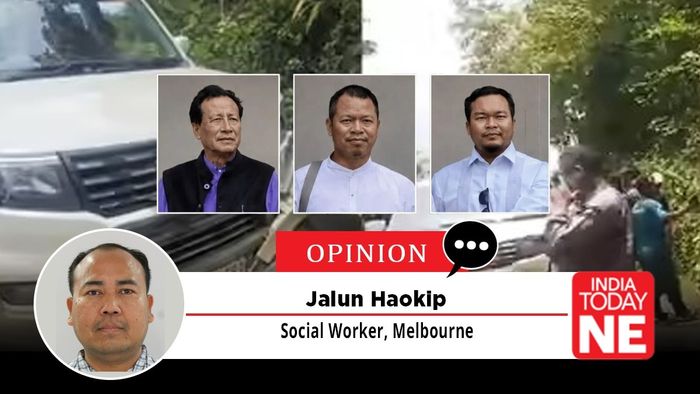
More than 100 days have passed since three senior leaders of the Thadou Baptist Association India (TBAI)—its President, Rev. Dr. Vumthang Sitlhou, Rev. Kaigoulun Lhouvum and Pastor Paogoulun Sitlhou—were killed in a targeted ambush in Kangpokpi district, Manipur, on 13 May 2026.
- Sep 05, 2026,
- Updated Sep 05, 2026, 12:01 PM IST
More than 100 days have passed since three senior leaders of the Thadou Baptist Association India (TBAI)—its President, Rev. Dr. Vumthang Sitlhou, Rev. Kaigoulun Lhouvum and Pastor Paogoulun Sitlhou—were killed in a targeted ambush in Kangpokpi district, Manipur, on 13 May 2026. Five others were seriously injured, including Rev. S. M. Haopu, Executive Secretary of TBAI; Rev. Hekai Simte; Rev. Kaikhothang Singsit; and two drivers, Thangtinlen Sitlhou and Goumang Lhouvum.
The National Investigation Agency (NIA), India’s premier investigating agency, took over the case on 24 June, based on an FIR registered on 8 June. Yet there has been no publicly known arrest or significant breakthrough.
For me, for many in the Thadou community, and for everyone who cares about justice and accountability, this prolonged silence is deeply troubling. The circumstances of this unprecedented attack demand clear answers about the effectiveness, independence and credibility of the investigation—and, above all, why those responsible remain at large till now.
NIA’s Double Standard: Why Won’t the NIA Correct the Victims’ Identity?
Perhaps the most troubling issue is the NIA’s wrongful identification of the victims. The three pastors were reportedly identified as “Kuki” or “Kuki-Zo” in NIA-related material despite their established Thadou identity and their leadership roles in TBAI, an independent Thadou Christian institution—not a Kuki church or organisation. Thadou Inpi Manipur formally requested a correction, but the NIA reportedly refused.
This matters because identity can be central to motive. The concern is heightened by an apparent double standard. In the Tronglaobi bombing case, the accused, Palal Kuki, an active Kuki militant reportedly belonging to an armed Kuki militant group opposed to Thadou, was identified as “Palal Thadou” in the NIA report, despite having previously been identified as Palal Kuki in police and other accounts. The NIA’s reported misclassification was subsequently repeated by the Manipur state Home Minister in a recent statement.
Why is “Thadou” rejected when accurately identifying the victims in the case of the three Thadou church leaders, yet used when it appears to contradict the established identity of a Kuki militant in the Tronglaobi bombing case? Is this merely an inconsistency, or does it reflect a deeper bias—or even a deliberate effort or conspiracy—to portray Thadou identity in ways that support Kuki narratives and appease Kuki militant groups?
Was this inconsistent classification merely an error, or did it serve to reinforce the Kuki supremacist narrative that Thadou is subordinate to or part of Kuki, while undermining recognition of Thadou as a distinct identity separate from Kuki? More seriously, was there any deliberate intent behind this classification to create mistrust between the Thadou and Meitei communities and undermine the growing understanding between them?
These are serious questions that the NIA should address transparently. It must explain the basis on which the identities of both the victims and the accused were classified and demonstrate that such classifications are determined by evidence and facts rather than political or ideological narratives.
I do not allege, without evidence, that the NIA deliberately labelled the victims as Kuki to protect anyone. But refusing to correct an allegedly inaccurate classification raises legitimate questions about impartiality.
If the victims were targeted because they were Thadou, wrongly identifying them as Kuki could obscure the motive itself and potentially distort the direction, findings and outcome of the investigation.
The Armed Groups in the Area
The attack occurred in an area where Kuki SoO militant groups, including the Kuki Revolutionary Army (KRA) under KNO and the Kuki National Front (KNF) under UPF, maintain a strong presence. These groups operate within a Unified Command of Kuki militant organisations, both under and outside the Suspension of Operations (SoO) framework in Kangpokpi district. The Unified Command is reportedly headed by Jangboi Kipgen, Home Secretary of the KNF and Chairman of the Unified Command, who is notorious for his Kuki supremacist and anti-Thadou stance, as well as his opposition to other indigenous communities.
This does not establish guilt. However, the networks, movements, intelligence capabilities and command structures of these groups are obvious lines of inquiry. Equally concerning is the absence of any publicly reported detention or interrogation of KRA, KNF or other armed-group cadres in connection with the massacre. There are substantial circumstances that raise serious questions about whether armed Kuki militant groups were involved in the attack. That possibility deserves thorough investigation.
The significance of these questions is heightened by another grave incident that occurred later that same day. Six Naga civilian men, including a church pastor, were abducted on 13 May, and their heavily mutilated, dismembered and beheaded bodies were discovered about 30 days later. Reports have also alleged that the families of the murdered Naga civilians were served the cooked flesh of their dead relatives by suspected Kuki militants.
The timing and circumstances of the two incidents warrant examination to determine whether they were entirely separate events or whether there was any connection between them. The perpetrators in the two incidents are strongly suspected by many to belong to the same group or to connected groups, but this remains to be established through evidence. One possible motive, if there was a connection, may have been to provoke conflict between the Thadou and Naga communities or to draw the peace-loving Thadou community into the wider Kuki-Naga violence. This possibility should be examined rather than assumed or dismissed.
Kuki militant organisations operating under the Suspension of Operations (SoO) agreement with the Government of India and the Manipur state government, along with non-SoO groups reportedly aligned with them as proxies, are widely perceived to enjoy considerable operational, financial, logistical and political space. This reportedly includes significant influence over elections, government and community affairs; extensive access to government and community institutions; and substantial influence over civilian life and activities. These groups also receive regular government stipends and have been accused of raising revenue through illegal taxation and extortion, as well as involvement in arms and drug smuggling.
This has fuelled widespread perceptions of impunity, with many describing the Kuki SoO arrangement as effectively enabling or shielding armed militancy, while some have even characterised it as state-sponsored armed militancy or terrorism. Whatever terminology is used, the fundamental question remains: are these armed groups being subjected to the same level of scrutiny, investigation and accountability expected of others?
The Rush to Blame
In the immediate aftermath of the killing of the three Thadou pastors, Kuki organisations and affiliated voices attributed responsibility to Naga groups before any verified evidence had been publicly presented. Within less than two hours, the Kuki Inpi Manipur issued what appeared to be a pre-prepared statement naming Naga armed organisations, including the ZUF-Kamson Group, and alleging a connection with the NSCN-IM.
Those named denied involvement. Neither accusation nor denial establishes guilt; responsibility must be determined through evidence and impartial investigation. Notably, no Kuki armed militant group has publicly claimed responsibility for, or denied involvement in, the gruesome attack.
The NIA should therefore ensure that early allegations do not predetermine the investigation and that all armed groups operating in the area receive equal scrutiny.
Were the Victims Specifically Targeted Because of Their Thadou Identity?
The two vehicles carrying the Thadou leaders reportedly displayed clearly visible TBA signage. Vehicles immediately ahead of and behind them, reportedly carrying people including Kukis, were not attacked. Only the two TBA vehicles were targeted, particularly the vehicle carrying Rev. Dr. Vumthang Sitlhou, who reportedly sustained at least 20 bullet wounds.
Were these men specifically identified and targeted because they were Thadou and TBAI leaders? This possibility deserves serious investigation. Four days before the massacre, Rev. Dr. Vumthang had been listed as the main minister for a “Kuki flag” hoisting ceremony scheduled for 9 May. On 8 May, he publicly stated that he had neither consented to the programme nor intended to attend it. The flag was adopted by Kuki militant groups under KNO and UPF on 3 May.
He rejected the representation that he endorsed the event and maintained his position as a Thadou Christian leader committed to peace and the distinct Thadou identity. Four days later, he was killed.
This does not prove a connection, but the timing warrants investigation. The NIA should determine whether his identity, public position, or refusal to participate had any bearing on the attack.
Militant, Church and Political Connections
The presence and influence of Kuki militant organisations in the area warrant particular scrutiny. Their networks, movements and command structures should be examined to determine whether they had prior knowledge of the leaders’ movements, provided intelligence, facilitated the attack, influenced the selection of the victims, or subsequently obstructed the investigation.
Jangboi Kipgen, a member and prominent promoter of the Kuki Christian Church (KCC), is closely associated with its leadership. The head of the KCC, Rev. T. Lunkim, has faced longstanding criticism over his promotion of false genealogical claims and sustained anti-Thadou campaigns. He has also been accused of promoting divisive and extremist Kuki-supremacist ideological frameworks, including the Any Kuki Tribes (AKT) framework and the Kuki country theory, which seek to erase or subsume the distinct and indigenous Thadou identity and have laid the ideological groundwork for violent armed Kuki militancy.
Rev. Dr. Vumthang Sitlhou, by contrast, was a prominent Christian leader, advocate of peace and communal harmony, and strong defender of the distinct Thadou identity—positions that placed him in clear ideological opposition to radical Kuki extremist elements. Against this backdrop, the NIA must examine whether these ideological differences, his public advocacy, or networks associated with those opposing his position had any bearing on the attack, including whether they contributed to his identification or selection as a target.
None of these associations establishes criminal responsibility. However, they are legitimate lines of inquiry. The NIA should determine whether militant or associated networks had prior knowledge of the leaders’ movements, provided intelligence, facilitated the attack, influenced the selection of the victims, or subsequently obstructed the investigation.
The broader political environment also demands scrutiny. The wives of the KNF and KRA supremos are members of the state government, one serving as Deputy Chief Minister, while several MLAs reportedly have family, political or organisational ties to Kuki SoO groups. These links do not establish wrongdoing, but they warrant an independent examination of any potential conflicts of interest, political influence or interference.
This is not about presuming guilt; it is about ensuring that no credible line of inquiry is ignored. The NIA must follow the evidence wherever it leads and investigate every plausible possibility impartially.
Given the apparent precision and selectivity of the attack, failure to examine these questions would raise serious concerns about the completeness, independence and credibility of the investigation.
Truth will remain elusive, and justice will be a victim if those responsible for the investigation are biased, influenced by, or perceived to be colluding with those advancing the political narratives of Kuki groups suspected of involvement in the very crime they are tasked with investigating.
The State government and NIA Must Answer
After more than 100 days, the public deserves answers. What progress has been made? What evidence has been collected? Why has there been no publicly known arrest? Have KRA, KNF and other armed groups, their cadres and command structures been thoroughly investigated?
What were the reasons for and outcome of the reported recent raid on Jangboi Kipgen’s residence? Why has he not been arrested, despite reportedly continuing to live in the community? Have his political connections and any potential conflicts of interest been examined? Why has the NIA refused to correct the victims’ Thadou identities? And has the possibility that they were targeted because of their Thadou identity and TBAI association been seriously investigated?
These are not demands for arbitrary arrests. They are legitimate questions arising from the circumstances of the massacre and the lack of visible progress.
The families deserve justice, and the public deserves the truth. The NIA must demonstrate that its investigation is guided by evidence and law, without political or ideological influence.
Justice must not become another casualty of the conflict.
The writer, Jalun Haokip (MSW), is a Melbourne-based native of Manipur with professional experience in social work across mainstream and Indigenous Australian communities. He currently works as a social worker in a family violence program within the Victorian Government in Melbourne.