13 September: Thadou Martyrs’ Day — Remembering the Sacrifice, Defending Our Identity
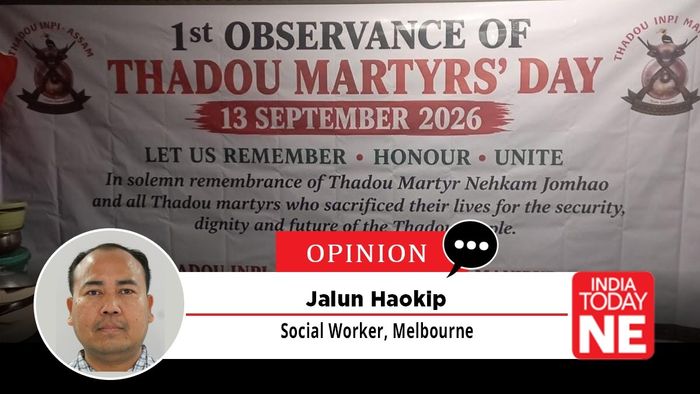
For the Thadou people, 13 September is such a day—a day to honour and remember the courageous life and sacrifice of the late Thadou hero and martyr, Pu Nehkam Jomhao, and the Thadou men and women who gave their lives in defence of their Thadou identity, dignity and peaceful existence.
Jalun Haokip
- Sep 13, 2026,
- Updated Sep 13, 2026, 2:27 PM IST
Some names are never forgotten. Some sacrifices become part of a people’s history. And some lives, taken by violence, continue to speak long after the voice is gone.
For the Thadou people, 13 September is such a day—a day to honour and remember the courageous life and sacrifice of the late Thadou hero and martyr, Pu Nehkam Jomhao, and the Thadou men and women who gave their lives in defence of their Thadou identity, dignity and peaceful existence.
This year, under the aegis of Thadou Inpi Assam and Thadou Inpi Manipur, Thadou Martyrs’ Day will be observed at Thadou Veng in Diphu, Assam, where the mortal remains of Nehkam Jomhao were laid to rest on 13 September 2025. He is remembered as a Thadou martyr because he was killed by Kuki armed militants for his Thadou identity and for advocating peace.
Thadou households have been urged to raise the white flag on 13 September as a visible declaration that the Thadou people are a peace-loving community seeking justice, dignity and peaceful coexistence. The white flag is not a symbol of surrender; it is an affirmation that the Thadou people seek peace without surrendering their identity or dignity.
30 August 2025: The Brutal Killing of Nehkam Jomhao
It is against the broader history of persecution of the Thadou people through violent Kuki supremacist campaigns that the killing of Pu Nehkam Jomhao on 30 August 2025 assumes particular significance.
Jomhao, 59, was a respected Thadou community leader, writer and chairman of the Thadou Literature Society, Assam. He was abducted from his residence at Manja, Karbi Anglong, and subsequently murdered. His body was recovered from a river on 4 September 2025 after an extensive search by local communities, including volunteers from Thadou and Karbi communities, and government agencies, and it was heavily mutilated.
Police subsequently arrested six suspects belonging to the Kuki Revolutionary Army (KRA), including one cadre from Manipur. According to police reports, the suspects confessed to the murder and disposal of Jomhao’s body. The KRA, along with the Kuki Liberation Army (KLA) and United Kukigam Defence Army (UKDA), all under Suspension of Operations (SoO) with the Assam state government at the time, was later dissolved following an agreement with the Assam Government on 15 March 2026.
Jomhao was not an armed combatant. He was a literary and community leader who defended the Thadou language, heritage and identity while advocating peaceful dialogue. On 6 August 2025, just weeks before his death, he participated in the Road to Peace – Covenant of Community Understanding in Imphal. He had received numerous death threats from Kuki groups, including Kuki SoO groups, Kuki civil-society organisations and individuals. Despite complaints from Thadou organisations, no preventive action was taken against those alleged to be responsible for the threats.
His killing therefore became a stark reminder of the dangers faced by those who assert their identity while choosing dialogue over violence. It also raised serious questions about the SoO framework and strengthened demands for its abrogation.
Jomhao was laid to rest with full honour at Thadou Veng, Diphu, on 13 September 2025 and was subsequently declared a Thadou martyr. His death has come to symbolise the price that individuals and communities can pay when they stand firmly for identity, dignity and peaceful coexistence.
A Struggle Beyond One Martyr
For the Thadou people, 13 September represents more than the sacrifice of one individual. It commemorates a broader historical struggle involving political pressure, identity appropriation, intimidation and violence.
Thadou society was peaceful and united, and the indigenous Thadou identity remained distinct and undisturbed until the rise of Kuki extremist-supremacist ideologies and campaigns in the 1970s. These developments were followed by the emergence and expansion of Kuki armed militancy in the 1980s and were further reinforced by political accommodation, including through the SoO framework. Together, these forces transformed the social and political landscape of many Thadou-inhabited areas and intensified efforts to subsume the distinct Thadou identity into a violent extremist Kuki political project, affecting not only Thadous but also other indigenous communities in Manipur and beyond.
The aggressive and often violent campaign to suppress and subsume Thadou identity operated through political mobilisation, armed organisations, civil-society platforms, religious institutions and other networks. Thadous who asserted a distinct identity have, according to community accounts, faced threats, persecution, social ostracisation, displacement, intimidation and other forms of coercion.
At the heart of the struggle is the Thadou people’s right to define themselves and determine their own future. Identity is not merely a matter of terminology. It is connected to language, culture, political representation, security and the right to participate equally in democratic life.
The Thadou position is therefore clear: Thadou is Thadou. The community maintains that its identity cannot legitimately be imposed, altered or subordinated to another political project.
The book “Manipur in Peril: The Danger of Kuki Supremacism and Radicalism — The Thadou Struggle: Defending Peace and Indigenous Identity Against Persecution,” published by the Thadou Students’ Association in collaboration with the Thadou Inpi Manipur and Thadou Community International in April 2026, documents and examines many of these experiences and the evidence surrounding them.
From Thadou Cultural Heritage to Kuki Cultural Genocide Against the Thadou
The struggle over Thadou identity also has a much earlier cultural and linguistic history. The Thadou New Testament predates the later controversy over identity. Pu Ngulhao Thomsong, with the assistance of Dr. G. G. Crozier, translated the New Testament into Thadou. The Gospel of John was published in 1925, followed by other portions of Scripture, and the complete Thadou New Testament was published in 1942. Thomsong also began translating portions of the Old Testament.
As discussed in Manipur in Peril, a major controversy emerged in 1971 when Rev. Dr. T. Lunkim, described as the lifetime supreme leader of the Kuki Christian Church (KCC), presented the existing Thadou Bible as the “Kuki Bible.” It was launched on 21 June 1971 at Molvom, Nagaland, following litigation and controversy in Manipur. Dr. Lunkim was subsequently jailed for contempt of court.
For Thadous, the significance of this episode went beyond the name given to a Bible translation. The Thadou Scriptures had already become an established part of the community’s linguistic, literary and Christian heritage. Their recharacterisation as a “Kuki Bible” is therefore regarded by Thadous as an early manifestation of a broader campaign to subsume aspects of Thadou cultural identity.
The Forgotten Violence of Assam: Kuki-Thadou Violence, 1992–93
The next major chapter came during 1992–93, when Thadou communities in Assam, particularly in Karbi Anglong and adjoining areas, experienced violence and intimidation.
As narrated in the publication "Manipur in Peril", armed Kuki militants called the Chin Kuki Resistance Force (CKRF), later known as the Kuki Liberation Army, were involved in a campaign against Thadou communities. The Kuki militant campaign was widely alleged to have been supported by Dr. T. Lunkim as part of an effort to rename the Thadou-language programme broadcast by All India Radio (AIR) Haflong as a “Kuki Programme.”
Thadou chiefs in Dima Hasao were pressured into accepting the change, while Thadou chiefs in Karbi Anglong resisted similar pressure concerning the AIR Diphu programme. The dispute subsequently became violent as Kuki militants started violent attacks against the Thadou community.
An article titled “Genesis of Kuki-Thadou Conflicts,” written by Janglam Kipgen, Secretary of the Thadou Tribe Council, India, and published in the Diphu Times on 18 July 1993, documented the conflict and its identity-related tensions, with many Thadou individuals and villages becoming victims of Kuki agression.
The violence received limited wider attention because it occurred alongside the more prominent Kuki-Naga clashes of the period. For Thadous, however, these events became a defining chapter in their experience of being caught between larger conflicts while defending their distinct identity.
Kuki Supremacism, Modus Operandi and Organised Influence
The conflict also points to the role of interconnected political, social, religious and militant networks. Radical Kuki networks have combined clan and family structures, political organisations, civil-society platforms, religious institutions and armed militant groups to advance a Kuki political agenda at the expense of the distinct identity of Thadous and other indigenous communities.
Organisations and platforms associated with this wider political network include the Kuki National Organisation (KNO), Kuki Inpi, Kuki Students’ Organisation, Kuki Christian Church and Kuki Worship Service, as well as various Kuki armed militant, church and civil-society organisations.
These networks have employed Kuki supremacist ideological mobilisation, cult indoctrination, religious and cultural messaging, financial influence, political relationships, intimidation and coercion to expand and consolidate their influence.
The concern is specifically about the use of interconnected political, religious, civil-society and militant networks to advance an agenda that seeks to subordinate or subsume the distinct identity and interests of the Thadou people.
SoO and AKT: The Contemporary Structure of the Dispute
For Thadous, the Suspension of Operations (SoO) framework and the “Any Kuki Tribes” (AKT) category represent two important dimensions of the contemporary dispute over identity, security and political influence.
The SoO arrangement has provided armed Kuki organisations with political and institutional accommodation while allowing them to retain influence in areas inhabited by Thadous. AKT, meanwhile, serves as an administrative framework through which distinct indigenous identities can be diluted or subsumed, with implications for political representation, land, benefits and community rights.
Thadou organisations have therefore demanded both the abrogation of the SoO agreement and the removal of AKT, arguing that neither armed organisations nor administrative classifications should determine the identity or political future of the Thadou people.
These concerns became particularly urgent following Jomhao’s killing. On 31 August 2025, Thadou Inpi Manipur submitted a 31-page memorandum to the Government of India and the Government of Manipur seeking the urgent abrogation of the SoO agreement with Kuki SoO groups.
The memorandum raised concerns about alleged violations of the SoO ground rules, the security of Thadou civilians and the growing influence of armed organisations in civilian affairs. It argued that an arrangement intended to facilitate peace cannot become a political shield for armed organisations while civilians remain vulnerable to intimidation and violence.
These concerns were not confined to Manipur. On 11 September 2025, Thadou tribal organisations protested in Guwahati and urged the Assam Government to terminate the SoO arrangement with Kuki militant groups, citing alleged violations and calling for the dismantling of Kuki militant camps.
Kuki Armed Militancy: A Major Threat and the Systematic Violation of Thadou Human Rights
For many Thadous, the issue extends beyond the technical management of a ceasefire. The SoO framework has allowed armed Kuki organisations to retain weapons and exercise influence within civilian society in ways that have affected ordinary citizens.
This is not an abstract political argument for me. It is a reality that I have followed closely through the experiences of my own community, documented incidents, community testimonies and evidence accumulated over decades.
For too long, many Thadous have become victims of crimes and violence perpetrated by SoO Kuki armed militants and their associates, often with little or no consequence for those responsible. Death threats, intimidation, punishment and other serious violations have contributed to a climate of fear in which people may be reluctant to speak, organise or openly assert their identity.
I have not merely witnessed this reality from a distance—I have lived it myself. I know firsthand the fear, intimidation and personal cost that can come with simply standing up and saying who we are as a Thadou community.
Kuki militant groups have also been accused of imposing “illegal taxes,” or extortion, interfering in social, political and religious affairs, and engaging in illicit activities, including drug and arms trafficking and poppy cultivation. Ordinary citizens have often been afraid to speak openly because challenging armed groups can carry serious consequences.
Their influence has also extended into the political sphere. Kuki armed militant groups have functioned as a “vote bank” for political parties, undermining citizens’ freedom to choose their representatives and influencing electoral processes, including through alleged election rigging.
One example cited in this context is Thadou leader Michael Lamjathang Haokip, who has faced multiple attempts on his life in Churachandpur, while his house was attacked and set on fire three times by Kuki armed militants before the outbreak of Kuki-Meitei violence in Manipur on 3 May 2023. His experience is presented by Thadou organisations as part of a broader pattern affecting those who assert a distinct identity.
Both SoO and non-SoO Kuki militant groups have operated predominantly in Thadou-inhabited areas, making Thadous among the communities most directly affected by Kuki armed militancy.
These concerns are not confined to India. Thadous in Myanmar have also experienced anti-Thadou campaigns by Kuki armed organisations. In Myanmar, Thadou is recognised as a distinct ethnic group, with its own history, identity and population code No. 427, whereas “Kuki” is not recognised as a distinct ethnic group and has no comparable historical standing there. Yet the Kuki National Army–Burma (KNA-B), closely associated with, or rather a proxy of, the Manipur-based Kuki National Army (KNA) / Kuki National Organization (KNO), has pursued activities that are directed against the Thadou community and identity.
Taken together, these experiences demonstrate why the Thadou community regards the issue as extending beyond conventional security concerns. It touches civilian safety, human rights, constitutional equality, democratic participation and the freedom of an indigenous community to define and protect its identity.
When armed actors are accommodated without addressing the ideological and structural roots of conflict, they can develop parallel centres of authority and leave communities that reject their political objectives vulnerable to continuing pressure and violence.
The Thadou position is therefore that peace arrangements must protect civilians and democratic rights rather than provide political protection or institutional accommodation to armed groups at the expense of civilian security.
13 May 2026 Massacre of Thadou Christian Leaders: A Continuing Reminder
The significance of Jomhao’s killing was further underscored by the targeted attack in Kangpokpi district on 13 May 2026, in an area where Kuki SoO militant groups, particularly the KRA and KNF, operated under the Unified Command, reportedly headed by Jangboi Kipgen, Home Secretary of the KNF and Chairman of the Unified Command of Kuki armed militant groups, including both SoO and non-SoO groups. In the gruesome attack, three Thadou church leaders, including Rev. Dr. Vumthang Sitlhou, President of the Thadou Baptist Association India, were massacred, while five TBA workers were injured. Later that day, in an adjoining area, six Naga civilians were also abducted and subsequently found dead. Their bodies were reportedly mutilated, dismembered and beheaded. There were also allegations that the cooked flesh of the six Naga men was served to their wives and families while they were still in Kuki captivity.
This reinforces the need for a credible investigation, justice for the victims, and protection of civilians and victims—not protection or accommodation for armed militant groups and perpetrators of violence and killings.
Why the White Flag Matters
Against this history, the decision by Thadou Inpi Assam and Thadou Inpi Manipur to observe Martyrs’ Day at Thadou Veng, Diphu, and their appeal for Thadou households to raise white flags on 13 September 2026 carries particular meaning.
The white flag represents the Thadou community’s choice of peace over revenge.
It declares that defending Thadou identity does not require hatred towards another community, and that seeking justice does not mean seeking collective punishment.
For the Thadou people, it is a statement that self-identification is not aggression, that peaceful coexistence does not require cultural surrender, and that political rights should be pursued through democratic and constitutional means rather than through the barrel of a gun.
Remembering Without Hatred
The history remembered on Thadou Martyrs’ Day stretches from the Kuki Cultural Genocide Against Thadou that began in the 1970s, through the Kuki violence reported in Assam in 1992–93, to continuing concerns surrounding Kuki armed militancy, rampant and widespread violations of Thadou human rights, the SoO framework and AKT, and finally to the killing of Nehkam Jomhao in 2025, as well as the continuing suppression, persecution and suffering endured by the Thadou people under sustained, violent and aggressive Kuki supremacist campaigns.
The Thadou demand is for recognition, security, dignity, constitutional equality and the right to self-identification and self-determination. Opposing political domination does not require hostility towards Kuki civilians, nor does defending Thadou identity require collective blame.
The appropriate response to historical suffering is truth, remembrance, democratic advocacy and accountability. Where crimes are alleged, those responsible must be identified through credible investigation, brought to justice through due process, and held accountable for their actions with the full force of the law.
Nehkam Jomhao’s legacy gives particular meaning to this approach. He was a community and literary leader who chose dialogue even amid conflict. His final public contribution to peace came only weeks before his death.
On 13 September 2026, as Thadou families raise the white flag and representatives gather at Thadou Veng in Diphu, the Thadou people will remember not only how Nehkam Jomhao died, but how he chose to live—with courage, dignity and a commitment to peace.
His memory should therefore not call the Thadou people towards revenge, but towards a deeper resolve: to defend their identity without hatred, pursue justice without vengeance, and seek coexistence without surrender.
Thadou Martyrs’ Day is ultimately a call for peace without erasure, coexistence without subordination, identity without hatred, and justice without revenge.
The writer, Jalun Haokip (MSW), is a Melbourne-based native of Manipur with professional experience in social work across mainstream and Indigenous Australian communities. He currently works as a social worker in a family violence program within the Victorian Government in Melbourne.
MORE NEWS
Read more!