157th in the world: The quiet erosion of India's press freedom
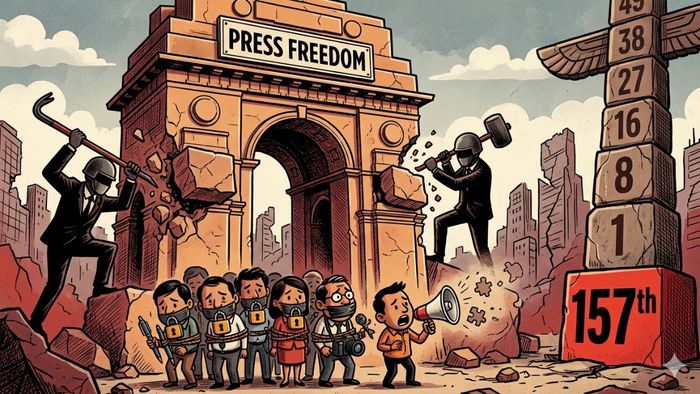
On World Press Freedom Day 2026, RSF's annual index lands with unusual weight. For India, ranked 157th out of 180 countries, the occasion is less a celebration than a reckoning.
- May 03, 2026,
- Updated May 03, 2026, 11:16 AM IST
Every year on May 3, the world pauses to reflect on the state of press freedom — on the journalists imprisoned, killed, harassed, and silenced in the pursuit of holding power to account. This year, World Press Freedom Day arrives with RSF's 2026 World Press Freedom Index freshly published, and its findings are, by any measure, bleak. More than half of the 180 countries surveyed — 52.2 per cent — are now rated "Difficult" or "Very Serious." Over 220 journalists have been killed in Gaza since October 2023. China alone has 121 media professionals behind bars.
And then there is India. Ranked 157th. Rated "Very Serious." Explicitly named by RSF as one of the sharpest legal indicator declines on earth.
For the world's largest democracy, World Press Freedom Day 2026 is an uncomfortable mirror.
The number and what it hides
A rank of 157 out of 180 is stark on its own. But the number understates the problem, because RSF's index is diagnostic. And the diagnosis for India in 2026 is specific: the legal environment in which journalists operate has deteriorated severely, deliberately, and through identifiable mechanisms.
RSF places India among only three countries worldwide — alongside Egypt and Israel — to suffer the maximum possible decline in its legal indicator, designated by the index's triple-downward marker. The primary instruments cited are national security laws and defamation statutes. Security provisions, broadly and often vaguely worded, have been used to detain and prosecute journalists covering topics the government finds inconvenient — communal violence, economic distress, dissent at the margins of political life.
Defamation law, both civil and criminal, has been weaponised not necessarily to win cases but to make the process the punishment: years of litigation, mounting legal costs, and the slow financial suffocation of independent newsrooms.
The result is what researchers have come to call "soft censorship." No formal ministry of truth. No official banned list. Just an environment in which critical journalism becomes progressively more expensive, more dangerous, and more professionally precarious — until self-censorship does the government's work for it.
A specific and worsening pattern
What makes India's 2026 placement especially significant is that it is not a surprise. This is not a country that fell suddenly from grace. India has been sliding down RSF's index for years, and each year the same mechanisms reappear in the assessment: legal pressure, political hostility toward independent reporting, economic coercion of media through the withdrawal of government advertising, and the use of regulatory bodies to threaten ownership structures of critical outlets.
The 2026 index does not represent a new problem. It represents an old problem becoming more entrenched. The legal indicator decline — now at its most severe level — suggests that the tools being used against the press are not being pulled back. They are being refined.
Journalists in India covering sensitive beats — Manipur, minority rights, agricultural distress, judicial independence — have reported operating under the constant awareness that a story can trigger not just criticism but criminal proceedings. The cumulative effect on editorial decision-making is difficult to quantify but impossible to ignore. Stories go unpursued. Sources go unprotected. Editors calculate legal risk alongside newsworthiness.
The democratic paradox
India has a free press enshrined in its constitution. It has an independent judiciary, at least in formal terms. It holds the world's largest democratic elections. It is, by the metrics that international institutions typically use to assess democratic health, a democracy.
And yet it ranks 157th on press freedom — below Singapore (123rd), Indonesia (129th), and Thailand (92nd), none of which make strong claims to being models of open governance. It sits in the same "severe legal decline" tier as Egypt, an authoritarian state that has systematically dismantled its independent media, and Israel, which RSF holds responsible for conditions that have led to the deaths of over 220 journalists in a single conflict zone.
This is the democratic paradox that RSF's index forces into view on World Press Freedom Day: formal democratic structures do not automatically protect the press. Elections can coexist with legal harassment. Constitutional guarantees can coexist with soft censorship. A government can win landslide mandates and still prosecute the journalists who cover its failures.
India is not China, where 121 journalists are in prison, and the state operates a total information architecture. It is not North Korea, where RSF describes press freedom as "entirely fictitious." It is not Afghanistan, where the Taliban has banned independent journalism outright and earns a rank of 175th. The absence of those extremes should not be mistaken for health.
Alone in the region
Within South Asia, India's position is particularly difficult to explain away. The region as a whole performs poorly — six of its seven nations are rated "Very Serious" or "Difficult" — but India ranks sixth out of seven, above only Taliban-controlled Afghanistan.
Nepal, at 87th and rated merely "Problematic," is the region's best performer and a reminder that geography and history alone do not determine press freedom outcomes. Sri Lanka, despite its own troubled recent past — economic collapse, political upheaval, sustained pressure on media — ranks 134th, still 23 places above India. Bangladesh, which RSF notes has been placed consecutively near the bottom of the global index, ranks 152nd, five places above India.
The 70-place gap between India and Nepal is a measure of divergent choices: about whether to use law as a tool of suppression or protection, about whether state power should be deployed for or against accountability journalism, about what kind of democracy a country wants to be.
The global frame
The 2026 index is not only India's story. The United States dropped seven places to 64th, with RSF characterising the Trump administration's attacks on the press as having become entrenched policy rather than political theatre. Argentina fell 11 places to 98th, linked to the Milei government's hostility toward the media. El Salvador dropped eight places. New Zealand slipped six. The global trend is unmistakably downward — 110 out of 180 countries saw their legal indicators worsen this year.
But India's position within that global deterioration is notable. At 157th, it sits 93 places below the United States — a country whose own press freedom is currently under significant strain. It ranks below every country in East and Southeast Asia that holds even partial democratic credentials. It is, on this index, closer to Iran (177th) and Russia (172nd, with 48 journalists jailed as of April 2026) than to any of the established democracies it shares platforms with at international forums.
What World Press Freedom Day means here
World Press Freedom Day is, officially, a day of recognition and advocacy — a moment to honour journalists who take risks and to pressure governments that punish them for it. In many countries, it passes as a diplomatic formality, a statement issued and forgotten.
In India in 2026, it arrives as something more pointed. It arrives on the same day that an index compiled by one of the world's most respected press freedom organisations has placed the country 157th globally, in the same severe-decline tier as authoritarian states, with a legal environment that RSF judges to be actively worsening.
The journalists who will mark this day in India, those still doing the work, still publishing stories that powerful people would prefer go unpublished, are doing so in conditions that this index describes, without euphemism, as Very Serious.
That is what the number means. Not a ranking in a table. A description of what it is like, today, to try to tell the truth in the world's largest democracy.