A Home Reduced to Ashes, an Identity Unbroken: A Thadou’s Return to Imphal After the May 2023 Violence
In January 2026, I visited Imphal twice, spending two nights on each occasion. Both visits took me back to Haokip Veng, my birthplace and childhood home, a Thadou settlement nestled within the Manipur Royal Palace Compound, beside the Imphal River, in the heart of Manipur’s capital. H
- Nov 11, 2026,
- Updated Nov 11, 2026, 2:54 PM IST
In January 2026, I visited Imphal twice, spending two nights on each occasion. Both visits took me back to Haokip Veng, my birthplace and childhood home, a Thadou settlement nestled within the Manipur Royal Palace Compound, beside the Imphal River, in the heart of Manipur’s capital. Having left for Australia in 2008 to pursue my higher studies, I had returned home several times over the years, but these were my first visits since ethnic violence erupted across Manipur in May 2023.
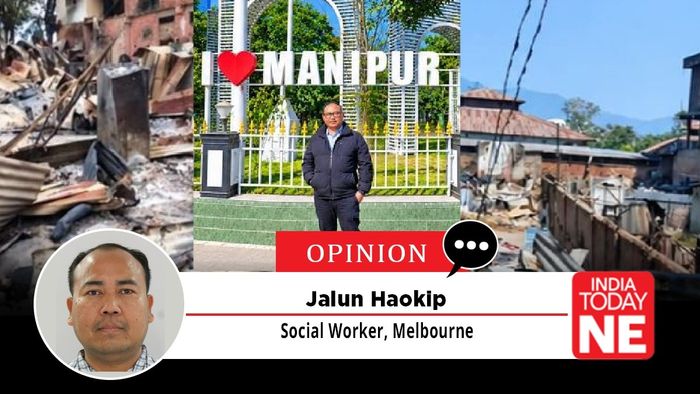
Accompanied by my wife and our three young children, we stood amid the charred remains of the house my parents had built and where they had raised their family. All five of us siblings were born there. It was also where I attended our local church and spent my childhood and part of my adult life, and where our eldest son was born. In many ways, the house embodied the shared history of two generations, representing our family’s roots, deep sense of belonging and cherished memories.
It was an emotionally overwhelming experience. Once filled with life, laughter and the memories of successive generations, the house had been reduced to ruins. For decades, it had provided shelter and hospitality not only to our immediate family but also to extended family members and relatives who came to stay, as well as to many other families who occupied separate blocks on the property as tenants. Now, that home was gone, destroyed by the brutality of ethnic violence.
On our first visit, on 3 January 2026, we went straight from Imphal Airport to our ancestral home in Haokip Veng, before shopping in the city and checking into Hotel Imphal. During my two-night stay, I revisited familiar places, including Checkon, Paona, Thangal and Khwairamband (Ima Keithel) bazars, along with various localities and offices. I also met Meitei internally displaced persons (IDPs) who had fled their homes in Churachandpur, Kangpokpi and Moreh after their properties were burnt down. We exchanged stories and reflected on Manipur’s recurring cycles of violence. We shared the view that, while some individuals and groups may benefit politically or otherwise, ordinary people across Manipur bear the heaviest consequences.
My second visit to Imphal, also lasting two nights, coincided with the horrific killing on 21 January 2026 of Mayanglambam Rishikant Singh, a 29-year-old Meitei man from Kakching who was visiting his wife in Churahandpur. His killing, like other ISIS-style executions attributed to Kuki armed militants involving beheading, dismemberment, and the alleged serving of human flesh to victims' families, was livestreamed by the perpetrators, apparently to spread terror, instill fear, and provoke large-scale retaliatory violence. I watched the horrible footage that night. It showed a helpless man pleading for his life, his desperate appeals falling on deaf ears. The video ended with gunshots and images of his lifeless body.
The killing sent shockwaves across the valley, and several people contacted me, concerned about my safety in Imphal. Yet what I witnessed was the restraint and maturity shown by the Meiteis. Despite their anger and grief, they did not turn against me or resort to retaliatory violence. Instead, they recognised me as Thadou, not Kuki, and never made me feel threatened or unwelcome.
Indeed, during both my visits, some people specifically asked whether I was Thadou, not Kuki, and I emphatically affirmed that I was. I was humbled and encouraged when some expressed regret that Thadou people had been misidentified as Kuki, recognising that this confusion had contributed to innocent Thadous becoming victims of the Kuki–Meitei conflict despite having had no involvement in the violence. These encounters reinforced my belief that peaceful coexistence is possible when people respect one another’s identities, reject collective blame and refuse to be manipulated into violence.
I acknowledge that, over several decades, various well-funded and well-organised Kuki organisations—including socio-political organisations, armed militant groups, cult-religious institutions and church organisations—have actively promoted and propagated violence-glorifying Kuki supremacist ideology and radicalism, further entrenching its influence within the Thadou community. This radical influence has spread wherever Kuki individuals or groups have established a presence, regardless of their initial size or numerical strength, and has continued to expand over time. The evidence of this pattern is clear, and I have personally experienced and witnessed it over the years.
As a result, some, or even many, Thadous have been misled and indoctrinated by these influences, converted to Kuki or otherwise persuaded to adopt a Kuki identity, and drawn into violence and Kuki militant activities directed against their own Thadou identity and other communities. However, the actions of individuals cannot justify collectively misidentifying an entire community or targeting innocent Thadous who have no involvement in such activities. Equally important is the need to reach out to those Thadous who have been misguided, help them break free from extremist Kuki radicalisation, and support them in rediscovering and reclaiming their Thadou identity.
Ironically, some people who identify as Kuki have mocked me for maintaining my Thadou identity amid the ongoing violence. Their argument is simple: “You claim to be Thadou, yet the Meiteis burnt down your family home because they identified you as Kuki.”
But how can someone else's misidentification determine who I am? Whether my family home was burnt because its occupants were mistakenly identified as Kuki, as retaliation for Kuki violence against Meiteis elsewhere, or for some other reason, none of this makes me Kuki, nor does it make me any less Thadou. Neither the destruction of my family home nor the persistent intimidation and death threats directed at me and other Thadou voices for refusing to relinquish our identity can alter that fundamental truth. Some people may succumb to intimidation, manipulation, or pressure and abandon their convictions, but I am not among them.
I belong to the indigenous Thadou community, one of Manipur’s hill communities and its largest tribe. I also belong to Manipur, a multi-ethnic state home to numerous ethnic communities, including the Thadou and more than 30 others. Hill or valley, it is all Manipur. Regardless of their ethnicity, its people are all people of Manipur. My Thadou identity and my belonging to Manipur are not mutually exclusive; they are integral parts of who I am.
I was always Thadou. I am Thadou. I will always be Thadou, as will my children and generations of our family to come. My forefathers were Thadou long before British colonial rule and the introduction of the term “Kuki” by the British for administrative convenience, apparently reflecting their limited understanding of the indigenous names and identities of the people they governed. Thadou has been my people's indigenous name since our very existence as a people; it is not an adopted identity. It is deeply rooted in our history, heritage and collective identity, passed down through generations. No amount of violence, misidentification, intimidation or ridicule can erase this truth.
I lost my home, but I also experienced something profoundly important during my return: the recognition of my identity as Thadou, not Kuki. That recognition brought me a sense of relief, although it could never compensate for the home I had lost.
The Meitei community and everyone else must understand that many people historically and incorrectly labelled as Kuki are, in fact, not Kuki. They reject the Kuki label and belong to distinct tribal communities, including the indigenous Thadou and other non-Kuki tribes such as the Vaiphei, Paite, Gangte, Hmar, Simte, Mizo and Zou, each with its own distinct identity and history. Indeed, if none of Manipur's original tribes identifies as Kuki, a fundamental question arises: who, then, are the so-called Kukis, and on whose authority is this identity being imposed on others?
I am encouraged by the growing recognition of this distinction through dialogue facilitated by Thadou Inpi Manipur, particularly under the courageous and unwavering leadership of M. James Thadou, Michael Lamjathang, Nehkholal Haokip, etc., in collaboration with Meitei civil society leaders.
The Thadous are a distinct indigenous tribal community of Manipur. Historical census records, from 1881 through 2011, consistently recorded Thadou as a distinct tribe and the largest tribe in Manipur. Kuki, on the other hand, is a colonial and political construct associated with a derogatory term, with various suggested origins including “migratory bird”, “cuckoo” and “coolie” (a labourer or porter). The colonial term was originally used to refer to various groups of unidentified people in the Chittagong Hill Tracts of Bangladesh. In post-independence Manipur, it has also become associated with a radical cult-political ideology that glorifies violence, rather than simply denoting a separately enumerated ethnic tribe in the same sense as Thadou.
Nor should Kuki be imposed as an umbrella identity on distinct tribal communities, particularly those that do not identify as Kuki. Unlike Zomi and Naga in Manipur, which serve as collective identities for various tribal communities, Kuki does not represent the distinct ethnic identity of any of Manipur’s tribal communities.
Sections of the media and others continue to perpetuate this indiscriminate labelling, disregarding the identities and wishes of the communities concerned. Such practices amount to a form of neo-colonialism: imposing an identity on people against their will.
The category “Any Kuki Tribes” (AKT) was introduced in 2003 for political reasons and first appeared in the 2011 Indian Census, recording 28,342 people. This raises a fundamental question: how did these people come to be classified under AKT? At the AKT recognition celebration-cum-conclave held at M. Songgel, Churachandpur, on 22 April 2023, radical Kuki protagonists reportedly advocated waging war against the Thadou and the state government, while declaring their ambition to make AKT the largest Scheduled Tribe category in the next census, by hook or by crook. This raises serious concerns that militant force, intimidation and political influence could be used to coerce members of the Thadou and other distinct non-Kuki tribes, and pressure census officials, into recording people as Kuki against their identities and wishes.
These distinctions are not merely administrative technicalities. They concern people's identity, history, dignity and right to self-identification. The Thadous must be free to identify themselves as Thadou without being misclassified as Kuki. Recognising distinct tribal identities and ending imposed misidentification would be an important step towards lasting peace in Manipur.
Haokip Veng, a postal name rather than an officially gazetted one, holds a special place in my heart. My father was among its early settlers, arriving as a young man from the hills of Manipur and raising his family there while working at the Directorate of Information and Public Relations in Keishampat. The Thadou enclave was gifted by the King of Manipur in recognition of the protection provided by the Thadou chiefs to the Royal Palace.
My memories of Haokip Veng are inseparable from Manipur's recurring ethnic conflicts. During the Kuki–Naga conflict of the 1990s, our house sheltered members of my extended family and others who had fled their homes. The same happened during the Kuki–Zomi violence of 1997–1998 in Churachandpur. I had spent six years studying and staying at Don Bosco Catholic High School in Churachandpur when the Kuki-Zomi violence broke out in June 1997. I was forced to transfer to Catholic School in Canchipur, Imphal.
The irony is heartbreaking: a home that once sheltered victims of ethnic violence eventually became a victim itself. On the morning of 4 May 2023, following the outbreak of violence the previous day, our family home was burnt down.
My family members, including my brother's one-month-old newborn and two other young children, fled to Delhi with almost nothing. Yet, while the houses of Haokip Veng could be reduced to ashes, the memories and stories of the settlement where I was born and raised could never be destroyed.
Why must Manipur continue to endure this recurring cycle of violence? We want a state where differences are respected, grievances are resolved through dialogue and political disagreements are addressed through democratic institutions, particularly the Legislative Assembly. Elected representatives must demonstrate the dignity and responsibility expected of public officeholders. They are elected to represent people and resolve grievances, not to behave like street gang fighters, incite violence, or exploit ethnicity for political gain. Manipur deserves responsible leadership, not political theatrics at the expense of human lives.
In the years leading up to May 2023, particularly from 2017 under the then Chief Minister N. Biren Singh, Manipur experienced relative peace, improved law and order, and a significant decline in bandhs, strikes and insurgent activity. Widely known for his strong commitment to Manipur’s territorial integrity, pragmatism, and reformist agenda, Biren Singh pursued a range of measures to protect indigenous people and safeguard Manipur’s interests.
These included seeking the removal of the “Any Kuki Tribes” (AKT) category from the Scheduled Tribes list; introducing and implementing the Inner Line Permit (ILP) system; pursuing the implementation of the National Register of Citizens (NRC); pressing SoO groups to comply with ground rules; and withdrawing the state government from the agreement with groups, including the Kuki National Organisation (KNO) and Kuki National Army (KNA), that failed to comply. He also pursued measures to protect forests and land while maintaining law and order.
However, these very positions also made him hated by some. That period of comparative peace came to an abrupt end when violence erupted on 3 May 2023 in the adjoining areas of Churachandpur and Bishnupur districts. The violence, apparently driven by individuals and groups with no interest in peace, came at an enormous cost to ordinary people while serving narrow political and selfish interests.
I longed for peace and wanted the violence to end where it had begun. Tragically, that had not happened. Although I had no involvement in or influence over the affairs of Kuki organisations, I felt a responsibility, as a Thadou and Manipuri, to engage with Thadou leaders and explore possible ways to bring the violence to an end, at least initially between the Thadou and Meitei communities, if not across Manipur as a whole.
At the initiative of Thadou leader Michael Lamjathang, whose courageous leadership and commitment to peace and indigenous identity deserve recognition, a meeting between Thadou Inpi and valley-based Manipur civil society organisations, including COCOMI, was scheduled for 6 May 2023, just three days after the violence erupted. Kanglatongbi, Motbung and Leimakhong Army Camp were among the locations considered as possible secure venues for the meeting.
Regrettably, the proposed meeting did not eventuate after Kuki militant groups acting under the direct command of Jangboi Kipgen—identified as the KNF's SoO home secretary, de facto chief of the non-SoO KNF (N), and chairman of the Unified Command of all Kuki armed militant groups (including SoO and non-SoO)—forced participants to report to their SoO camp and threatened to kill the Thadou leaders intending to attend.
It was particularly disturbing that even a genuine effort to bring communities together through peaceful dialogue was met with intimidation and death threats. This was more than a setback for the Thadou leaders who took the initiative; it was a blow to the broader prospects of peace, reconciliation and coexistence in Manipur.
I hold in high regard the Meitei and Thadou leaders who sincerely sought to ease tensions and pursue peace. Unfortunately, many Kuki protagonists, including armed militants, MLAs and other influential figures, exploited the violence and invoked separation from Manipur as a pretext to advance Kuki supremacist objectives and their own political interests. They openly described the violence as an unprecedented opportunity that should not be wasted. I firmly rejected this approach, regardless of who advanced it or their professed motives. The deliberate killing of innocent people and attacks on civilians can never be justified by political ambitions, whatever the victims’ identities or the perpetrators’ affiliations.
If violence and bloodshed were legitimate instruments for achieving political separation in contemporary India, Manipur would long ago have fragmented into multiple territories along every ethnic boundary. Political differences and demands for self-determination must be addressed through dialogue, democratic engagement and constitutional processes, not through armed coercion, intimidation or the sacrifice of innocent lives.
I often find myself reflecting on what might have happened had that proposed meeting taken place on 6 May 2023. How many lives could have been spared? How many families might have retained their homes? How much of the suffering that followed could perhaps have been avoided? These are questions to which we may never find answers. What remains undeniable, however, is that a valuable opportunity to bring people together, ease tensions and reach a Thadou-Meitei community understanding and pursue a peaceful resolution was lost at a critical moment.
Although my ancestral home was destroyed, my Thadou identity remains unbroken. I hope to return one day and rebuild our ancestral home—not merely to reclaim what was lost, but to uphold my identity, stand against ethnic violence and renew the historic bonds between the Thadou and Meitei communities and the Manipur Royal Palace. In recognition of its history and distinct identity, the enclave should be formally restored to its rightful name: Thadou Enclave.
Lasting peace in Manipur requires an end to imposed identities, collective blame, political exploitation and armed militancy and armed violence. It demands justice, protection of the indigenous people, mutual respect and the courage to resolve differences through dialogue.
That is the Manipur I hope to see restored—a place where all communities live in dignity, security and mutual respect, and one our children can inherit with hope.
About the Author: Jalun Haokip (MSW) is a Melbourne-based native of Manipur with professional experience in social work across mainstream and Indigenous Australian communities. He currently works as a family violence practitioner within the Victorian Government in Melbourne.