A homeland torn asunder: Why India must fulfill its historic debt to the Kuki people
In the grand narrative of India’s freedom struggle, some battles are etched in gold, while others are left to fade in the sepia of forgotten archives. The story of the Kuki people is one such poignant erasure—a saga of unparalleled resistance against colonialism and steadfast loyalty to the idea of India, met not with integration but with indifference and fragmentation.
- Dec 13, 2025,
- Updated Dec 13, 2025, 6:45 PM IST
In the grand narrative of India’s freedom struggle, some battles are etched in gold, while others are left to fade in the sepia of forgotten archives. The story of the Kuki people is one such poignant erasure—a saga of unparalleled resistance against colonialism and steadfast loyalty to the idea of India, met not with integration but with indifference and fragmentation. Today, as ethnic violence rends the social fabric of Manipur—now entering its third year with over 260 lives lost and 60,000 souls displaced—the Kuki demand for a separate administration, a Union Territory with legislative powers, is not a call for secession. It is a cry for restitution, a plea to correct a century of historical wrongs and honor a blood-soaked compact of sacrifice. In a world watching India’s Northeast as a tinderbox of ethnic strife—echoing the plights of the Kurds in the Middle East or the Rohingya in Myanmar—granting this demand could redefine India’s federal ethos, turning a liability into a beacon of inclusive governance.
The “Forgotten War” That Shook an Empire
Long before “Quit India” became a national mantra, the Kuki people in the rugged hills of the Northeast issued their own defiant declaration of sovereignty. The Anglo-Kuki War (1917–1919) was no minor skirmish. It was a meticulously coordinated uprising by a grand council of 150 Kuki chiefs across a vast, interconnected homeland spanning over 6,000 square miles. This was a pan-Kuki resistance, with messengers on horseback rallying tribes not just in Manipur, but in the Naga Hills, the North Cachar Hills of Assam, and the Chin Hills—prefiguring the transnational solidarities of today’s Indigenous movements.
Faced with forced conscription for World War I, the Kuki chose a war for self-determination. For two grueling years, their guerrilla tactics—ambushes from mist-shrouded ridges and hit-and-run raids—tied down imperial resources, requiring a dedicated force of 5,400 British-led troops. The conflict cost the British exchequer 28 lakhs of rupees and resulted in significant casualties: 60 killed, 142 wounded, and 97 dead from disease. The Empire’s brutal “scorched-earth” response—razing 126 villages and executing chiefs—could not extinguish the spirit the war embodied: the Kuki were not colonial subjects, but a sovereign people demanding agency over their ancestral domains.
This “forgotten war,” as historians now call it, outlasted many vaunted tribal revolts, forcing Britain to divert soldiers from the trenches of Europe. Yet, in Delhi’s retelling of azadi, it lingers as a footnote, overshadowed by the plains’ pageantry—a colonial erasure compounded by postcolonial amnesia.
From Colonial Rebels to Architects of Indian Freedom
This spirit of independence seamlessly transformed into a commitment to Indian liberty a generation later. During World War II, while the subcontinent’s political future hung in the balance, the Kuki made a decisive choice. They became the standout contributors from Northeast India to the Indian National Army (INA), mobilizing in the hundreds. Figures like Jamthang Haokip (1916–1998), the Ukhrul-born intelligence officer who defected from British service to recruit Kuki youths, draft clandestine maps, and lead a 25-man unit through the Indo-Burma borderlands, risked everything for Netaji Subhas Chandra Bose’s vision. Haokip’s post-war accolades—a Tamrapatra from Indira Gandhi and Japanese commendations—pale against the collective valor: up to 6,000 Kukis, through provisioning, scouting, and guiding INA troops during the 1944 Imphal campaign, turned the hills into a lifeline for liberation.
Their contribution was disproportionate and profound, a grassroots alliance that bridged tribal chieftains like the Haokips and Singsons with the pan-Indian dream. Post-independence, the government acknowledged this valor with pensions and the INA Memorial in Moirang—where 170 Kuki names dominate the rolls—yet this recognition remained tokenistic when what was needed was a political settlement honoring their distinct identity. As global Indigenous rights frameworks like the UN Declaration on the Rights of Indigenous Peoples (UNDRIP) affirm, such sacrifices demand not just plaques, but self-determination.
The Great Partition: A Homeland Fragmented
The cruelest blow to Kuki aspirations came not from war, but from the drawing of maps. Their contiguous ancestral homeland, which had united them in rebellion, was brutally dissected in the mid-20th century. Colonial and post-colonial border-making splintered the Kuki people administratively between India, Burma (Myanmar), and East Pakistan (now Bangladesh)—a gerrymandering that mirrors the arbitrary lines fueling conflicts from Palestine to Sudan.
Within India, they were further scattered as minorities across multiple states—Manipur, Nagaland, Assam, Mizoram, Tripura, and Meghalaya. In Nagaland, they are denied “Indigenous Inhabitant” certificates essential for jobs and land; in Myanmar’s Chin State, kin endure junta crackdowns; in Bangladesh’s Chittagong Hill Tracts, they battle for basic rights amid ongoing insurgency. This systemic fragmentation is the root of their political vulnerability, rendering them perpetual outsiders in states where they form the demographic spine. The demand for a unified administrative territory is, first and foremost, a struggle against this enforced diaspora within their own land—a call to redraw maps not for division, but for wholeness.
Manipur 2023: The Unraveling of a Social Contract
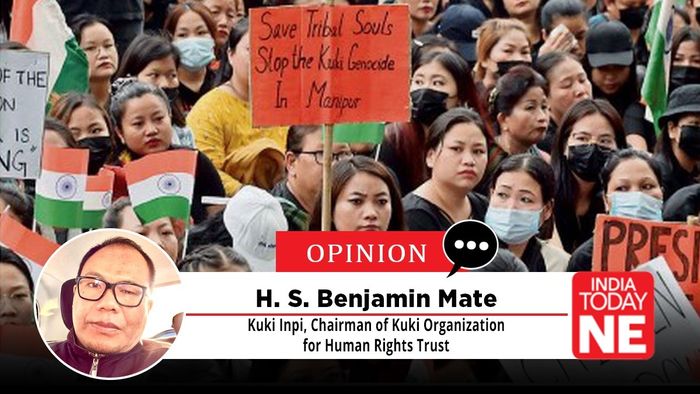
The current crisis in Manipur is the inevitable eruption of this long-simmering historical grievance. The violence that erupted in May 2023, displacing over 60,000 people and claiming hundreds of lives, is more than an ethnic clash. It is the collapse of a failed political arrangement, where hill-valley divides—exacerbated by land encroachments and affirmative-action disputes—have hardened into fortified fault lines.
The trigger—the Meitei demand for Scheduled Tribe status—symbolized to the Kuki-Zo communities an existential threat to their land rights and identity under the current state structure. The complete breakdown of trust has led all ten Kuki-Zo MLAs to unanimously demand a separate administration. In September 2025, they implored Prime Minister Narendra Modi: “We can now live in peace only as good neighbours, never under the same roof again. We therefore place the anguish and aspiration of our people before you for sympathetic consideration.” Yet, in November, when umbrella groups representing 25 Kuki armed outfits formally petitioned the Ministry of Home Affairs for a Union Territory with a legislative assembly—citing historical “Excluded Area” status and constitutional imperatives—the response was a virtual rejection, deeming it “not feasible.”
As December 2025 unfolds, the wound festers. President Droupadi Murmu’s recent visit to Manipur—hailed as a gesture of solidarity—drew sharp rebuke from Kuki organizations for omitting Churachandpur and Kangpokpi districts, home to thousands of displaced families in relief camps. “No access, no resolution,” lamented camp residents, their pleas for security and return eclipsed by valley-centric optics. Sporadic glimmers of reconciliation, like a Meitei leader’s visit to a Kuki camp, offer hope but underscore the chasm: without structural change, such gestures risk being performative.
Conclusion: The Path to Justice Lies in Courageous Statecraft
India’s genius has historically lain in its flexible federalism, its ability to politically accommodate distinct ethnic aspirations to strengthen the whole. The creation of Nagaland (1963) and Mizoram (1987) stand as precedents of successful, peaceful resolution—transforming insurgents into stakeholders. The Kuki people, whose history is defined by resisting empire and building nation, deserve no less.
Their demand is legally grounded in the pre-Independence “Excluded Area” status of their hills, which were never part of the Manipur princely state. It is morally imperative, given the blood they spilled for India’s freedom—from Anglo-Kuki battlefields to INA trails. It is politically urgent, as the alternative is perpetual conflict, draining resources and tarnishing India’s global image as a pluralist powerhouse.
Granting a Kuki-Zo Union Territory is not an act of guilt, but of gratitude and wisdom. It would honor the sacrifices of Jamthang Haokip and the thousands of unnamed heroes. It would stabilize a volatile frontier, fostering economic corridors with Myanmar and beyond. Most importantly, it would affirm the founding promise of the Indian republic: that true unity is forged not by assimilation, but by empowering diversity. The Kuki have kept their history’s ledger; it is time for India to settle its account—before the ink of indifference runs dry.